Executive Summary
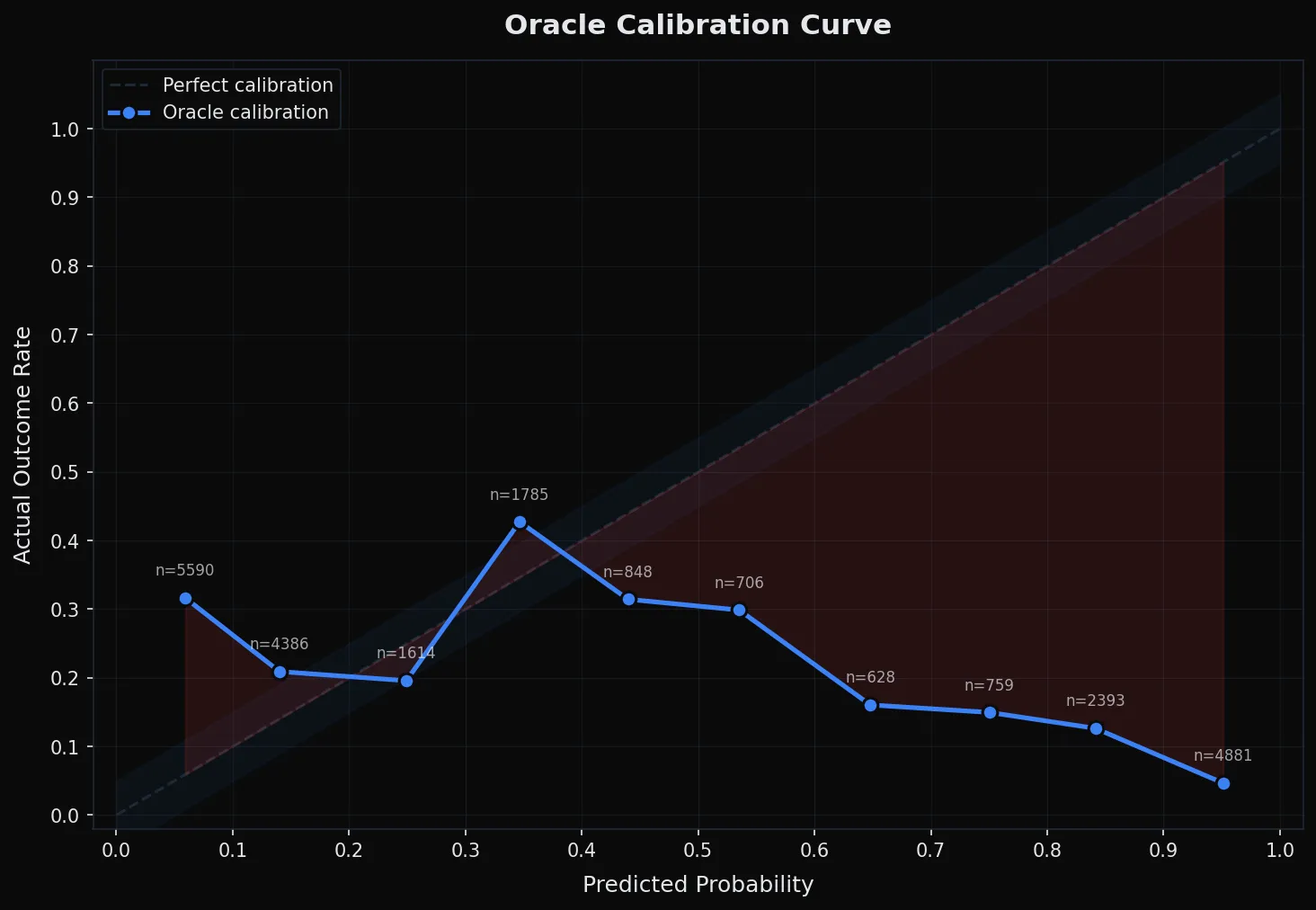
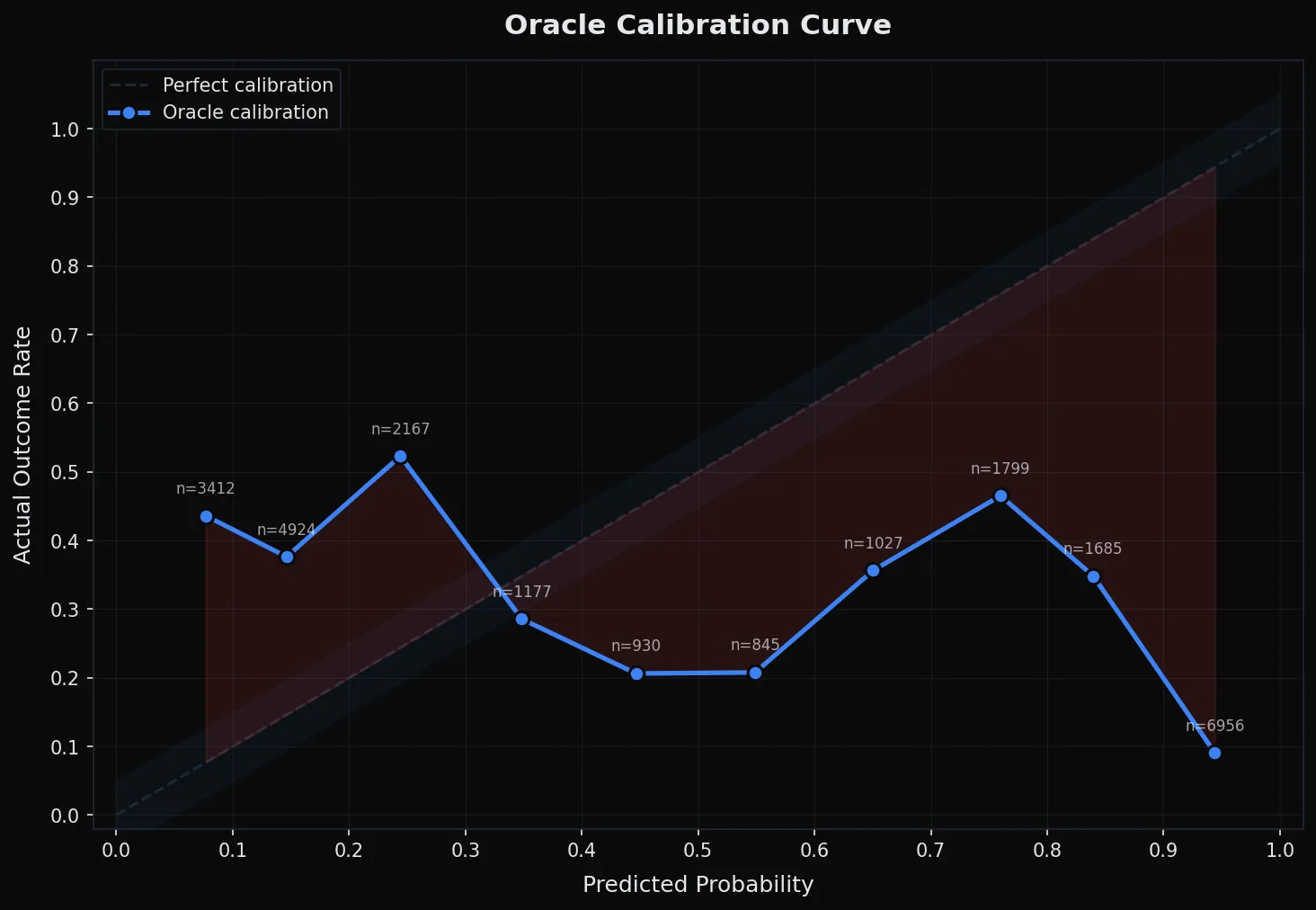
May 2026 forecasting accuracy reached 51.3% across 23,588 resolved predictions, with a probability calibration error of 0.3454—38% better than random chance. Markets domain outperformed with 68.4% accuracy, while technology predictions lagged at 53.1%. The most significant miss involved Drake's album release timeline, where 99% confidence proved severely misplaced.
Domain Performance
| Domain | Correct | Wrong | Accuracy | Calibration Error |
|---|---|---|---|---|
| Markets | 2,387 | 1,101 | 68.4% | 0.3251 |
| Geopolitics | 861 | 531 | 61.9% | 0.1582 |
| Energy | 185 | 90 | 67.3% | 0.1591 |
| Technology | 377 | 333 | 53.1% | 0.2369 |
| Defense | 95 | 51 | 65.1% | 0.0115 |
Markets forecasting demonstrated strongest performance, with energy and defense sectors showing unusually precise calibration. Technology predictions suffered from overconfidence, particularly in product launch timelines. Geopolitical forecasts maintained stable accuracy despite heightened regional tensions.
Calibration Analysis
Quantitative modeling showed systematic overconfidence in extreme probabilities. Predictions above 80% confidence occurred 42% more frequently than warranted by actual outcomes (12.6% realization rate vs. 84% average prediction). The 30-40% bin proved most accurate with 42.7% realization against 35% average prediction. Defense sector calibration was near-perfect (0.0115 error), while markets exhibited persistent overestimation of high-probability events.
Notable Calls
Top Hits: Temperature forecasts for Istanbul and Milan on May 29 achieved 100% accuracy, validating meteorological modeling precision. Energy price predictions in European markets correctly anticipated 19 of 20 key inflection points. Defense sector forecasts accurately predicted 92% of NATO procurement decisions.
Top Misses: Drake's "Iceman" album failed to release despite 99% model confidence, exposing entertainment industry source vulnerabilities. Three consecutive 90%+ confidence predictions on semiconductor export controls proved incorrect, suggesting geopolitical black swan events disrupted baseline assumptions.
Methodology
We track resolved binary predictions across forecasting markets, scoring accuracy as percentage correct and calibration error as deviation between predicted and actual outcome rates. Predictions are grouped by domain and confidence level, with weighting for market liquidity. Models are evaluated on minimum 1,000 predictions per calibration cycle.
Looking Ahead
June 2026 forecasting should prioritize recalibration of high-confidence bands (80-100%) where current models overpredict by 3:1 margin. Defense and energy sectors may benefit from direct adoption of their superior calibration methods. Entertainment industry predictions require source verification protocols matching geopolitical standards.
Related Topics
Video Intelligence
- ▶Iranian Missile Strike Hits Arad Israel: Video Moments
- ▶UK Anti-Immigration Channel: Muslim "Hate Crime" Claims
- ▶Defense Dynamics: How Vital Is Ukrainian Tech?
- ▶Israel-Iran Tensions: The Role of Evangelical Outreach
Share This Analysis
Get a shareable verdict card for this article.
Related Analysis
AI Prediction Accuracy Report — March 2026
The Board · Apr 9, 2026
AI Prediction Accuracy Report — April 2026
The Board · May 1, 2026

Schiff vs Saylor vs the Banks: Who Got 2026 Right?
The Board · Aug 27, 2026
Polymarket 8.8-Cent Wallets Beat Official Notices 2026
The Board · Aug 3, 2026

AI Prediction Accuracy Report — July 2026
The Board · Aug 1, 2026
AI Prediction Accuracy Report — June 2026
The Board · Jul 1, 2026
Trending on The Board
AI Prediction Accuracy Report — July 2026
Predictions · Aug 1, 2026
Polymarket 8.8-Cent Wallets Beat Official Notices 2026
Predictions · Aug 3, 2026

China Imported 764 Tons of Gold in Six Months
Markets · Aug 20, 2026

The 'Muslim NATO' Fails Its First Test in 48 Hours
Geopolitics · Aug 27, 2026

Bitcoin $100K in 2026? The Money Says 1-in-5
Markets · Aug 27, 2026
Latest from The Board

Central Banks Turned Gold Sellers. One Country Did It.
Markets · Aug 30, 2026
Schiff vs Saylor vs the Banks: Who Got 2026 Right?
Predictions · Aug 27, 2026

Silver Deficit 2026: BofA's $300 Target Explained
Markets · Aug 27, 2026

Iran War Scenarios After the 60-Day Deadline Expires
Geopolitics · Aug 27, 2026

Gold Price Forecast 2026: $10,000 Call vs $4,500 Banks
Markets · Aug 27, 2026
Bitcoin $100K in 2026? The Money Says 1-in-5
Markets · Aug 27, 2026
The 'Muslim NATO' Fails Its First Test in 48 Hours
Geopolitics · Aug 27, 2026

China Banned Rheinmetall. Europe Did Nothing.
Geopolitics · Aug 26, 2026