Every few years, the "death of the dollar" narrative surges, and every time the data tells a different story. Here is the sober scorecard on BRICS dedollarization — grading the hype against the hard numbers.
The Claim vs The Data
The headline is irresistible: a bloc of nine major economies is building a weapon to dethrone the US dollar. Social media feeds are thick with charts showing the dollar's declining share of reserves. Commentators declare the end of "petrodollar hegemony."
But the gap between what is asserted and what is actually happening is wide enough to drive a currency peg through. The most important fact in the entire dedollarization debate is this: there has never been a formal dedollarization proposal tabled at BRICS. Not a draft resolution, not a working paper, not a communiqué line. The bloc's official position, as India's External Affairs Minister put it bluntly, is: "I don't think there's any policy on our part to replace the dollar," adding, "I don't think there's a unified BRICS position on this."
That is not the sound of a currency coup in progress.
Reserve Share, In Context
The dollar's share of global central-bank reserves has indeed fallen — from roughly 73% in 2001 to the high-50s today, or about 58-60% depending on valuation effects. That is a genuine, secular decline. It reflects the rise of the euro, the gradual internationalization of the yuan, and a diversification impulse after the 2008 financial crisis and the 2022 freezing of Russian central-bank assets.
But "reduced" is not "replaced." A share in the high-50s is still well above the euro's share and many times the yuan's. More critically, around 90% of global transactions are still conducted in dollars. Reserves are a stock measure — a store of value. Transactions are a flow measure — the actual grease of commerce. The dollar dominates flows by a far larger margin than it dominates stocks, which means the real economy's plumbing is still wired for dollars.
If the dollar were truly losing reserve status in a structural way, we would expect to see a cascade: central banks selling dollar bonds, trade invoicing shifting away from dollars, and a visible uptick in non-dollar settlement. That cascade has not materialized.
What BRICS Actually Built
The confusion arises because BRICS has built something real — just not what the hype suggests. The bloc is developing a blockchain-based cross-border payment system called the "BRICS Bridge", designed to settle transactions in local currencies without routing through SWIFT or dollar correspondent banks. Separately, members have signed bilateral local-currency deals: Brazil and China signed a yuan-real trade settlement in 2023, and India has bought Russian oil in rupees.
These are meaningful innovations. They reduce transaction costs for members, lower exposure to US sanctions risk, and create an alternative channel for trade settlement. For Russia, which faces near-total exclusion from dollar clearing, BRICS Bridge is a lifeline. For China, it is a way to push yuan internationalization without challenging the dollar head-on.
But note what these projects do not do: they do not price commodities in a BRICS currency, they do not create a shared central bank or monetary union, and they do not offer a reserve asset that any central bank outside the bloc would want to hold. BRICS Bridge is a payment rail, not a reserve currency.
Why Displacement Is Hard
The reason the dollar remains dominant is not inertia — it is a set of structural features that no BRICS member individually or collectively can replicate quickly. Displacing the dollar would require deeper capital markets, stronger rule of law, and broad trust built over many years.
Consider the US Treasury market: unmatched depth and liquidity that allows any central bank to buy or sell hundreds of millions of dollars' worth in minutes without moving the price. No BRICS member has a bond market that comes close. China's government bond market is large but still has capital controls, limited foreign access, and occasional intervention. India's market is smaller and less liquid. Russia's is sanctioned.
Then consider rule of law. Foreign central banks hold dollars because they believe the US will not expropriate their assets arbitrarily — a belief that took a hit after 2022 but has not collapsed. The alternative is holding yuan, which requires trusting Chinese legal institutions that are not independent of the Party, or holding rupees in a market with a history of capital controls.
Finally, trust. Reserve currency status is a network effect that takes decades to build and cannot be legislated. The euro has existed for over 25 years and has barely dented the dollar's share. BRICS held its first leaders' summit in 2009.
The Scorecard Verdict
Grade each major dedollarization claim against the evidence:
- "BRICS is replacing the dollar in reserves" — F. The dollar's reserve share has fallen, but not because of BRICS. Most of the decline happened before BRICS existed, and the bloc has no coordinated reserve policy.
- "BRICS is building a new reserve currency" — F. No such proposal exists. BRICS Bridge is a payment system, not a currency.
- "BRICS is shifting trade away from the dollar" — C+. Bilateral local-currency deals are real but small. 90% of global transactions are still in dollars.
- "The dollar is losing reserve status" — C-. It is losing share, slowly, from a very high base. That is not the same as losing status. The dollar remains the dominant reserve asset by a wide margin.
Overall score: D+. The hype is dramatically overblown. The dollar is not dying; it is being chipped at around the edges.
What Would Change the Answer
The scorecard would shift if three things happened. First, if BRICS members actually tabled a formal dedollarization proposal and began coordinating reserve policy — that would signal intent, not just rhetoric. Second, if a BRICS member developed a capital market deep enough to absorb large-scale foreign official holdings, with credible rule-of-law protections. Third, if the US fiscal trajectory led to a genuine crisis of confidence in Treasuries, forcing central banks to seek alternatives.
None of those conditions are close to being met. BRICS Bridge is a useful infrastructure project. It is not a dollar killer. The dollar's reign will not end with a summit declaration; it will end, if it ends, with a bond market panic and a flight to quality. And ironically, that flight would probably go to the dollar first.
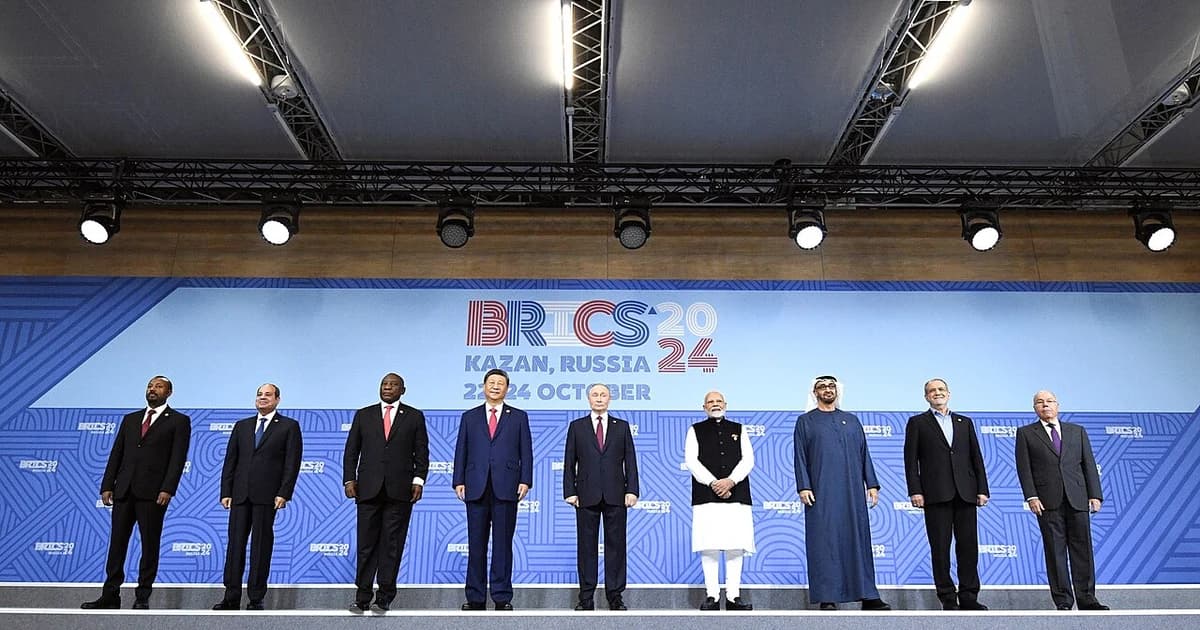
Hero image: 2024 BRICS Summit, Kazan — Presidential Press and Information Office (kremlin.ru), CC BY 4.0, via Wikimedia Commons.
Related Analysis
- 2026 AI Chip Rally: The Bottleneck Nobody's Pricing
- Strategy's $64bn Bitcoin Bet: The Warning and What Saylor's Filings Show
- Blackstone Sells $7.8bn Virginia Data Centers in 2026 — Top Signal?
- Iran Oil Waiver 2026: $8.5bn Loaded, No Buyers in China
- Gold Forecast 2026-2027: Central Bank Record Buying
- Will AI Replace Software Engineers by 2030? The 2026 Reality
- Prompt Drift: Will Claude & Gemini Fail in 2026?
- Oil War Premium: Will Conflict Drive Crude Above $100?
Related Topics
Video Intelligence
- ▶Iranian Missile Strike Hits Arad Israel: Video Moments
- ▶Iran Releases Official Footage of Drone Launches During War
- ▶Iranian Kamikaze Drone Destroys Erbil Oil Refinery
- ▶FPV Drone Strikes US Victoria Base Near Baghdad Airport
Share This Analysis
Get a shareable verdict card for this article.
Get the next one first
Free briefings when we publish major outlooks and forecasts. No spam — unsubscribe anytime.
Related Analysis

2026 Economic Crisis: Why Central Banks May Fail
The Board · Feb 22, 2026

Copper Price Forecast 2029-2031: Supply vs Green Demand
The Board · Feb 22, 2026

US Inflation Outlook and Fed Interest Rate Strategy
The Board · Feb 20, 2026

Will AI Replace White-Collar Jobs in 10 Years
The Board · Feb 22, 2026

When to Hire a VP of Sales vs Investing in PLG
The Board · Feb 22, 2026
ECB Rate Strategy Amid US Tariffs and Eurozone Inflation
The Board · Feb 22, 2026
Trending on The Board

79 Years of UFO Lies, Roswell to the Pentagon
Defense & Security · Sep 29, 2026

How CENTCOM Is Brokering an Israel-Saudi Pact
Defense & Security · Sep 19, 2026

Why the Pentagon Pulled Its Iran War Plans Offline
Defense & Security · Sep 19, 2026
How a Stablecoin Funded Moldova's 2026 Election
Geopolitics · Sep 19, 2026

The Hidden Gold Demand Behind the $6,000 Target
Markets · Sep 17, 2026
Latest from The Board
79 Years of UFO Lies, Roswell to the Pentagon
Defense & Security · Sep 29, 2026
How CENTCOM Is Brokering an Israel-Saudi Pact
Defense & Security · Sep 19, 2026
Why the Pentagon Pulled Its Iran War Plans Offline
Defense & Security · Sep 19, 2026
How a Stablecoin Funded Moldova's 2026 Election
Geopolitics · Sep 19, 2026
The Hidden Gold Demand Behind the $6,000 Target
Markets · Sep 17, 2026
Houthis Take Perim as Saudis Halt Pipeline 2026
Geopolitics · Sep 13, 2026

Epstein Intelligence Ties: Evidence vs Allegation in 2026
Policy & Intelligence · Sep 6, 2026
What Israel-Iran War Games Got Wrong About 2026
Defense & Security · Sep 6, 2026