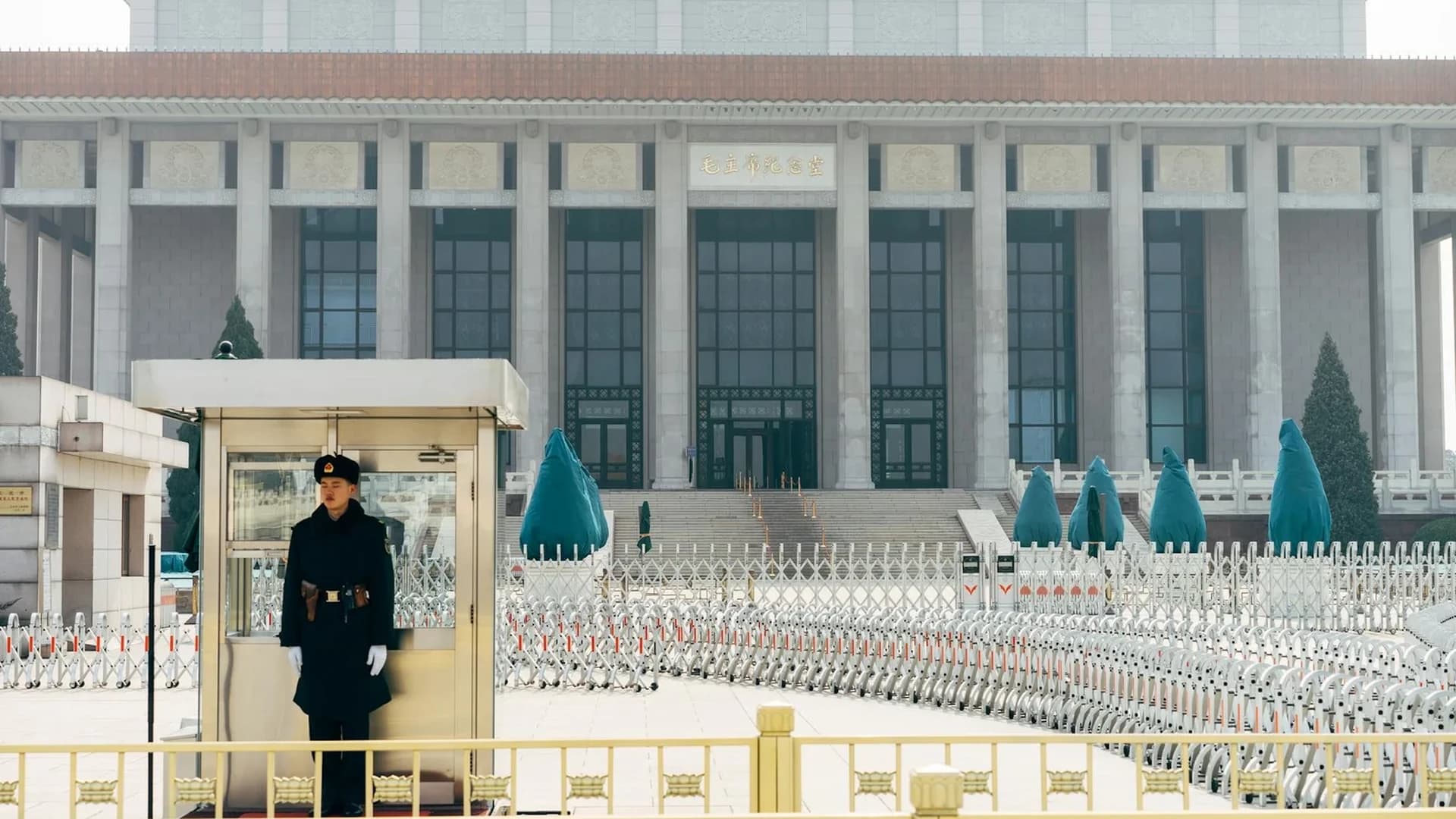
On the morning of 24 July 2026, China's Ministry of Commerce published an export-control notice that instantly barred fourteen European firms from receiving any China-origin dual-use items. Rheinmetall, Europe's largest ammunition maker, was on the list. So were Lafert, TATRA TRUCKS, Vigo Photonics and the Wroclaw University of Science and Technology. The measure took effect that day, without a transition period.
The timing was not a coincidence. On the evening of 23 July, the European Union had published its 21st Russia sanctions package, naming fourteen mainland Chinese and Hong Kong firms. Beijing answered the next morning with fourteen of its own.
Key findings
- China's commerce ministry used the same dual-use export-control instrument against the United States, Japan and the European Union within 32 days, each time within a day or two of a Western listing.
- Each announcement carries two prohibitions: no exports to the listed entity, and no overseas re-transfer of China-origin dual-use items to it — a reach that extends to middlemen in third countries.
- As of late August 2026, a month after the European list took effect, no matching EU counter-listing of Chinese firms had appeared.
- Customs data shows the squeeze is aimed rather than general: rare-earth magnet exports to Japan fell 52.2 percent year on year in July, while shipments to the United States and Korea rose.
The same instrument, three times in 32 days
China had already fired the same weapon twice before it reached Europe.
On 22 June 2026, MOFCOM Announcement No. 23 listed ten United States entities, among them Aveox, Red Cat, Teal Drones, Oshkosh Defense, Ball Aerospace, MP Materials and USA Rare Earth. The ministry said the list answered recent American additions to a Chinese-military-company designation.
On 29 June, Announcement No. 27 added twenty Japanese entities, including the National Institute for Defense Studies, the Ground, Naval and Air Systems Research Centers, and defence units of Mitsubishi Electric and Mitsubishi Heavy. A same-day watch list placed a further twenty Japanese firms, including MITSUI E&S, under stricter end-use review with no general licences.
Japan had been the target earlier in the year as well. Announcement No. 11, on 24 February 2026, listed twenty Japanese entities. Announcement No. 1, on 6 January, banned all dual-use items to Japanese military users and to any end-use that would enhance Japan's military strength. Japan's chief cabinet secretary Kihara protested the June listings and asked Beijing to withdraw them. A Mainichi tally of listed and watch-listed Japanese entities reached eighty once the February wave was counted.
Reported one at a time, these read as three separate trade disputes. Read together, they are one instrument, proven against three of the largest economies in the world inside a single month.
What Brussels did instead
European Commission spokesperson Paula Pinho said the bloc was analysing the Chinese measures, would consult member states and the companies concerned, and would seek clarification from its Chinese counterparts. No reciprocal listing followed.
The signals since have been gestures rather than instruments. Germany's foreign minister abruptly scrapped a planned trip to China days before the two sides were due to meet over rare earths, and EU trade chief Valdis Dombrovskis has said countermeasures are possible in response to China's rare-earth curbs. A cancelled visit and a conditional sentence are, so far, the whole of the European response.
China's foreign ministry spokesperson Lin Jian framed the controls as a response to "wrongful sanctions" on Chinese enterprises, adding that the measures did not target any specific country.
The asymmetry is the story. Japan protested and asked for withdrawal. The European Union announced a process. A month later the process had produced no list.
The squeeze is aimed, not general
Chinese customs data for July 2026 shows what the controls do in practice:
| Flow | July 2026 | Change |
|---|---|---|
| Rare-earth magnets → Japan | 111 t | −52.2% y/y |
| Rare-earth magnets → United States | 647 t | +4.6% y/y |
| Rare-earth magnets → Korea | 606 t | +19.3% y/y |
| Tungsten carbide → Japan | 0 t | zero for 6 straight months |
| Dysprosium raw material → Japan (H1) | 13 t | −82% y/y |
This is not a blanket restriction on the West. It is a targeted one, and the target is visible in the trade figures.
The leverage behind it is concentration. China refines roughly 91 percent of the world's rare-earth magnets and holds about 60 percent of refined antimony, a metal used in ammunition primers. Announcement No. 30 also barred parties abroad from re-transferring China-origin dual-use items to the fourteen listed European entities, which converts an export control into something closer to a secondary sanction and catches firms that never traded with China directly.
Ownership makes the targets bigger than they look
The European names on the list show how corporate structure turns into exposure. Lafert, an Italian electric-motor maker, is owned by Japan's Sumitomo Heavy Industries, so a single listing reaches across two of the three theatres at once. TATRA TRUCKS, a Czech manufacturer of military vehicles, is now barred from receiving China-origin dual-use components. Vigo Photonics and the Wroclaw University of Science and Technology had both participated in European Defence Fund programmes, including a heavy-drone project.
The case for Brussels' silence
There is a reading in which the missing counter-list is calculation rather than paralysis. A European list of Chinese firms would be cheap to write and expensive to mean: with China refining roughly 91 percent of the world's magnet supply, the pain of an escalation cycle would fall mostly on European industry, and a list Brussels could not afford to enforce might advertise weakness more loudly than silence does. Several member states also have rare-earth negotiations with Beijing in the pipeline that a counter-list could sink. That logic is likely part of the calculation — but it was equally available to Tokyo, which protested anyway, and it leaves untested whether restraint reads in Beijing as prudence or as permission. The customs data suggests Beijing calibrates these controls flow by flow, which implies Europe's treatment probably depends on what Brussels does next, not on what it says.
What Japan is doing about it
Japan's answer has been supply, not retaliation. Prime Minister Takaichi proposed a G7 Joint Stockpiling Cooperation Initiative for rare earths and critical minerals at the Evian summit, and it was written into the summit's outcome documents. Japan is the only G7 member with a civilian critical-minerals stockpile, held by the Japan Oil, Gas and Metals National Corporation. In August 2026, Japan's Ministry of Economy, Trade and Industry proposed letting JOGMEC invest in critical-minerals projects without a Japanese company as co-investor, citing the difficulties Japanese firms had faced under China's controls.
What to watch
The open question is whether the absence of a European counter-list reflects restraint or incapacity. A list is cheap to write and expensive to mean, and with 91 percent of magnet refining on the other side of the table, the cost of meaning it falls almost entirely on Europe.
The second thing to watch is enforcement of the re-transfer ban. It is the most far-reaching clause in the package and the least tested: it binds parties who are not Chinese, trading goods that have already left China, and nobody has yet demonstrated how it gets policed in practice — or whether it can be. The first enforcement case, whenever it comes, will show whether Announcement No. 30 is a sanction or a signal.
Related Analysis
- Iran War Scenarios After the 60-Day Deadline Expires
- The 'Muslim NATO' Fails Its First Test in 48 Hours
- Myanmar 2026: China vs India for Ore and Ports
- Trump Iran Deal Stalemate: Naval Blockade Impact
- Netanyahu Prostate Cancer: A Geopolitical Analysis
- China Imported 764 Tons of Gold in Six Months
- Iran Oil Waiver 2026: $8.5bn Loaded, No Buyers in China
- China Won the Brain Race While America Was Building a...
Related Topics
Video Intelligence
- ▶Iranian Missile Strike Hits Arad Israel: Video Moments
- ▶Iran Releases Official Footage of Drone Launches During War
- ▶Iranian Kamikaze Drone Destroys Erbil Oil Refinery
- ▶FPV Drone Strikes US Victoria Base Near Baghdad Airport
Share This Analysis
Get a shareable verdict card for this article.
Get the next one first
Free briefings when we publish major outlooks and forecasts. No spam — unsubscribe anytime.
Related Analysis

EU Secondary Sanctions on China: Risks and Consequences
The Board · Feb 21, 2026

Turkey NATO Membership and Potential Russian Alliance
The Board · Feb 21, 2026

Modern World War 3 Scenarios and Systemic Collapse
The Board · Feb 19, 2026

How Iran's State Media Edits Itself Between Languages
The Board · Apr 15, 2026
China's Taiwan Dictionary: Ten Words Instead of Invasion
The Board · Apr 15, 2026

Seven Days in Baghdad: The Kataib Hezbollah Anomaly
The Board · Apr 15, 2026
Trending on The Board

79 Years of UFO Lies, Roswell to the Pentagon
Defense & Security · Sep 29, 2026

How CENTCOM Is Brokering an Israel-Saudi Pact
Defense & Security · Sep 19, 2026

Why the Pentagon Pulled Its Iran War Plans Offline
Defense & Security · Sep 19, 2026
How a Stablecoin Funded Moldova's 2026 Election
Geopolitics · Sep 19, 2026

The Hidden Gold Demand Behind the $6,000 Target
Markets · Sep 17, 2026
Latest from The Board
79 Years of UFO Lies, Roswell to the Pentagon
Defense & Security · Sep 29, 2026
How CENTCOM Is Brokering an Israel-Saudi Pact
Defense & Security · Sep 19, 2026
Why the Pentagon Pulled Its Iran War Plans Offline
Defense & Security · Sep 19, 2026
How a Stablecoin Funded Moldova's 2026 Election
Geopolitics · Sep 19, 2026
The Hidden Gold Demand Behind the $6,000 Target
Markets · Sep 17, 2026
Houthis Take Perim as Saudis Halt Pipeline 2026
Geopolitics · Sep 13, 2026

Epstein Intelligence Ties: Evidence vs Allegation in 2026
Policy & Intelligence · Sep 6, 2026
What Israel-Iran War Games Got Wrong About 2026
Defense & Security · Sep 6, 2026