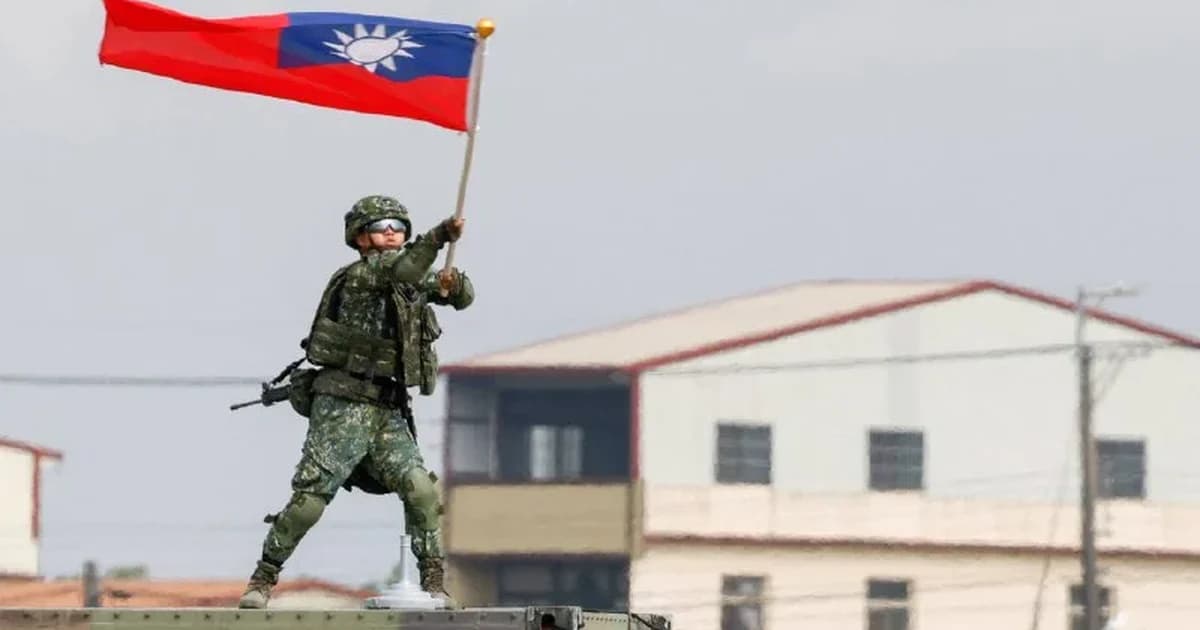
The question "will China invade Taiwan in 2027" dominates defense headlines, but the US intelligence community has already answered it with a firm "no." The 2027 date isn't a Chinese plan—it's an American assessment timeline that has been widely misread.
Where "2027" Came From: The Davidson Window
The year 2027 entered the Taiwan discourse not from Beijing's strategic documents but from a single moment of US congressional testimony. In 2021, Admiral Phil Davidson, then head of US Indo-Pacific Command, raised the year during a hearing as a time horizon for when China might feel capable of acting. This became known as the "Davidson window."
The label matters. It is a US assessment date, not a Chinese plan. There is no evidence that Xi Jinping's government has set 2027 as a target for invasion. The term itself—"window"—implies an opportunity, not a deadline. Yet media coverage and think-tank briefings have calcified the year into a fixed expectation, transforming an intelligence estimate into a pop-culture countdown.
What US Intelligence Actually Says
The US 2026 Annual Threat Assessment, the most authoritative unclassified intelligence document on the topic, is blunt: "Chinese leaders do not currently plan to execute an invasion of Taiwan in 2027, nor do they have a fixed timeline for achieving unification."
That sentence is worth reading twice. It doesn't hedge—it states that Beijing has no current plan for 2027 and, more broadly, no fixed timeline at all. This directly contradicts the alarmist framing that treats 2027 as a pre-set trigger. The intelligence community's job is to warn of threats; if they saw a 2027 invasion as probable, they would say so. They did not.
The 83% Expert Split
The intelligence assessment aligns with expert opinion. A CSIS survey found that 83% of China experts reject the idea that China plans kinetic action against Taiwan by 2027. That is not a close call—it is a near-consensus among the people who study China professionally.
The remaining 17% are not necessarily predicting invasion; many cite uncertainty or the possibility of miscalculation. But the dominant view, backed by the US intelligence establishment, is that a planned 2027 invasion is a myth. The question "will China invade Taiwan in 2027" thus misdirects attention from what is actually unfolding.
The Likelier Path: Blockade and Gray-Zone
China has not ruled out force, but its preference is unification without it. The more likely near-term path is gray-zone pressure and blockade—what analysts describe as "taking Taiwan without firing a shot."
A blockade would not look like the D-Day imagery that dominates invasion speculation. It would be incremental: increased naval patrols, quarantine of shipping lanes, cyberattacks on port infrastructure, and diplomatic isolation. These actions stay below the threshold that triggers a US military response under the Taiwan Relations Act, yet they gradually strangle the island's economy and political will. China has been rehearsing these tactics for years, from military drills around Taiwan to economic coercion against countries that recognize Taipei.
The Chip Chokepoint
Any serious discussion of Taiwan must confront the semiconductor reality. Taiwan is a semiconductor chokepoint: China imports close to US$90 billion of semiconductors from Taiwan annually, and TSMC is the central dependency. An invasion would destroy TSMC's fabrication facilities, either through combat damage or through a Chinese takeover that triggers global sanctions and technology flight.
China's own economy would be devastated. Cutting off the chip supply would halt production across Chinese electronics, automotive, and defense sectors. This is not a cost China can absorb lightly. The US intelligence assessment of "no current plan" reflects this calculus: invasion risks destroying the very asset China needs to maintain its technological trajectory.
The economic entanglement extends to US policy. Trump levied tariffs—most Taiwan exports to the US face a 15% tariff—while pursuing an approximately US$11 billion arms deal with Taipei. The US simultaneously arms Taiwan and taxes its goods, a contradiction that reveals how deeply Taiwan is embedded in both supply chains and strategic competition.
What to Actually Watch
The 2027 invasion question is a distraction. What matters are the indicators of gray-zone escalation: changes in Chinese coast guard patrol patterns, the frequency of incursions into Taiwan's air defense identification zone, and the pace of China's naval buildup in the South China Sea. Also watch for shifts in TSMC's ownership structure and technology-transfer agreements, which are more likely flashpoints than amphibious assault ships.
The US intelligence community has given its answer. The question now is whether policymakers and markets will listen, or continue chasing a phantom deadline.
Related Analysis
- SpaceX IPO: Decoding the Securities Filing [2024]
- Eli Lilly Just Paid $2.75 Billion for Drugs Designed by...
- AI Models Are Disobeying Humans 500% More Than Six Months Ago
- Google's TurboQuant: The Memory Stock Crash
- The Largest Supply Chain Attack You Missed
- Gold Forecast 2026-2027: Central Bank Record Buying
- Oil Price Prediction 2026-2027: Scenarios, Forecasts &
- Crisis in the Strait: The 2027 "Fragmented Stalemate" and
Related Topics
Video Intelligence
- ▶Iranian Missile Strike Hits Arad Israel: Video Moments
- ▶Iran Releases Official Footage of Drone Launches During War
- ▶Iranian Kamikaze Drone Destroys Erbil Oil Refinery
- ▶FPV Drone Strikes US Victoria Base Near Baghdad Airport
Share This Analysis
Get a shareable verdict card for this article.
Get the next one first
Free briefings when we publish major outlooks and forecasts. No spam — unsubscribe anytime.
Related Analysis

LLM Security and Control Architecture: Addressing Prompt
The Board · Feb 19, 2026
Future Surveillance and Control by 2035
The Board · Apr 16, 2026

US Semiconductor Supply Chain Security: Geopolitical Risks 2026
The Board · Feb 17, 2026

Global Tech Intersections and Regulatory Arbitrage
The Board · Feb 17, 2026

Securing LLM Agents and AI Architectures in 2026
The Board · Feb 20, 2026
Quantum Computing Breakthroughs: Geopolitical Implications
The Board · Mar 4, 2026
Trending on The Board

79 Years of UFO Lies, Roswell to the Pentagon
Defense & Security · Sep 29, 2026

How CENTCOM Is Brokering an Israel-Saudi Pact
Defense & Security · Sep 19, 2026

Why the Pentagon Pulled Its Iran War Plans Offline
Defense & Security · Sep 19, 2026
How a Stablecoin Funded Moldova's 2026 Election
Geopolitics · Sep 19, 2026

The Hidden Gold Demand Behind the $6,000 Target
Markets · Sep 17, 2026
Latest from The Board
79 Years of UFO Lies, Roswell to the Pentagon
Defense & Security · Sep 29, 2026
How CENTCOM Is Brokering an Israel-Saudi Pact
Defense & Security · Sep 19, 2026
Why the Pentagon Pulled Its Iran War Plans Offline
Defense & Security · Sep 19, 2026
How a Stablecoin Funded Moldova's 2026 Election
Geopolitics · Sep 19, 2026
The Hidden Gold Demand Behind the $6,000 Target
Markets · Sep 17, 2026
Houthis Take Perim as Saudis Halt Pipeline 2026
Geopolitics · Sep 13, 2026

Epstein Intelligence Ties: Evidence vs Allegation in 2026
Policy & Intelligence · Sep 6, 2026
What Israel-Iran War Games Got Wrong About 2026
Defense & Security · Sep 6, 2026