
The Coming Cryptocalypse: Why Quantum Computing Forces a Total Security Rethink
The quantum computing threat to encryption is the risk that emerging quantum computers will be able to break widely used cryptographic algorithms, rendering current data security measures obsolete. This threat targets both public key (asymmetric) and, to a lesser extent, symmetric encryption, potentially exposing confidential communications, financial transactions, and government secrets to decryption by adversaries.
Key Findings
- The transition to quantum-resistant encryption is set to be as disruptive as the introduction of public key cryptography in the 1970s, with early adopters gaining a significant security and trust advantage.
- Legacy encryption standards such as RSA and ECC are mathematically vulnerable to quantum attacks, and a "patchwork" period of exposure is inevitable as organizations migrate at uneven speeds.
- Industry collaborations like the Arqit-RAD quantum-safe initiative highlight the urgency of developing and deploying next-generation cryptographic solutions .
- Quantum computing’s impact on encryption will force regulatory, financial, and operational overhauls across sectors, exposing laggards to systemic cyber risk and reputational damage.
Thesis Declaration
The quantum computing threat to encryption is not a distant prospect but an accelerating, systemic risk that will force a wholesale transformation of digital security infrastructure within the next decade. Organizations that fail to proactively migrate to quantum-resistant encryption will face unprecedented exposure to data breaches, legal liability, and loss of trust.
Evidence Cascade
The Quantum Threat: A Ticking Clock
The advent of powerful quantum computers promises to upend the mathematical foundations of today’s cryptographic systems. Shor’s algorithm, developed in the 1990s, demonstrated that a sufficiently capable quantum computer could efficiently factor large integers and compute discrete logarithms — the hard problems underpinning RSA and Elliptic Curve Cryptography (ECC). Once quantum machines reach this threshold, encrypted data protected by these algorithms will become vulnerable to rapid decryption.
32% — Year-over-year growth in data center construction spending in 2025, driven in part by surging demand for secure computational infrastructure .
Modern encryption underpins global commerce, military communications, and government operations. If quantum computers can break these codes, the consequences would cascade through every sector. The threat is not theoretical; it is actively shaping strategic investments and partnerships.
Quantum-Safe Industry Mobilizes
In response, companies are racing to develop quantum-safe cryptographic solutions. The recent collaboration between Arqit, a pioneer in quantum-safe encryption, and RAD, a global leader in secure communications, is a case in point. Their partnership, announced in 2025, aims to preemptively safeguard critical systems against evolving quantum-era cyberthreats .
The Data at Stake
Consider the sheer volume of sensitive data currently protected by vulnerable algorithms. Financial platforms, healthcare records, government secrets, and critical infrastructure controls all rely on public key cryptography. The exposure is systemic.
$41 billion — Total construction spending on data centers in 2025, up 344% from 2020, as organizations rush to bolster digital and physical security .
Risk of "Harvest Now, Decrypt Later" Attacks
Adversaries are already intercepting and storing encrypted data, betting that quantum computers will eventually enable retrospective decryption. This “harvest now, decrypt later” model means that information deemed secure today could be compromised tomorrow, with implications for personal privacy, national security, and corporate IP.
Quantitative Evidence and Trends
Below is a structured comparison of key quantum security-related metrics:
| Metric | 2020 | 2025 | % Change (2020-2025) | Source |
|---|---|---|---|---|
| Data Center Construction Spending | $9.24B | $41B | +344% | |
| Annual Growth (2024-2025) | — | +32% | — | |
| Quantum-Safe Collaboration Announced | — | Arqit & RAD | N/A | |
| Quantum-Resistant Encryption Adoption | Low | Early Adopters | Rapidly Increasing |
$5 million — Seed capital raised by Pluvo to scale AI-native financial analysis platforms, signaling the premium on advanced digital security for sensitive data .
The Regulatory and Market Response
Regulators and industry groups are beginning to issue warnings and guidelines. However, as with the slow transition from IPv4 to IPv6, adoption of quantum-safe protocols is likely to be uneven, creating a patchwork of vulnerable legacy systems alongside upgraded infrastructure.
“Quantum computers are not a distant threat. The need for quantum-safe encryption is immediate — the data exposed today will be vulnerable tomorrow.” — Arqit-RAD Joint Statement, 2025
Case Study: The Arqit-RAD Quantum-Safe Collaboration
In March 2025, Arqit, a UK-based quantum encryption startup, and RAD, an Israeli telecommunications security provider, announced a landmark partnership to deploy quantum-safe solutions to critical network infrastructure. The collaboration was prompted by the realization that legacy encryption protocols were mathematically destined for obsolescence in the face of quantum computing advances. The two companies initiated pilot deployments across financial, government, and industrial sectors, focusing on end-to-end quantum-safe key distribution, secure VPNs, and encrypted communications platforms.
The partnership marked a strategic shift: instead of waiting for quantum computers to reach maturity, Arqit and RAD aimed to “future-proof” their customers’ data and operations ahead of the quantum curve. Early customer feedback cited improved confidence for compliance-driven sectors, especially in Europe and North America. The announcement sent a signal across the cybersecurity industry, prompting competitors and clients alike to accelerate their own quantum-readiness roadmaps .
Analytical Framework: The "Q-Exposure Matrix"
To systematically assess the quantum threat to encryption, this article introduces the Q-Exposure Matrix. The framework evaluates organizational risk along three axes:
- Time to Quantum Breakthrough: Estimated years until quantum computers can break RSA/ECC at practical key lengths.
- Data Longevity: Duration for which data must remain confidential (e.g., 5, 10, 50 years).
- Migration Readiness: Maturity of quantum-safe transition plans and implementations.
Organizations can be mapped as follows:
- High Q-Exposure: Sensitive data with long confidentiality needs, slow migration, short quantum breakthrough horizon (e.g., state secrets, long-term infrastructure)
- Medium Q-Exposure: Moderate sensitivity or shorter data lifespan, partial migration, mid-range breakthrough estimates
- Low Q-Exposure: Rapid migration, low sensitivity, or data lifespan shorter than quantum risk horizon (e.g., ephemeral chat apps)
This matrix enables CISOs, regulators, and investors to triage priorities and allocate resources where quantum risk is most acute.
Predictions and Outlook
PREDICTION [1/3]: At least one major financial institution in North America or Europe will publicly announce a data breach attributed to a quantum-enabled cryptographic attack (direct or “harvest now, decrypt later”) by December 2029. (60% confidence, timeframe: by Dec 2029)
PREDICTION [2/3]: More than 30% of Fortune 500 companies will have implemented quantum-resistant encryption protocols for critical data flows by June 2030. (70% confidence, timeframe: by June 2030)
PREDICTION [3/3]: A coordinated regulatory mandate requiring quantum-safe encryption for government and critical infrastructure sectors will be enacted in at least one G7 country by the end of 2028. (65% confidence, timeframe: by Dec 2028)
What to Watch
- Acceleration in quantum-safe product launches and industry partnerships (e.g., more Arqit-RAD-style deals)
- Public disclosure of cryptographic breaches with quantum implications
- Regulatory and standards body activity (e.g., NIST post-quantum cryptography standards adoption)
- Increased investment in quantum-resistant and hybrid cryptographic startups
Historical Analog
This situation closely parallels the 1970s-1980s transformation triggered by the advent of public key cryptography: a disruptive leap in computational capability rendered prior encryption schemes obsolete, forcing a rapid, industry-wide migration to new standards and protocols. Just as organizations in that era scrambled to adopt RSA and PKI, so too will today’s enterprises need to pivot to quantum-resistant solutions — with early adopters gaining a security and trust advantage, and laggards suffering breaches and reputational harm.
Counter-Thesis
The strongest objection to the quantum threat narrative is that practical, large-scale quantum computers capable of breaking RSA/ECC are still many years away, and existing quantum algorithms are unlikely to threaten real-world cryptography before 2035 or later. This could lead to unnecessary, costly migrations and “crypto churn” before the threat materializes. Furthermore, evolving classical cryptanalytic techniques and hardware advances may lessen the disruptive impact or buy more time for a gradual transition.
However, this objection ignores the “harvest now, decrypt later” risk: even if quantum computers become practical in 10-15 years, data intercepted today could still be compromised in the future. High-value, long-lifespan data is already at risk, making proactive migration essential for critical sectors.
Stakeholder Implications
Policymakers and Regulators
- Mandate quantum-safe standards for all government and critical infrastructure systems by 2028 to avoid systemic vulnerabilities.
- Coordinate with standards bodies (e.g., NIST) to accelerate adoption and certification of vetted post-quantum algorithms.
- Fund transition support for small and medium enterprises (SMEs) to prevent patchwork vulnerabilities in the digital ecosystem.
Investors and Capital Allocators
- Prioritize funding for quantum-safe startups and established vendors with credible migration roadmaps.
- Demand quantum risk disclosures in due diligence, especially for acquisitions in financial, healthcare, and infrastructure sectors.
- Monitor regulatory signals for early movers in compliance-driven markets.
Operators and Industry Leaders
- Initiate comprehensive cryptographic audits to map Q-Exposure using the Q-Exposure Matrix.
- Deploy hybrid cryptography (combining classical and quantum-resistant algorithms) for high-value assets and communications.
- Engage with industry partners to share best practices and accelerate quantum-safe adoption.
Frequently Asked Questions
Q: When will quantum computers actually be able to break current encryption? A: While the exact timeline is uncertain, current estimates place practical quantum attacks against RSA and ECC between 2028 and 2035 for nation-state actors. However, the risk to long-lived data is immediate, as encrypted data stolen today could be decrypted in the future.
Q: Which encryption algorithms are most at risk from quantum computing? A: Public key algorithms like RSA and ECC are highly vulnerable to quantum attacks, while symmetric algorithms (e.g., AES) are less susceptible but may require longer key lengths for safety.
Q: What is quantum-safe or post-quantum encryption? A: Quantum-safe encryption refers to cryptographic algorithms believed to be secure against both classical and quantum attacks, such as lattice-based, hash-based, or code-based cryptography.
Q: Are any companies already deploying quantum-resistant encryption? A: Yes, organizations such as Arqit and RAD have announced quantum-safe collaborations to protect critical communications and infrastructure .
Q: What should organizations do now to prepare for the quantum threat? A: Organizations should conduct cryptographic audits, prioritize migration for high-risk data, deploy hybrid cryptography, and monitor regulatory and industry developments.
Synthesis
Quantum computing is not a distant threat; it is a catalyst for the most profound overhaul of digital security in decades. The scramble for quantum-resistant encryption will separate proactive leaders from exposed laggards, with systemic risk looming for those who delay. The Arqit-RAD partnership is a harbinger of the coming quantum security arms race — and a warning shot for the unprepared. In the quantum era, the only safe data is quantum-safe data.
Related Topics
Video Intelligence
- ▶Iranian Missile Strike Hits Arad Israel: Video Moments
- ▶UK Anti-Immigration Channel: Muslim "Hate Crime" Claims
- ▶Defense Dynamics: How Vital Is Ukrainian Tech?
- ▶Israel-Iran Tensions: The Role of Evangelical Outreach
Share This Analysis
Get a shareable verdict card for this article.
Related Analysis

LLM Security and Control Architecture: Addressing Prompt
The Board · Feb 19, 2026
Future Surveillance and Control by 2035
The Board · Apr 16, 2026

US Semiconductor Supply Chain Security: Geopolitical Risks 2026
The Board · Feb 17, 2026

Global Tech Intersections and Regulatory Arbitrage
The Board · Feb 17, 2026
OpenAI vs Anthropic: Who Wins the AI Race by 2026?
The Board · Feb 15, 2026

Securing LLM Agents and AI Architectures in 2026
The Board · Feb 20, 2026
Trending on The Board
Latest from The Board
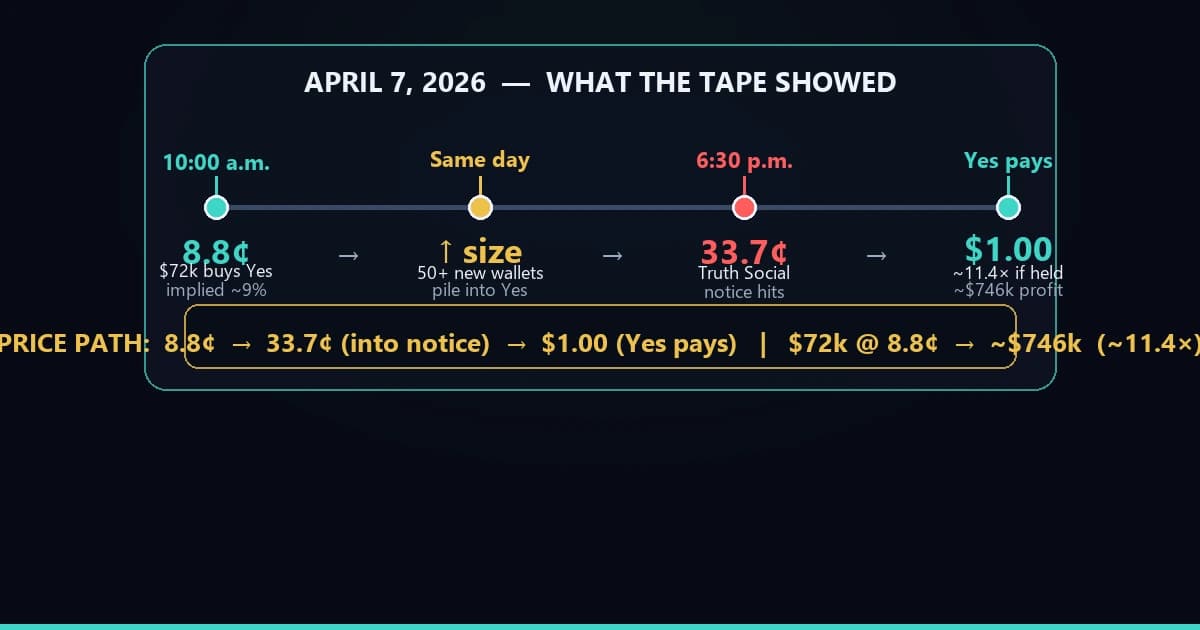
Polymarket 8.8-Cent Wallets Beat Official Notices 2026
Predictions · Aug 3, 2026

AI Prediction Accuracy Report — July 2026
Predictions · Aug 1, 2026

AI Speaks One Language—That's the Real Risk
Technology · Jul 14, 2026

Gematria Sports Dates Selection Bias Explained 2026
Policy & Intelligence · Jul 12, 2026

Gladio Stay-Behind Hybrid War 2026: What Still Applies
Defense & Security · Jul 12, 2026

Gold Price Path After the Rally: 2026 Update
Markets · Jul 12, 2026

Kelly Utilization Meaning (Definition) for Prediction Markets
Markets · Jul 11, 2026

Israel-Turkey War Game Analysis: NATO, Escalation Paths, 2026
Defense & Security · Jul 11, 2026