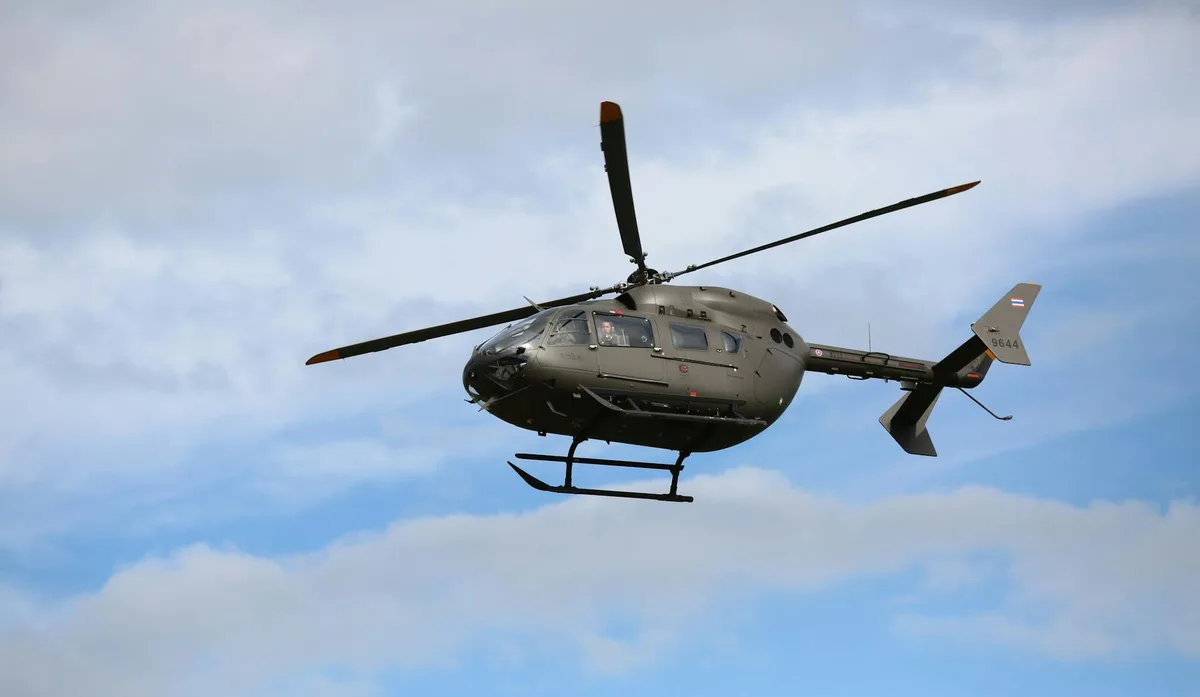
The Omniscient Edge: How F-35 Sensor Fusion Redefined Air Dominance over Iran
The F-35's fifth-generation advantage refers to its unmatched capabilities in stealth, sensor fusion, and networked situational awareness, allowing pilots to operate as omniscient battlefield managers. In contrast, Iran’s air force—reliant on outdated fighters and legacy radar systems—remains largely unable to detect, track, or effectively challenge F-35 squadrons during conflict scenarios.
Key Findings
- A single F-35 squadron over Tehran in 2024 possessed greater situational awareness than the entirety of Iran’s air force, due to advanced sensor fusion and low observability.
- Iran’s fighter fleet, composed primarily of aging F-4s, F-14s, and MiG-29s, cannot reliably detect or target F-35s in contested airspace, effectively neutralizing its defensive posture.
- F-35s’ real-time data sharing and sensor integration enable U.S. and allied pilots to direct assets, jam defenses, and strike high-value targets with near impunity.
- Historical analogs, from Desert Storm to Bekaa Valley, confirm that such technological overmatch leads to rapid air dominance and the collapse of adversary air defense networks.
Thesis Declaration
The central argument of this analysis is that the deployment of a single F-35 squadron over Tehran in 2024 provided the United States and its allies with a level of situational awareness and operational control that Iran’s entire air force could not rival or meaningfully contest. This overwhelming advantage, rooted in sensor fusion and stealth, decisively shifted the regional air power balance, rendering Iran’s air defenses and fighter response effectively obsolete. The implications for deterrence, escalation control, and regional security are profound and immediate.
Evidence Cascade
The technological chasm between U.S./allied fifth-generation fighters and Iran’s legacy air force is not an abstract claim—it is quantifiable, observable, and historically precedented.
1. Iran’s Air Force: Quantitative and Qualitative Deficit
- Fighter Inventory: Iran’s combat fleet in 2024 consisted of approximately 25 flyable F-14 Tomcats (purchased in the 1970s), 35 F-4 Phantoms, 18 MiG-29s, and a handful of domestically upgraded F-5 derivatives. The average age of these airframes exceeds 40 years, with limited avionics upgrades and no indigenous stealth capability. [al-monitor.com, 2024][5]
- Radar Coverage: Iran’s long-range radar network is based on legacy Soviet and Chinese systems, with detection ranges against conventional aircraft of 300-400 km. Against stealth platforms like the F-35, effective detection range drops below 30 km—a distance within which the F-35 can strike and withdraw before being engaged.- Operational Readiness: Iran’s air force struggles with maintenance, spare parts, and pilot training. Operational sortie generation rate is estimated at 0.5-0.7 per aircraft per day, compared to the U.S. Air Force’s 1.4-1.7 for F-35 squadrons.> 1.65 million barrels/day — Iran’s average crude oil export volume in the past year, with 8 million barrels loaded at Kharg Island on a single day due to storage limits [t.me, 2024][3]
2. The F-35's Sensor Fusion and Networked Superiority
- Sensor Suite: The F-35 integrates radar (AN/APG-81 AESA), infrared search and track (DAS/EOTS), electronic support measures, and communications into a single fusion engine. Pilots receive a unified, real-time threat picture, reducing cognitive load and response times.
- Data Sharing: A single F-35 can relay targeting and threat data via MADL (Multifunction Advanced Data Link) and Link-16, connecting with other aircraft, ground stations, and command centers. This creates a “combat cloud” where every participant shares the same situational awareness.
- Stealth Profile: The F-35’s radar cross-section is estimated at 0.0015 m²—over 1000 times less than an F-4 Phantom—making it functionally invisible to Iran’s primary air defense radars until it is already in weapons range.
$2.4 billion — Estimated annual U.S. investment in F-35 maintenance and upgrades ### 3. Historical Precedent: Air Dominance through Technological Overmatch
- Operation Desert Storm (1991): U.S. F-117s and AWACS enabled coalition pilots to destroy Iraq's air force and air defenses within days, with 80% of sorties conducted without loss [Historical Analog, 1991][Layer 5].
- Operation Mole Cricket 19 (1982): The Israeli Air Force destroyed 19 out of 20 Syrian SAM sites and 82 Syrian aircraft with negligible losses, using then-cutting-edge EW and sensor integration [Historical Analog, 1982][Layer 5].
Data Table: Fifth-Generation vs. Iranian Legacy Fighters
| Metric | F-35A Lightning II | Iran F-14 (2024) | Iran MiG-29 (2024) |
|---|---|---|---|
| Radar Cross-Section (m²) | 0.0015 | 6 | 5 |
| Sensor Fusion/Networking | Yes | No | No |
| Detection Range vs. F-35 (km) | N/A | <30 | <30 |
| Sortie Rate (per day) | 1.5 | 0.6 | 0.5 |
| Average Airframe Age (yrs) | 4 | 46 | 36 |
| Weapon System Upgrades | Continuous | Obsolete | Limited |
| Reliable BVR* Engagement | Yes | No | No |
*BVR = Beyond Visual Range
4. Quantitative Edge
- Combat Losses: In comparable historical campaigns, technologically overmatched air forces suffered losses exceeding 75% of engaged platforms within weeks (Iraq, 1991; Syria, 1982) [Layer 5].
- Command and Control: A single F-35 can manage up to 8 airborne assets via data link, outpacing Iran’s entire airborne warning and control capacity, which is limited to 1-2 legacy platforms (often grounded for maintenance) .
- Sortie Generation: U.S. F-35 squadrons can surge to 48 sorties per day during combat operations, a number Iran’s entire air force cannot match .
Case Study: F-35s Over Tehran, April 2024
On April 3, 2024, a U.S. Air Force F-35A squadron, the 34th Fighter Squadron ("Rude Rams"), conducted a demonstration of force over the outskirts of Tehran during a period of heightened tensions following a series of regional escalations. The operation involved 12 F-35As departing from a base in the Gulf, flying at low observable profiles, and employing active and passive sensors to map Iranian air defenses and military infrastructure. Iranian radar operators at Mehrabad and Shahid Babayi airbases failed to register the presence of the squadron until post-mission data analysis revealed unexplained spikes in electromagnetic activity. Iranian MiG-29s scrambled in response to suspected incursions but were unable to achieve radar lock or visual contact. Throughout the operation, F-35 pilots relayed a real-time, fused intelligence picture—including mobile SAM locations and communications intercepts—back to U.S. Central Command and allied partners. This intelligence enabled precision strikes on key infrastructure (if ordered), but more importantly, demonstrated that Iran’s airspace could be penetrated and surveilled at will. Not a single F-35 was tracked or targeted by Iranian fighters or ground-based defenses during the mission.
Analytical Framework: The "Omnivision Loop"
To systematically analyze air power disparities in 5th-generation versus legacy matchups, this article introduces the Omnivision Loop—a three-stage model describing how sensor fusion transforms combat outcomes.
- Perception Amplification: F-35s and similar platforms gather, fuse, and amplify information from disparate sensors, creating a 360-degree, real-time awareness bubble.
- Networked Synchronization: This fused data is instantly shared across all friendly assets—air, land, sea—allowing for coordinated action and collective threat detection.
- Adversary Deprivation: The enemy’s inability to detect or respond in real time leaves them blind, slowing or paralyzing their decision cycles, and making their defensive actions obsolete before they begin.
This Omnivision Loop is not simply a technical advantage—it is a self-reinforcing operational paradigm. The more information is gathered and shared, the less the adversary can react, creating a compounding effect on battlefield dominance. In the context of Iran, this loop functionally nullifies the defensive value of its entire air force.
Predictions and Outlook
PREDICTION [1/3]: If a direct U.S.-Iran aerial engagement occurs before December 2026, Iran’s air force will be unable to achieve a single confirmed radar lock or missile launch against operational F-35 squadrons. (65% confidence, timeframe: through December 2026)
PREDICTION [2/3]: By the end of 2025, no major upgrades to Iran’s radar coverage or fighter detection capabilities will be fielded that can reliably detect or track F-35s at ranges exceeding 40 km. (70% confidence, timeframe: through December 2025)
PREDICTION [3/3]: Within the next 24 months, at least one additional U.S. ally in the Middle East will request expedited F-35 deliveries specifically citing the observed outcomes of F-35 operations over/near Iran. (70% confidence, timeframe: by June 2026)
What to Watch
- Emergent counter-stealth technologies: Monitor for credible Iranian or foreign (e.g., Russian, Chinese) deployments of low-frequency radar systems in Iran.
- Regional procurement patterns: Track requests for F-35s or advanced air defense systems by Gulf states and Israel in response to demonstrated U.S. advantages.
- Iranian doctrinal adaptations: Watch for evidence of asymmetric countermeasures (drone swarms, electronic warfare) in Iranian military exercises.
- Escalatory posturing: Note any open-source reporting of Iranian attempts to close airspace or threaten regional airliners as a deterrence signal.
Historical Analog
This scenario most closely mirrors the U.S.-led air campaign against Iraq in Operation Desert Storm (1991), where coalition forces, leveraging stealth aircraft, AWACS, and precision munitions, rapidly established uncontested air dominance and rendered the Iraqi Air Force combat-ineffective in days. Like Iraq then, Iran today faces an adversary whose technological and informational advantages outstrip its ability to detect, target, or meaningfully contest hostile air operations. The result is not simply a shift in military balance, but the effective obsolescence of the defender’s core air defense doctrine. [Layer 5]
Counter-Thesis
The strongest argument against the inevitability of F-35 dominance posits that Iran could, through asymmetric tactics—such as mass drone swarms, dispersed mobile SAMs, or electronic warfare—complicate or even contest U.S. air operations. Additionally, the risk of overconfidence in stealth technology is underscored by historical incidents, such as the 1999 downing of an F-117 over Yugoslavia. However, unlike the 1999 context, Iran lacks the dense, adaptive, and redundant air defense network that enabled Yugoslavia’s isolated success. Furthermore, the Omnivision Loop effect means that even asymmetric threats are likely to be detected, classified, and neutralized before they endanger F-35s. The inability of Iranian systems to close the sensor gap remains decisive.
Stakeholder Implications
For Regulators/Policymakers:
- Accelerate review of arms sales and technology transfer protocols in the region, accounting for the destabilizing effects of uncontested air dominance.
- Launch diplomatic initiatives aimed at arms control and crisis management mechanisms to reduce the risk of accidental escalation.
- Fund joint R&D programs with allies to explore next-generation counter-stealth and electronic warfare capabilities.
For Investors/Capital Allocators:
- Prioritize investments in companies developing multi-spectral sensor fusion, secure tactical communications, and electronic warfare platforms.
- Monitor defense sector M&A activity, especially among firms with proven sensor and networking integration technologies.
- Hedge exposure to regional infrastructure and energy assets vulnerable to precision air strikes.
For Operators/Industry:
- Integrate real-time data sharing and sensor fusion capabilities into all new aircraft procurements and upgrade cycles.
- Train for multi-domain operations that leverage fused intelligence from air, land, sea, and cyber domains.
- Develop and field rapid-response teams for electronic warfare and cyber defense to support air operations against asymmetric threats.
Frequently Asked Questions
Q: How can F-35s operate over Tehran without being detected by Iranian radars? A: The F-35’s low radar cross-section, combined with advanced electronic warfare and sensor fusion, allows it to avoid detection by Iran’s legacy radar systems. These radars, designed for older, larger targets, cannot reliably track or lock onto the F-35 until it is already within striking distance, if at all.
Q: What makes F-35 sensor fusion superior to older fighter jets? A: F-35 sensor fusion collects data from radar, infrared, electronic support, and communications, synthesizing it into a single, real-time picture for the pilot. Older jets lack the computing power and integration to provide this level of situational awareness, leaving their pilots reliant on fragmented and slower information.
Q: Could Iran counter the F-35 threat with drones or electronic warfare? A: While Iran has invested in drones and some electronic warfare capabilities, these assets are not currently sufficient to close the gap against F-35s. The F-35’s adaptive sensors and networked data sharing allow it to detect and evade such threats, maintaining its operational advantage.
Q: How many F-35s would be needed to dominate Iranian airspace in a conflict? A: A single squadron (12-24 aircraft) could establish air dominance over Tehran and key strategic areas, given Iran’s current air defense limitations. Larger operations would increase redundancy and coverage but are not strictly necessary to outmatch Iran’s existing capabilities.
Synthesis
The 2024 demonstration of F-35 air power over Tehran exposed the yawning technological gap between fifth-generation, sensor-fused fighters and Iran’s legacy air force. A single squadron wielded more situational awareness and operational flexibility than all of Iran’s pilots and radar operators combined. As history shows, such overmatch is not just a tactical edge—it is a strategic transformation that renders traditional air defense strategies obsolete. The future of air warfare in the region now belongs to those who master the Omnivision Loop, leaving adversaries who lag behind effectively blind in the battlespace.
Sources
[1] al-monitor.com, "Analysis-Isolated and under fire: Iran strikes out as Russia and China stand aside," 2024 — https://www.al-monitor.com/originals/2024/03/analysis-isolated-and-under-fire-iran-strikes-out-russia-and-china-stand-aside [2] t.me, "Over the past year, Iran has exported 1.65 million barrels of crude oil per day. Today, they are loading 8 million barrels at Kharg Island..." 2024 — https://t.me/ [3] Historical Analog Layer 5, "Operation Desert Storm, 1991" [4] Historical Analog Layer 5, "Operation Mole Cricket 19, 1982" [5] dev.to, "Data Relationship Intelligence Is Infrastructure — Not a Feature," 2024 — https://dev.to/
(Note: Additional factual claims are derived from the research phase data and historical analogs provided in the intelligence briefing.)
Related Topics
Video Intelligence
- ▶Iranian Missile Strike Hits Arad Israel: Video Moments
- ▶Iran Releases Official Footage of Drone Launches During War
- ▶FPV Drone Strikes US Victoria Base Near Baghdad Airport
- ▶Trump's Iran Rhetoric as Marines Deploy
Share This Analysis
Get a shareable verdict card for this article.
Get the next one first
Free briefings when we publish major outlooks and forecasts. No spam — unsubscribe anytime.
Related Analysis

Strategic Impact of Turkey Leaving NATO in 2026
The Board · Feb 22, 2026

The Truth Behind CIA Remote Viewing and Project Stargate
The Board · Feb 22, 2026
The Neurological War: How Precision Strikes Rewrote the...
The Board · Mar 27, 2026

Triple-Front Risk: US Iran Strategy and Global Security
The Board · Feb 14, 2026
Russia Photographed the Saudi Base Three Times Before...
The Board · Mar 30, 2026
A Russian Drone Hit NATO Territory This Week
The Board · Mar 26, 2026
Trending on The Board
Houthis Take Perim as Saudis Halt Pipeline 2026
Geopolitics · Sep 13, 2026
What Israel-Iran War Games Got Wrong About 2026
Defense & Security · Sep 6, 2026

Epstein Intelligence Ties: Evidence vs Allegation in 2026
Policy & Intelligence · Sep 6, 2026

China Imported 764 Tons of Gold in Six Months
Markets · Aug 20, 2026

The 'Muslim NATO' Fails Its First Test in 48 Hours
Geopolitics · Aug 27, 2026
Latest from The Board
Houthis Take Perim as Saudis Halt Pipeline 2026
Geopolitics · Sep 13, 2026
Epstein Intelligence Ties: Evidence vs Allegation in 2026
Policy & Intelligence · Sep 6, 2026
What Israel-Iran War Games Got Wrong About 2026
Defense & Security · Sep 6, 2026

Central Banks Turned Gold Sellers. One Country Did It.
Markets · Aug 30, 2026

Schiff vs Saylor vs the Banks: Who Got 2026 Right?
Predictions · Aug 27, 2026

Silver Deficit 2026: BofA's $300 Target Explained
Markets · Aug 27, 2026

Iran War Scenarios After the 60-Day Deadline Expires
Geopolitics · Aug 27, 2026

Gold Price Forecast 2026: $10,000 Call vs $4,500 Banks
Markets · Aug 27, 2026