On April 14, 1988, the USS Samuel B. Roberts — a guided-missile frigate carrying 200 American sailors — struck an Iranian moored contact mine in the Persian Gulf. The blast tore a 15-foot hole in the ship's hull, buckled the keel, and nearly sent the vessel and her crew to the bottom. The mine that almost killed 200 Americans cost Iran approximately $1,500 to manufacture. Repairing the Roberts cost the US Navy $96 million.
That 64,000-to-1 cost ratio is not a historical footnote. It is the central logic of Iranian strategic planning — and in 2026, with US-Iran tensions at their highest point in decades, it has become one of the most consequential military calculations on the planet.
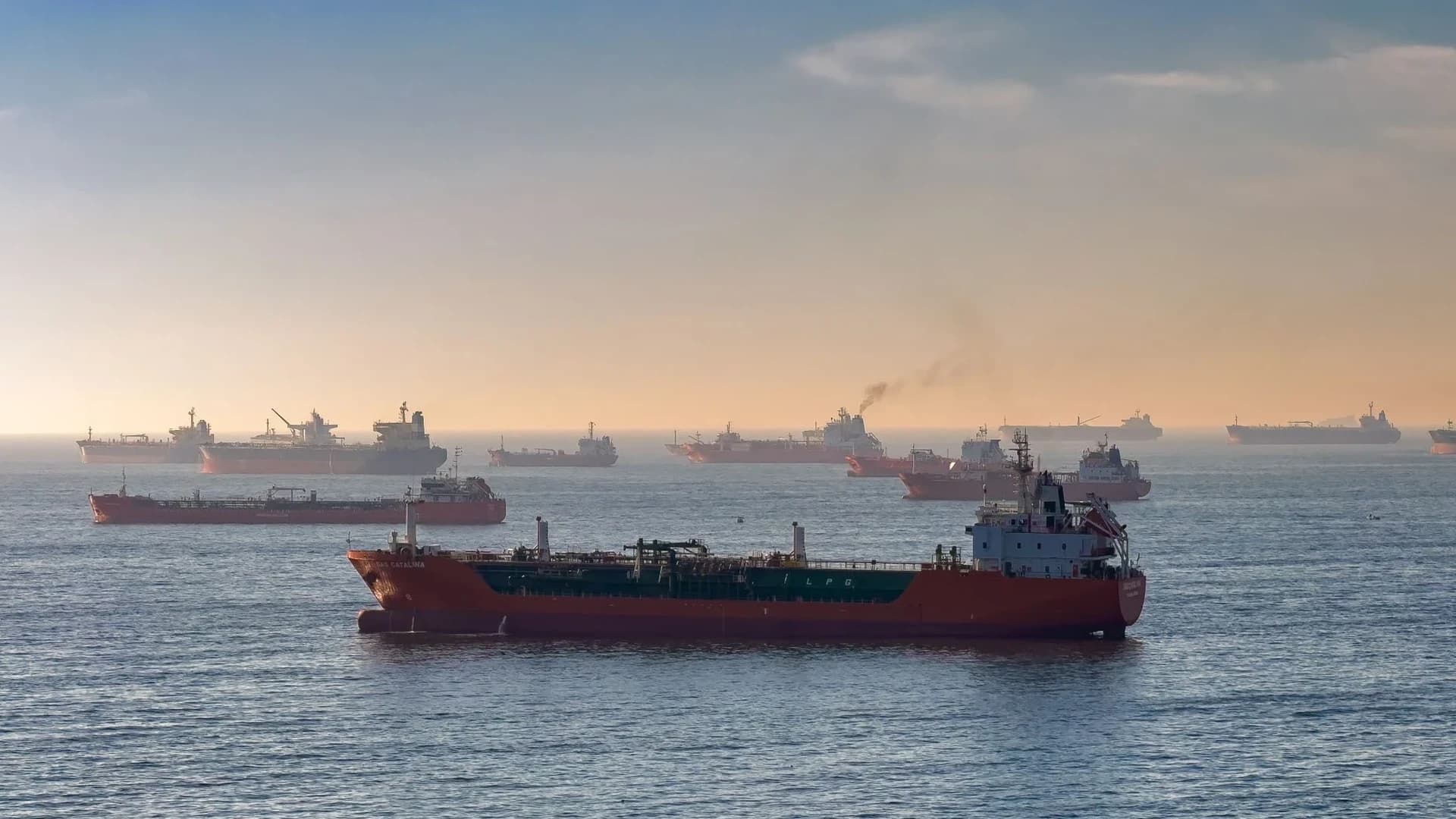
Iran controls access to the Strait of Hormuz, the 21-mile-wide chokepoint through which approximately 21 million barrels of oil flow every single day — roughly 20 percent of global petroleum consumption. The Islamic Revolutionary Guard Corps Navy (IRGCN) has spent four decades studying how to shut that strait down permanently, cheaply, and in a way that no Western countermeasure can quickly reverse. Their answer is naval mines: an ancient, unglamorous, decidedly low-tech weapon that has humiliated the world's most advanced navies for over a century.
Understanding Iran's mine warfare strategy is not an academic exercise. It is a prerequisite for understanding why the global economy can be held hostage by a weapon that costs less than a used car.
The Geography of Leverage
The Strait of Hormuz is not just strategically important — it is strategically irreplaceable. Bounded by Iran to the north and Oman and the UAE to the south, the strait connects the Persian Gulf to the Gulf of Oman and the Arabian Sea. There is no viable pipeline alternative that can absorb the full volume of traffic; the Saudi East-West Pipeline and the Abu Dhabi Habshan-Fujairah line together carry only a fraction of the strait's throughput.
The navigable channel is deceptively narrow. While the strait itself spans roughly 33 miles at its widest point, the internationally recognized shipping lanes run through two corridors — each approximately two miles wide — that hug the Omani coast to the south. These lanes handle supertankers, LNG carriers, and container ships whose drafts leave them with minimal room to maneuver. They also happen to run within 40 miles of the Iranian coastline, well within the operational range of every mine-delivery platform Iran possesses.
This geography is not incidental. It is the entire strategic premise. Iran does not need to sink ships in the open ocean. It needs to make two two-mile corridors impassable — or merely to make commercial operators believe they are impassable. The psychological impact of a single tanker striking a mine can achieve what dozens of warships cannot: it can empty the lanes of commercial traffic overnight.
Iran's Mine Arsenal: Three Tiers of Lethality
Iran's naval mine inventory is estimated by Western intelligence agencies to number in the thousands, with some assessments placing the figure between 2,000 and 5,000 mines of multiple types. The arsenal spans three distinct technological generations, each presenting different challenges to minesweeping forces.
Tier One: Legacy Contact Mines
The oldest and most numerous category consists of Soviet-era and domestically produced moored contact mines — descendants of the weapons that sank Allied shipping in both World Wars. These mines float at a predetermined depth, anchored to the seabed by a cable, and detonate on physical contact with a ship's hull.
Iran acquired significant stocks of Soviet M-08 and M-26 contact mines during and after the Iran-Iraq War, and has since reverse-engineered and domestically produced variants. These weapons are simple, reliable, and extraordinarily cheap to manufacture — estimated at $500 to $2,000 per unit. Critically, their wooden and fiberglass construction makes them difficult to detect using standard hull-mounted sonar systems calibrated for metallic signatures.
The M-08 is the mine that struck the Samuel B. Roberts in 1988. Its 115-kilogram explosive charge was sufficient to nearly break a 3,600-ton warship in half. Against an unarmored commercial supertanker displacing 300,000 tons, the structural damage would be catastrophic and the resulting oil spill would itself constitute an additional navigational hazard.
Tier Two: Influence Mines
The second tier comprises more sophisticated influence mines — weapons that do not require physical contact. They rest on the seabed and activate in response to a combination of magnetic, acoustic, and pressure signatures unique to large vessels. Iran acquired substantial numbers of UTES-based bottom mines from Russia in the 1990s, and intelligence assessments indicate Iran has developed domestic variants incorporating multiple-influence fuzing.
Bottom mines present a fundamentally different minesweeping challenge. Moored mines can be swept by cutting their cables and then detonating or sinking the floating mine. Bottom mines must be individually located by sonar, approached by either a diver or a remotely operated vehicle, and neutralized with a precisely placed explosive charge. The process for a single mine can take four to eight hours under ideal conditions. In contested waters, with Iranian fast boats and shore-based anti-ship missiles threatening the sweeping force, ideal conditions will never exist.
The influence mine also provides Iran with a strategic option that contact mines do not: selective activation. Modern influence mines can be programmed with ship-count delays — remaining dormant for the first three, five, or ten vessels that pass overhead — before activating against a specific target profile. This capability allows Iran to seed a declared-safe corridor with dormant weapons, allow commercial traffic to resume, and then detonate against a high-value military target weeks or months later.
Tier Three: The EM-52 Rocket-Rising Mine
The most technically sophisticated element of Iran's mine arsenal is the Chinese-designed EM-52 rocket-propelled rising mine, which Iran has acquired and is assessed to have domestically produced in variant form. This weapon represents a qualitative leap over conventional mines and remains the element of Iran's arsenal that most concerns Western mine warfare specialists.
The EM-52 sits on the seabed in up to 200 meters of water — well below the operating depth of most conventional minesweeping systems. When its passive sensors detect the acoustic signature of a target vessel overhead, it fires a rocket-propelled warhead upward through the water column at high speed, striking the target's keel from below. The weapon's operating depth alone places it beyond the reach of the Avenger class's standard sonar sweeping protocols. Its rocket propulsion means it cannot be neutralized by the cable-cutting techniques used against moored mines.
The practical implication is stark: a minefield seeded with even a small proportion of EM-52 variants renders the entire field effectively non-sweepable using current US Navy equipment. A minesweeping force must assume any cleared corridor may still contain viable EM-52 weapons until every square meter of seabed has been individually surveyed — a process that would take weeks even in peacetime.
Millennium Challenge 2002: The War Game That Changed Everything
In the summer of 2002, the US military conducted its most expensive and ambitious war game in history. The exercise, called Millennium Challenge, was designed to validate the Pentagon's new "Rapid Decisive Operations" doctrine — the theory that overwhelming information superiority and precision strike capability would allow a smaller US force to defeat a larger, conventionally structured adversary in days.
The Red Team representing the adversary force (widely understood to model Iran) was commanded by retired Marine Lieutenant General Paul K. Van Riper. Van Riper was not a cooperative test subject for the Pentagon's assumptions. He was a decorated combat commander who had spent years studying how asymmetric forces could defeat conventional superpowers, and he brought that knowledge to Millennium Challenge with full force.
Van Riper's opening gambit was asymmetric from the first moment. Rather than using conventional military radio communications that the Blue Team's signals intelligence could intercept and locate, he coordinated his forces through motorcycle couriers and coded messages embedded in the call to prayer broadcast from mosques — methods the Blue Team had no capability to monitor. He launched pre-emptive attacks before the Blue Team had fully deployed, negating the US force's technological advantage. He deployed waves of small, fast suicide boats against the Blue Team's naval forces, overwhelming their point defense systems through sheer volume.
And he mined the approaches.
Van Riper seeded the simulated Persian Gulf with large numbers of mines before Blue Team naval forces entered the operational area. The minesweeping assets available to the Blue Team were insufficient to clear the approaches before the exercise's combat phase began. Blue Team forces that attempted to operate in the mining area took catastrophic losses.
The final tally, before the exercise controllers intervened: Van Riper's Red Team had sunk 16 Blue Team ships — including an aircraft carrier, ten cruisers, and five amphibious ships — in the first 24 hours of simulated combat. An estimated 20,000 American service members would have been killed.
The Pentagon's response was to reset the exercise. Blue Team ships were refloated. Van Riper was instructed to make his forces behave in ways that allowed the scripted Blue Team victory to proceed. He resigned his command mid-exercise in protest, later telling reporters that the exercise had been "almost entirely scripted to ensure a Blue 'win.'"
Van Riper's tactics in Millennium Challenge — mine warfare, small boat swarms, asymmetric communications, pre-emptive action — were not theoretical constructs. They were a precise model of what Iran's IRGCN has been training to execute for the past forty years. The exercise demonstrated, under controlled conditions, that this approach could inflict catastrophic losses on a US carrier strike group before that group's technological advantages became militarily relevant.
The Tanker War: Historical Proof of Concept
Millennium Challenge demonstrated the theory. The 1987-1988 Tanker War demonstrated the reality.
The naval conflict that developed during the final stages of the Iran-Iraq War was, from Iran's perspective, a laboratory for mine warfare doctrine. As US forces began escorting Kuwaiti tankers under Operation Earnest Will — the first major US naval convoy operation since Vietnam — Iran responded with a campaign of covert mine-laying in the Persian Gulf shipping lanes.
The methods were deliberate and technically sophisticated for their era. Iranian naval vessels, including the minelayer Iran Ajr (caught red-handed by US Navy SEALs in September 1987 and boarded while deploying mines at night), laid fields of moored contact mines across the main shipping channels. The operation demonstrated that mines could be deployed covertly, at night, from vessels that appeared to be ordinary commercial craft — a capability Iran has refined considerably in the three decades since.
The Samuel B. Roberts incident was the most dramatic single event of the mine campaign, but it was not isolated. Multiple commercial vessels struck mines during this period. The psychological effect on merchant shipping was immediate and severe: insurance rates for Gulf-bound tankers increased by 400 percent, and several major shipping companies temporarily suspended Persian Gulf operations.
The US Navy's response — deploying minesweepers and conducting clearance operations — was slow, resource-intensive, and only partially effective. Mines continued to be discovered throughout the 1987-1988 period despite intensive sweeping operations. The experience taught Iran a lesson it has never forgotten: a relatively small number of mines, intelligently deployed, can impose costs on commercial shipping that dwarf the cost of the mines themselves.
The economic multiplier effect was extraordinary. Iran spent perhaps $500,000 on the mines used during the Tanker War campaign. The insurance premium increases, rerouting costs, shipping delays, and oil price volatility generated by that campaign cost the global economy billions of dollars. That return on investment — roughly 10,000-to-1 — represents the purest expression of asymmetric warfare mathematics.
The Minesweeping Gap: America's Achilles Heel
The United States Navy has 14 Avenger-class Mine Countermeasures (MCM) ships. These are wooden-hulled, glass-reinforced plastic vessels displacing approximately 1,300 tons, equipped with sonar systems, remotely operated mine neutralization vehicles, and mechanical cable-cutting sweeps. They are the largest minesweepers ever built in the United States — a distinction that sounds impressive until you consider that the previous generation of comparable vessels was built in 1967.
Fourteen ships to clear the world's most strategically critical chokepoint. Fourteen ships to neutralize a mine arsenal that Iran has spent forty years developing and stockpiling. Fourteen ships against a threat environment that includes not just the mines themselves, but the IRGCN fast boats, shore-based anti-ship missiles, and suicide drone assets that would be operating simultaneously to prevent those ships from doing their job.
The mathematics are prohibitive. Mine clearance operations, even under ideal conditions, proceed at rates measured in square miles per day — for a strait whose navigable area spans approximately 50 square miles. In a contested environment, with Iranian forces actively threatening the clearance vessels and the waters themselves potentially seeded with EM-52 weapons that standard sonar cannot locate, the timeline extends dramatically.
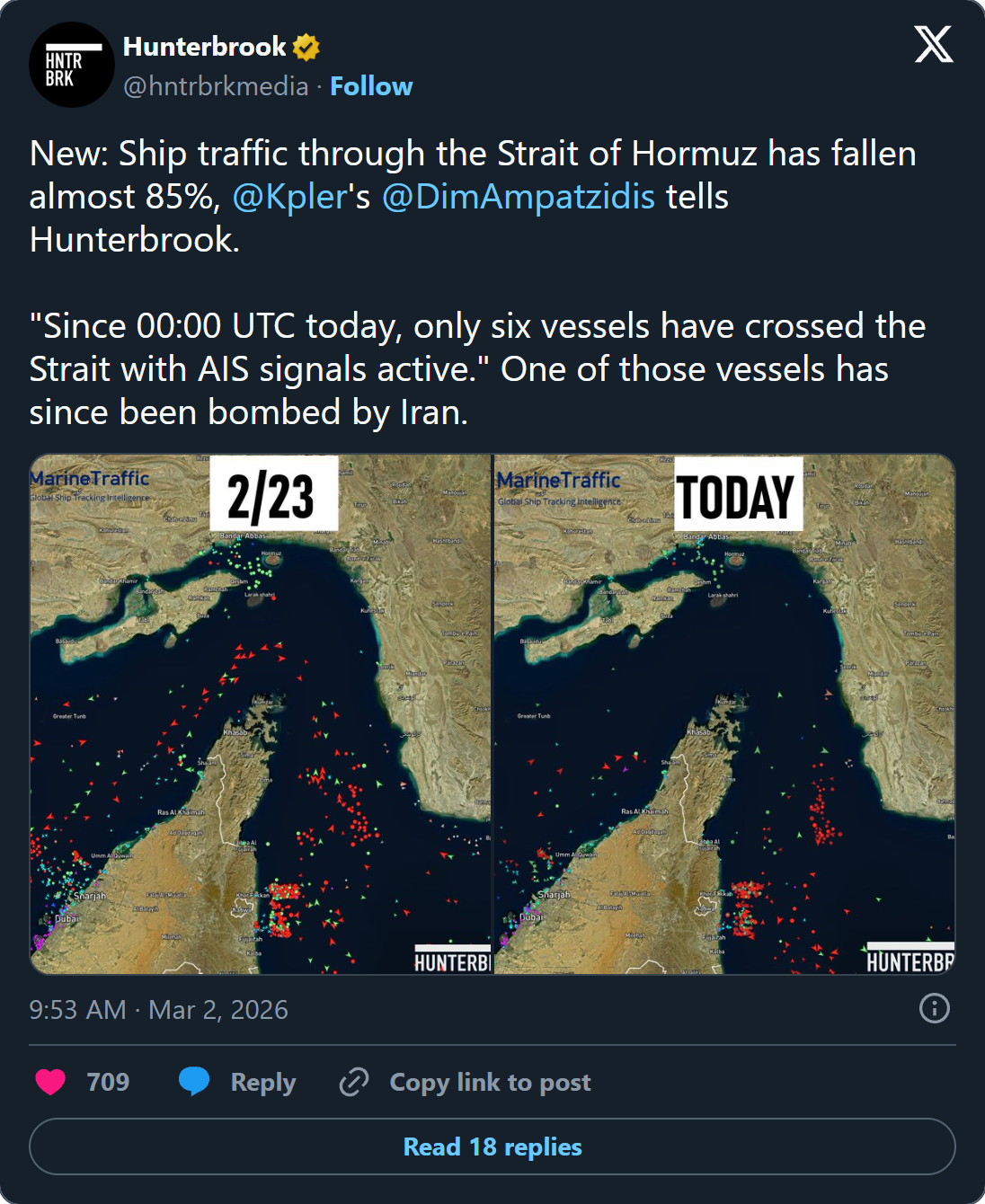
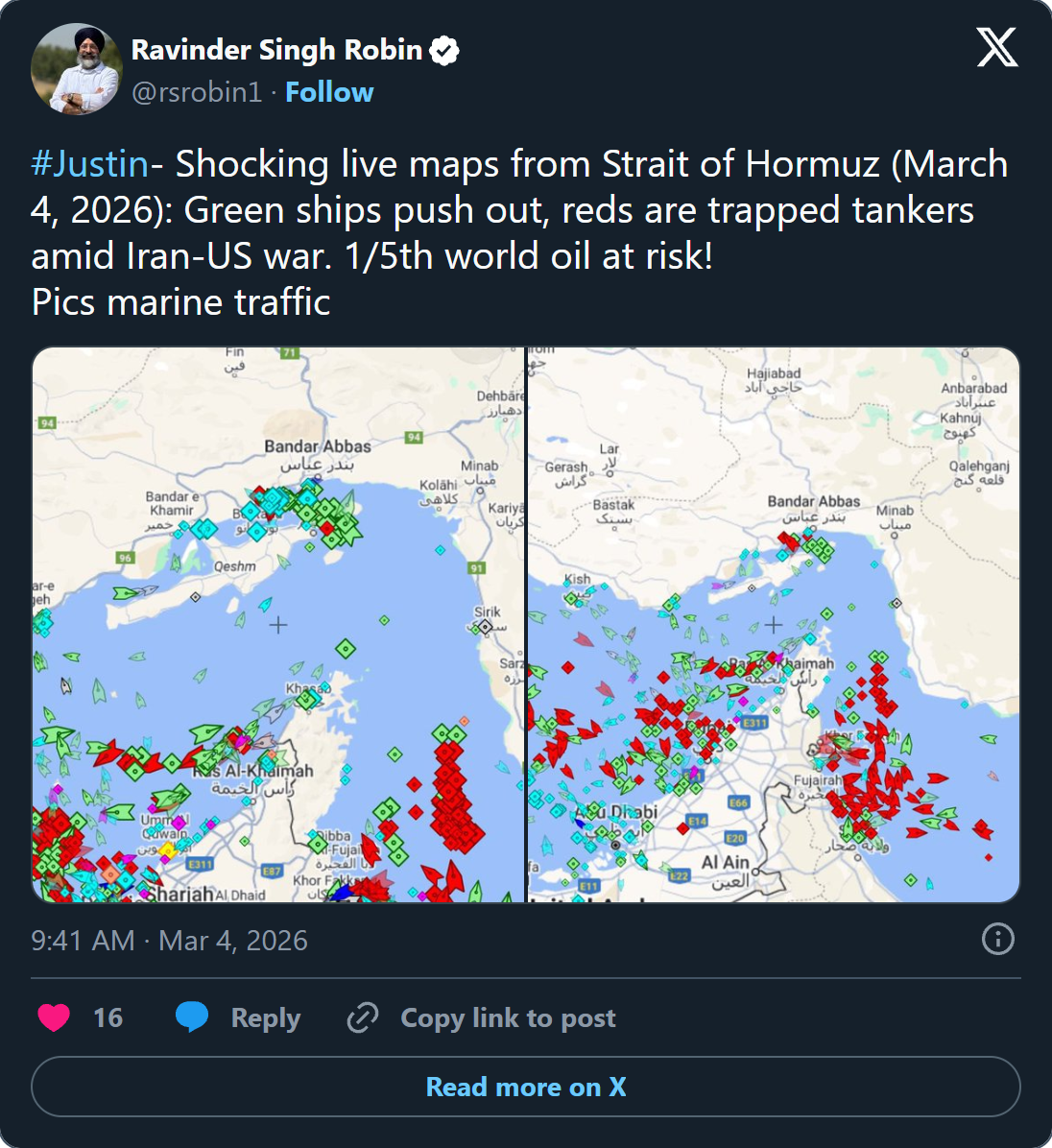
Independent analysts and former US Navy mine warfare officers have estimated that clearing the Strait of Hormuz of a full Iranian mine deployment — assuming Iran seeded the strait with several hundred mines of mixed types — could take anywhere from three weeks to three months. During that period, commercial shipping would be effectively suspended. The global oil market would be operating without its single most critical transit point.
The US Navy has recognized this gap for years. Congressional testimony from mine warfare specialists has repeatedly highlighted the Avenger class as aging, insufficient in number, and inadequately equipped for the EM-52 threat. The Littoral Combat Ship was intended to provide a modular mine countermeasures capability that would supplement and eventually replace the Avengers — but the LCS's Mine Countermeasures Mission Package has been plagued by development delays, cost overruns, and capability shortfalls. As of 2026, the US Navy's mine warfare capacity remains critically constrained.
The allies have some additional capacity. The UK Royal Navy, French Marine Nationale, and several Gulf states operate minesweepers that would be available in a coalition response. But coalition mine clearance operations require coordination, command agreements, and time to assemble that Iran's initial mining action would not provide.
Iran's Deployment Doctrine: Speed, Deception, and Depth
Iran's mine deployment doctrine reflects four decades of refinement since the Tanker War. The IRGCN does not plan to lay mines in a leisurely, observable manner. Its operational concept centers on rapid, covert, distributed deployment before US forces can establish the sea control necessary to interdict the mining operation.
The delivery systems are deliberately low-profile. Dhows, fishing vessels, and small commercial craft — indistinguishable from the thousands of such boats that transit the Persian Gulf daily — can be rapidly converted to mine layers. IRGCN fast boats operating at night under electromagnetic emissions control can deploy moored contact mines from converted containers in a matter of hours. Submarine-laid mines can be deployed in the deepwater approaches well before any surface-based interdiction could begin.
The three Kilo-class submarines Iran operates are specifically relevant here. These diesel-electric boats, acquired from Russia in the 1990s, are genuinely quiet at low speeds — among the quietest conventional submarines in the world — and are capable of mine delivery from their torpedo tubes. A single Kilo can carry a substantial mine load and deploy it with minimal acoustic signature. Detecting and interdicting a Kilo conducting a covert mine-laying mission in the constricted, noisy waters of the Gulf of Oman before the mines are deployed would be extraordinarily difficult.
The IRGCN's organizational structure adds another layer of complexity. Unlike a conventional naval force with a clearly identifiable command-and-control architecture, the IRGCN operates as a genuinely distributed network. Responsibility for mine warfare assets is dispersed across multiple bases along the Iranian coast, under commanders who have pre-delegated authorities to execute certain operations without real-time communication with Tehran. This decentralization means that an attempt to destroy Iran's mine warfare capability through strikes on command nodes would be ineffective — the capability exists at the individual unit level throughout the force.
The Economic Weapon: $21 Million Per Barrel
The strategic genius of Iran's mine threat is not military — it is financial. Iran does not need to sink ships to achieve its strategic objectives. It needs to make the market believe it might.
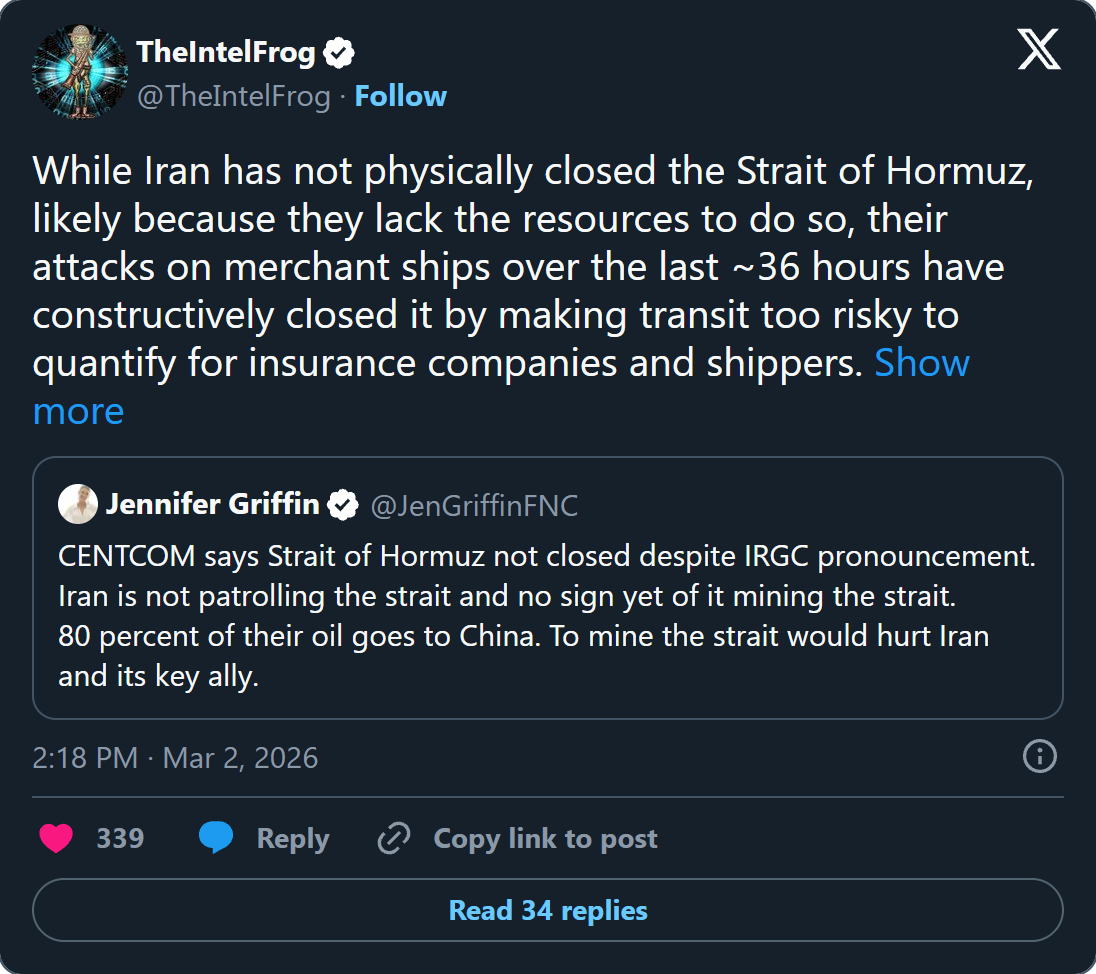
The Strait of Hormuz handles approximately 21 million barrels of oil per day, along with significant volumes of liquefied natural gas from Qatar. A confirmed Iranian mine-laying operation — even one that produced no actual ship casualties — would trigger immediate and severe market responses. The last significant Hormuz crisis, in 2019 following the tanker attacks, briefly pushed Brent crude above $65 per barrel on minimal actual disruption to oil flow.
A confirmed mine-laying campaign, with even a single commercial vessel struck, would produce market responses an order of magnitude larger. Energy market analysts have modeled a sustained Hormuz closure (defined as commercial shipping suspending operations for 30 or more days) as producing oil price spikes to $200-$250 per barrel. At those prices, the global economic damage — in supply chain disruption, transportation cost increases, industrial production curtailments, and cascading inflation — would be measured in the trillions of dollars.
Iran spent perhaps $1 million on mines that disrupted the Persian Gulf economy by billions during the 1988 Tanker War. The return on investment of a modern mining campaign, against a global economy far more integrated and far more dependent on just-in-time supply chains, would dwarf those historical precedents.
This is the hostage dynamic. Iran does not need to actually close the Strait of Hormuz to extract concessions or deter military action. It needs to credibly threaten to do so — and its mine arsenal, combined with its demonstrated willingness to employ it, gives that threat genuine credibility.
The Diplomatic Leverage Dimension
Iran's mine threat functions at multiple levels simultaneously, and it is important not to reduce it to purely military analysis. The mining option is a diplomatic instrument as much as a military one.
Every time US-Iran tensions escalate — over sanctions, over nuclear negotiations, over regional proxy conflicts — Iranian officials and military commanders publicly reference the Hormuz mining option. These statements are not bluster. They are deliberate signals to the market, to US allies in the Gulf, and to Washington that any military action against Iran will carry a price measured not in Iranian casualties but in global economic pain.
The Gulf Cooperation Council states — Saudi Arabia, the UAE, Kuwait, Qatar, Bahrain, and Oman — are acutely aware of this dynamic. Their economies are structurally dependent on Hormuz remaining open. Their populations would bear immediate economic consequences from any sustained disruption. This awareness shapes their willingness to support or participate in US military operations against Iran in ways that Iranian strategists understand very well and have explicitly incorporated into their deterrence calculations.
The mine threat thus serves a deterrent function that operates on allies as well as adversaries — a form of extended deterrence in reverse, where Iran's threat to one party (global oil markets) constrains the behavior of another party (US allies) that might otherwise support military action against Iran.
Can the Strait Be Defended?
The question Western planners most struggle with is not whether Iran can mine the strait — that is now essentially undisputed — but whether the mining can be detected and interdicted before it achieves strategic effect.
The answer, based on current capabilities, is qualified at best. The US Navy's P-8 Poseidon maritime patrol aircraft maintain persistent surveillance over the Gulf and can detect surface mine-laying operations in daylight conditions. US attack submarines maintain continuous presence in the Gulf of Oman and would likely detect and be able to track an Iranian Kilo attempting a mine-laying approach. Surface combatants on patrol can intercept obvious mine-laying vessels.
But Iran does not plan to lay mines with obvious military vessels in daylight. The covert, distributed, night-operation, commercial-vessel-disguise doctrine that Iran has practiced since 1987 significantly reduces the probability of effective interdiction. A determined, well-organized Iranian mine-laying campaign conducted over 48 to 72 hours — as a pre-conflict or very early-conflict action, before US forces have fully transitioned to a wartime posture — could seed the navigable channels with enough weapons to create a credible hazard to commercial shipping before clearance operations could begin.
The technological countermeasure gap is being addressed, slowly. Unmanned underwater vehicles capable of autonomous mine detection and neutralization are in development and limited deployment. Airborne mine detection systems have improved significantly over the past decade. But as of 2026, these systems are not deployed in sufficient numbers in the Gulf region to provide confident mine clearance within the timeframes that strategic deterrence requires.
The Asymmetric Arithmetic That Cannot Be Argued Away
Strip away the geopolitical complexity and the historical detail, and what remains is a mathematical reality that has not changed since the USS Samuel B. Roberts limped back to port with her keel buckled in 1988.
An Iranian naval mine costs between $500 and $15,000 to produce, depending on type. A single mine neutralization operation using a US Navy remotely operated vehicle takes four to eight hours of a highly trained crew's time, under protective surface escort, at a cost of several hundred thousand dollars per mine. The Avenger-class minesweeper costs approximately $90 million per hull and requires years to build. The mine threat it is designed to counter can be replenished in hours for a fraction of that cost.
At scale, the arithmetic is devastating. Iran does not need to win a naval engagement with the United States to achieve its strategic objectives in the Strait of Hormuz. It does not need to maintain sea control or defend any territory. It needs only to make the strait expensive enough, dangerous enough, and uncertain enough that the commercial insurers who backstop global shipping decide the risk exceeds their acceptable loss thresholds.
That is achievable with weapons that cost less than a used car. It has been achievable since 1988. And in 2026, with Iran's mine inventory larger, more sophisticated, and more deeply integrated into a comprehensive asymmetric warfare doctrine than at any point in its history, it remains the single most cost-effective strategic threat that any actor anywhere in the world can credibly deploy against the United States and its allies.
Related Social Posts
What The World Is Saying
FAQ
Q: How many mines does Iran actually have?
Precise figures are classified, but US defense intelligence assessments and open-source analysis consistently estimate Iran's naval mine inventory at between 2,000 and 5,000 mines of multiple types, including Soviet-era contact mines, domestically produced variants, influence mines acquired or derived from Russian designs, and EM-52 rocket-rising mines acquired from China. Iran has also demonstrated a substantial domestic mine production capability, meaning that even if existing stocks were depleted in a conflict, replenishment would be possible.
Q: How long would it actually take to clear the Strait of Hormuz after a large-scale Iranian mining operation?
Mine clearance timelines are highly scenario-dependent, but conservative estimates from former US Navy mine warfare officers suggest three to eight weeks for a relatively thorough clearance operation in the navigable channels — assuming friendly forces maintain uncontested surface and air control over the strait, which would not be the case in an active conflict with Iran. More pessimistic assessments, accounting for the presence of EM-52 weapons that current systems cannot reliably locate and the sustained threat from IRGCN surface and missile forces to the minesweeping vessels themselves, suggest one to three months.
Q: Why doesn't the US Navy just strike Iran's mines before they're deployed?
Iran's mine storage and handling infrastructure is dispersed along approximately 1,500 miles of Persian Gulf coastline in hardened and underground facilities that would require a comprehensive, sustained strike campaign to neutralize. Individual mine-laying vessels are indistinguishable from civilian craft until the moment of deployment. And Iran's mine doctrine explicitly accounts for pre-emptive strike scenarios, with pre-positioned stocks distributed to small coastal units with pre-delegated deployment authority. Eliminating the mine threat through air or missile strikes would require a scale of military action that itself would trigger the economic consequences (oil price spikes, market panic) that policymakers are trying to avoid.
Q: What happened to the Millennium Challenge 2002 findings?
The official exercise was reset and re-scripted to produce a Blue Team victory, and the Pentagon's "Rapid Decisive Operations" doctrine proceeded largely unchanged. Van Riper resigned his command mid-exercise and gave extensive interviews afterward criticizing the Pentagon for ignoring the exercise's actual findings. Many of the capability gaps Van Riper exposed — including inadequate mine countermeasures — were subsequently identified in official reviews but addressed only partially. Van Riper later described his experience as evidence that the US military was "not learning from exercises but validating predetermined conclusions."
Q: Could Iran actually afford to mine the Strait — given that Iran also exports oil through Hormuz?
This is the central strategic paradox of Iran's mine threat. Approximately 90 percent of Iran's own oil exports transit the Strait of Hormuz. Mining the strait would devastate Iran's own export revenue in the short term. Iranian strategists address this paradox in two ways: first, the threat is primarily a deterrent rather than an intended action — its strategic value is maximized by never having to use it; second, in a scenario where Iran is already under maximum sanctions or facing an existential military threat, its oil export revenue has already been largely cut off, eliminating the economic downside of mining. The mine threat is most credible precisely in the scenarios where Iran has the least to lose from its employment.
The Board provides independent analysis of global security, defense, and geopolitical developments. This article is based on open-source reporting, declassified documents, and publicly available military analysis.
Video Intelligence
- ▶Iranian Missile Strike Hits Arad Israel: Video Moments
- ▶Iran Releases Official Footage of Drone Launches During War
- ▶FPV Drone Strikes US Victoria Base Near Baghdad Airport
- ▶Trump's Iran Rhetoric as Marines Deploy
Share This Analysis
Get a shareable verdict card for this article.
Get the next one first
Free briefings when we publish major outlooks and forecasts. No spam — unsubscribe anytime.
Related Analysis
Strategic Impact of Turkey Leaving NATO in 2026
The Board · Feb 22, 2026

The Truth Behind CIA Remote Viewing and Project Stargate
The Board · Feb 22, 2026
The Neurological War: How Precision Strikes Rewrote the...
The Board · Mar 27, 2026

Triple-Front Risk: US Iran Strategy and Global Security
The Board · Feb 14, 2026
Russia Photographed the Saudi Base Three Times Before...
The Board · Mar 30, 2026
A Russian Drone Hit NATO Territory This Week
The Board · Mar 26, 2026
Trending on The Board
Houthis Take Perim as Saudis Halt Pipeline 2026
Geopolitics · Sep 13, 2026
What Israel-Iran War Games Got Wrong About 2026
Defense & Security · Sep 6, 2026

Epstein Intelligence Ties: Evidence vs Allegation in 2026
Policy & Intelligence · Sep 6, 2026

China Imported 764 Tons of Gold in Six Months
Markets · Aug 20, 2026

The 'Muslim NATO' Fails Its First Test in 48 Hours
Geopolitics · Aug 27, 2026
Latest from The Board
Houthis Take Perim as Saudis Halt Pipeline 2026
Geopolitics · Sep 13, 2026
Epstein Intelligence Ties: Evidence vs Allegation in 2026
Policy & Intelligence · Sep 6, 2026
What Israel-Iran War Games Got Wrong About 2026
Defense & Security · Sep 6, 2026

Central Banks Turned Gold Sellers. One Country Did It.
Markets · Aug 30, 2026

Schiff vs Saylor vs the Banks: Who Got 2026 Right?
Predictions · Aug 27, 2026
Silver Deficit 2026: BofA's $300 Target Explained
Markets · Aug 27, 2026
Iran War Scenarios After the 60-Day Deadline Expires
Geopolitics · Aug 27, 2026
Gold Price Forecast 2026: $10,000 Call vs $4,500 Banks
Markets · Aug 27, 2026