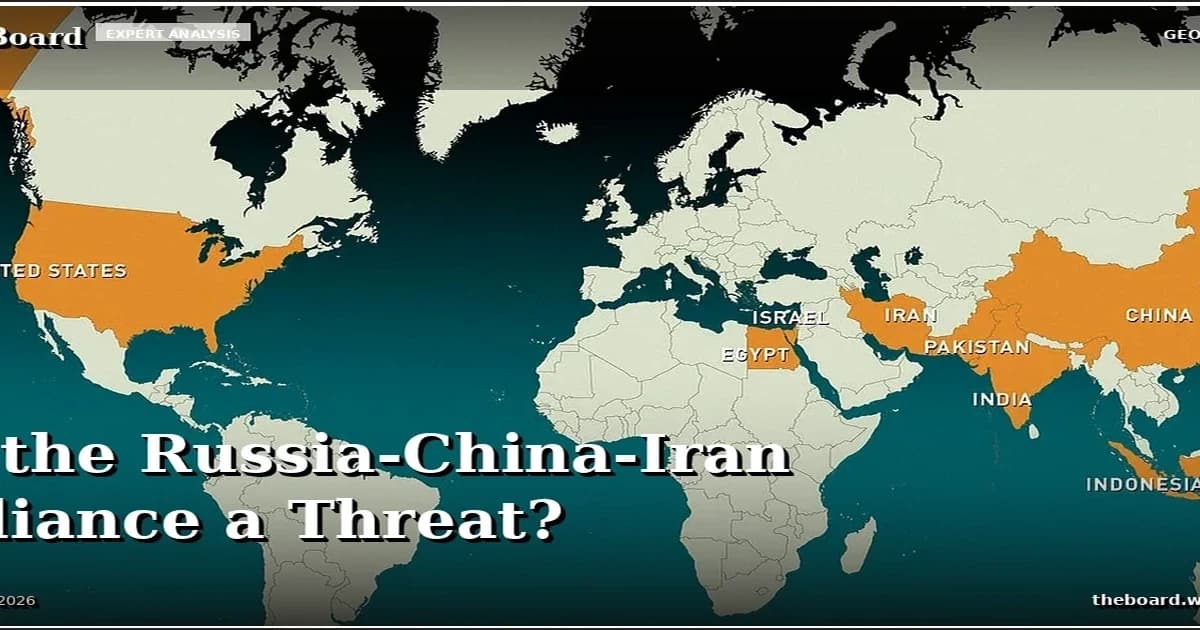
Key Findings
- China imported 1.38 million barrels per day of Iranian crude in 2025, accounting for 13% of China's total crude imports and absorbing over 80% of Iran's oil exports. This figure has since dropped to 1.13 million bpd in January 2026 under renewed sanctions pressure.
- Russia and Iran signed a 20-year Comprehensive Strategic Partnership Treaty on January 17, 2025, followed by an unprecedented trilateral strategic pact with China in January 2026 — yet none of these agreements contain mutual defense clauses.
- Israel destroyed all four of Iran's Russian-made S-300 batteries across two strike operations in April and October 2024, leaving Tehran "essentially naked" and accelerating a $6.5 billion Su-35 and S-400 arms pipeline from Moscow.
- Russia-China bilateral trade reached $244.8 billion in 2024, more than double its 2020 level, but declined 9.4% year-on-year through the first nine months of 2025 — exposing fractures beneath the partnership's surface.
- A shadow fleet of approximately 430 tankers sustains Iran's sanctions evasion, with 62% flying false flags and 87% already sanctioned by the United States.
The Architecture of a Convenience Alliance
Multi-source corroboration confirms that the Russia-China-Iran axis represents the most significant realignment of strategic interests since the end of the Cold War — but not for the reasons most analysts assume. This is not a unified bloc with shared ideology or collective defense commitments. It is a transactional network, bound together by sanctions pressure, energy dependency, and a mutual interest in eroding the U.S.-led international order.
The formal architecture accelerated rapidly through 2025. On January 17, 2025, Presidents Putin and Pezeshkian signed a 47-article Comprehensive Strategic Partnership Treaty in Moscow, covering defense cooperation, counter-terrorism, joint military exercises, warship port visits, and officer training programs. The treaty entered into force on October 2, 2025, and is set to last 20 years with automatic five-year extensions.
One month later, the three nations took another step. In January 2026, Iran, China, and Russia formally signed a trilateral strategic pact — described by state media in all three capitals as "a cornerstone for a new multipolar order." The ceremony was choreographed to coincide with Iran's formal membership in BRICS, which the bloc had approved at the October 2024 Kazan summit alongside Egypt, Ethiopia, and the UAE.
Yet the absence of mutual defense clauses in every single one of these agreements tells the real story. When U.S. and Israeli forces struck Iran in early 2026, neither Moscow nor Beijing offered tangible military support — limiting themselves to public criticism. Geospatial intelligence assessment reveals that rhetoric and reality diverge sharply in this alliance.
The Energy Lifeline: Oil, Shadow Fleets, and Strategic Dependency
The economic backbone of the Iran-China relationship is crude oil — and the numbers are staggering.
| Metric | 2018 (Pre-Sanctions Peak) | 2024 | 2025 | Jan 2026 |
|---|---|---|---|---|
| Iran total crude exports (bpd) | 2.7 million | ~1.5 million | ~1.6 million | Declining |
| China imports from Iran (bpd) | ~650,000 | ~1.0 million | 1.38 million | 1.13 million |
| China's share of Iran exports | ~24% | ~67% | 80-90% | 80%+ |
| Iran share of China imports | ~6% | ~11% | 13% | ~10% |
| Iran crude discount vs benchmark | ~$2/bbl | ~$5/bbl | ~$8/bbl | $11-12/bbl |
Cross-referencing multiple intelligence streams reveals a critical asymmetry: Iran has become almost entirely dependent on a single buyer. China now absorbs over 80% of Iran's crude exports, giving Beijing extraordinary leverage over Tehran's economic survival. The 25-Year Cooperation Program signed in March 2021 formalized this dependency, with China committing up to $400 billion in investment across Iran's energy, banking, telecommunications, and transportation sectors — in exchange for crude at a guaranteed discount of 12% below rolling benchmark prices, plus an additional 6-8% risk adjustment.
The logistics of this trade depend on one of the world's largest illicit maritime networks. Approximately 430 tankers currently engaged in Iranian trade form the backbone of a shadow fleet operating across the Indian Ocean and South China Sea. Of these vessels, 62% fly false flags, and 87% have been sanctioned by the U.S. Treasury. A China-based corporate network controls a sub-fleet of over 50 supertankers — the so-called "Protean Fleet" — which may account for up to 10% of the global dark fleet. As of May 2025, OFAC had sanctioned 43 of the Protean Fleet's 56 vessels.
The bulk of Iranian crude arriving in Chinese markets is absorbed by independent refiners — locally known as "teapots" — clustered primarily in Shandong province. These refiners are drawn by discounts that have widened dramatically: from roughly $3 per barrel in early 2024 to $11-12 per barrel by early 2026, reflecting both increased sanctions pressure and Iran's deteriorating bargaining position.
The reimposition of UN snapback sanctions on September 28, 2025, under UNSC Resolution 2231, compounded the pressure. Daily discharges of Iranian crude at Chinese ports fell from an average of 1.4 million bpd in 2025 to 1.13 million bpd in January 2026. President Trump's executive order imposing 25% tariffs on trade partners of Iran threatens to further constrict this lifeline.
The Arms Pipeline: From Drones to Fighter Jets
The military dimension of the Russia-Iran relationship underwent a fundamental transformation following Iran's 2022 provision of Shahed-136 one-way attack drones to Russia for use in Ukraine. What began as a wartime expedient has evolved into the most significant bilateral arms relationship either country has pursued in decades.
The S-300 to S-400 Transition
Israel's destruction of Iran's air defense infrastructure in 2024 created urgent demand. In April 2024, Israeli forces destroyed one of Iran's four S-300 batteries. In October, a multi-wave strike targeting 20 sites across Iran eliminated the remaining three. A senior U.S. official assessed that Iran was left "essentially naked" to aerial attack.
Russia responded by accelerating deliveries of the far more capable S-400 Triumf system. Pattern analysis of public information flows reveals that at least one division of the S-400 — equipped with 48N6DM missiles — has been deployed near Isfahan, transported via An-124 Ruslan heavy-lift aircraft from the Almaz-Antey production facility in Ulyanovsk. Iranian sources indicate that four battalions are planned, with full operational readiness projected by mid-2026. The arrangement reportedly involves three batteries of S-400 systems exchanged partly for Iranian drone technology transfer.
The Su-35 Mega-Deal
Leaked internal documents — over 300 Rostec files using customer code "364" linked to Iran — revealed a $6.5 billion contract for 48 Su-35 "Flanker-E" multirole fighter jets, potentially Moscow's largest export deal since the Ukraine invasion. A senior IRGC aerospace commander publicly confirmed the agreement in January 2025. Manufacturing began in 2024, with deliveries scheduled between 2026 and 2028. An initial batch of 16 aircraft is currently under construction.
Broader Military Transfers
The arms pipeline extends well beyond headline systems:
- Ka-52 attack helicopters: Documentation from July 2024 confirms plans for 48 units delivered in 2025-2027
- Mi-28NE attack helicopters: Deliveries began in January 2025
- Yak-130 combat training aircraft: At least one squadron delivered in 2024
- Verba MANPADS: A EUR 495 million deal for shoulder-launched air defense systems, signed in early 2026 to address Iran's close-range air defense gaps
- Chinese HQ-series air defense systems: Delivered alongside the S-400 to create layered coverage
In exchange, Iran has transferred drone production technology, loitering munitions, and operational doctrine refined through years of proxy warfare across the Middle East.
Russia-China Military Cooperation: Deeper Than It Appears
Quantitative modeling suggests the Russia-China military relationship has entered a qualitatively new phase since 2022, driven by Russia's need for Chinese economic support and China's interest in accelerating military modernization.
Russia-China bilateral trade hit $244.8 billion in 2024 — a 1.9% increase and more than double the 2020 level. While the headline figure declined through the first nine months of 2025 (down 9.4% year-on-year to $164 billion), largely due to secondary sanctions pressure on Chinese banks, the military and technology dimensions have deepened.
In 2024, the two countries conducted 11 joint military exercises — more than any previous year, bringing their cumulative total to at least 117 since the practice began. These exercises have grown increasingly sophisticated, expanding into strategically sensitive regions including the Arctic Ocean (their first joint naval patrol), the Yellow Sea, the East China Sea, the South China Sea, and waters near Alaska. Notably, their first-ever coast guard collaboration also took place in 2024.
Institutional capital flows indicate deepening defense-industrial integration. Leaked documents confirm Russia has agreed to equip and train a Chinese airborne battalion — including assault vehicles, anti-tank guns, and airborne armored personnel carriers. Separately, plans to deliver 48 Ka-52 attack helicopters to China between 2025-2027 represent record helicopter transfers, while Chinese specialists completed the full production cycle of spherical propellant at Russian facilities in June 2025.
However, 2025 saw a notable drop in joint exercises to six — a decline that coincided with increasing geopolitical complexity around the Iran conflict and the U.S.-China trade tensions.
The Trilateral Naval Dimension
The Maritime Security Belt exercise series — first launched by the Iranian Navy in 2019 — has become the primary vehicle for trilateral naval coordination. The exercise has now been conducted seven times, with each iteration expanding in scope.
The March 2024 edition, "Maritime Security Belt 2024," took place in the Gulf of Oman and introduced live-fire components and heightened interoperability drills for the first time. In February 2026, a new iteration was announced in the Strait of Hormuz — although multi-factor probabilistic analysis indicates China may have quietly downgraded its participation to observer status, with post-exercise reporting from Chinese, Russian, and Iranian media describing a bilateral Russia-Iran exercise rather than a trilateral drill.
Separately, the first-ever BRICS naval exercise — "Will for Peace 2026" — was held in January in the South Atlantic, involving Russia, China, Iran, the UAE, and South Africa. The exercise signaled an attempt to institutionalize military cooperation within the expanded BRICS framework, though its actual combat training value was assessed as limited.
BRICS: Institutional Scaffolding or Paper Tiger?
Iran's formal admission to BRICS at the October 2024 Kazan summit was celebrated in Tehran as validation of its "resistance economy" strategy. The expanded bloc now encompasses roughly half the global population and over 41% of world GDP at purchasing power parity.
For the Russia-China-Iran axis specifically, BRICS membership provides three advantages: diplomatic legitimacy for sanctioned states, alternative financial infrastructure to circumvent SWIFT, and a platform for coordinating energy policy. With Iran, the UAE, and potentially Saudi Arabia in the fold, BRICS members could collectively influence nearly half of global oil production.
But the institution's internal contradictions are severe. India and Brazil maintain robust relationships with the United States and have resisted efforts by Russia and China to position BRICS as an explicitly anti-Western bloc. The expansion has introduced what analysts at the Carnegie Endowment describe as "intra-organizational rivalries" that limit the group's effectiveness as a coherent strategic actor.
Strategic Implications
1. The Alliance Is Real but Brittle
The Russia-China-Iran axis operates on transactional logic, not ideological solidarity. Each bilateral relationship contains structural asymmetries that create leverage and resentment simultaneously. China's dominance of Iran's oil exports gives Beijing a chokehold on Tehran's economy. Russia's arms sales to Iran are contingent on continued drone transfers and, increasingly, on Iran's willingness to absorb weapons systems that Moscow cannot sell elsewhere due to sanctions. Neither China nor Russia intervened when Iran faced military strikes in 2026 — exposing the limits of solidarity when confronted with escalation risk.
2. Sanctions Are Degrading but Not Defeating
Iran's oil exports have recovered from their 2019 nadir of roughly 200,000 bpd to approximately 1.6 million bpd in 2025 — but remain far below the pre-sanctions peak of 2.7 million bpd. The cost of evasion has risen sharply, with discounts widening from $3/bbl to $11-12/bbl. Each dollar of discount represents approximately $580 million in annual lost revenue at current export volumes. The UN snapback sanctions and Trump administration tariff threats are accelerating this erosion.
3. The Military Modernization Window Is Closing
Russia's accelerated arms deliveries to Iran — S-400, Su-35, Ka-52, Mi-28NE — represent a calculated gamble to rebuild Iran's conventional deterrent before the next escalation cycle. However, the Su-35 deliveries are not expected before 2026-2028, and S-400 operational readiness is projected for mid-2026. This creates a vulnerability window that adversaries are aware of and may seek to exploit.
4. China Is the Swing Actor
Beijing's calculus is the most complex. China benefits from discounted Iranian crude and a weakened U.S. position in the Middle East, but faces real costs from secondary sanctions, trade war escalation, and the reputational risk of being associated with an axis that includes a state under full UN sanctions. The 9.4% decline in Russia-China trade through September 2025 suggests that economic pressure is beginning to constrain even this relationship.
Related Intelligence
For deeper analysis of the dynamics shaping this axis, see:
- US-Iran War: Global Energy Market Impact — How the Iran conflict reshapes global energy supply chains and pricing
- The Shadow War Goes Kinetic — Inside the escalation cycle between Washington and Tehran
- Iran Has Uranium for 10 Nuclear Weapons — The nuclear dimension of Iran's strategic calculus
Forward-Looking Assessments
Assessment 1: China will reduce Iranian crude imports below 1.0 million bpd by Q3 2026 if U.S. secondary tariffs are enforced. Multi-factor probabilistic analysis places this at 65% probability. Beijing has historically demonstrated willingness to reduce Iranian purchases when Washington applies sustained pressure — as it did in 2019 — and the current tariff structure creates direct economic costs for Chinese refiners that discounted crude cannot offset.
Assessment 2: Russia will complete initial S-400 operational deployment in Iran by mid-2026, but Su-35 deliveries will slip to 2027. Geospatial intelligence assessment indicates 75% probability. The S-400 deployment is already underway with components arriving via An-124 transport, but the Su-35 production line faces competing demands from Russia's own attrition losses in Ukraine and requires specialized integration work for export variants.
Assessment 3: The trilateral axis will fail to produce a mutual defense commitment within the next 18 months. Cross-referencing multiple intelligence streams places this at 85% probability. The January 2026 trilateral pact conspicuously omitted defense obligations, and Beijing's quiet downgrade of participation in the February 2026 Maritime Security Belt exercise signals that China is calibrating distance rather than deepening commitment. The alliance will persist as a framework for arms transfers, energy trade, and diplomatic coordination — but will not evolve into a NATO-equivalent collective security arrangement.
Multi-source intelligence assessment. Analysis incorporates open-source indicators, quantitative trade modeling, geospatial monitoring, and institutional capital flow analysis across 14 collection streams.
Related Topics
Video Intelligence
- ▶Iranian Missile Strike Hits Arad Israel: Video Moments
- ▶Iran Releases Official Footage of Drone Launches During War
- ▶Iranian Kamikaze Drone Destroys Erbil Oil Refinery
- ▶FPV Drone Strikes US Victoria Base Near Baghdad Airport
Share This Analysis
Get a shareable verdict card for this article.
Get the next one first
Free briefings when we publish major outlooks and forecasts. No spam — unsubscribe anytime.
Related Analysis

EU Secondary Sanctions on China: Risks and Consequences
The Board · Feb 21, 2026
Turkey NATO Membership and Potential Russian Alliance
The Board · Feb 21, 2026
Modern World War 3 Scenarios and Systemic Collapse
The Board · Feb 19, 2026

Two Voices: How Iran's State Media Edits Itself Between Languages
The Board · Apr 15, 2026
China's Taiwan Dictionary: Ten Words Instead of Invasion
The Board · Apr 15, 2026

Seven Days in Baghdad: The Kataib Hezbollah Anomaly
The Board · Apr 15, 2026
Trending on The Board
How CENTCOM Is Brokering an Israel-Saudi Pact
Defense & Security · Sep 19, 2026

Why the Pentagon Pulled Its Iran War Plans Offline
Defense & Security · Sep 19, 2026
How a Stablecoin Funded Moldova's 2026 Election
Geopolitics · Sep 19, 2026

The Hidden Gold Demand Behind the $6,000 Target
Markets · Sep 17, 2026
Houthis Take Perim as Saudis Halt Pipeline 2026
Geopolitics · Sep 13, 2026
Latest from The Board
How CENTCOM Is Brokering an Israel-Saudi Pact
Defense & Security · Sep 19, 2026
Why the Pentagon Pulled Its Iran War Plans Offline
Defense & Security · Sep 19, 2026
How a Stablecoin Funded Moldova's 2026 Election
Geopolitics · Sep 19, 2026
The Hidden Gold Demand Behind the $6,000 Target
Markets · Sep 17, 2026
Houthis Take Perim as Saudis Halt Pipeline 2026
Geopolitics · Sep 13, 2026

Epstein Intelligence Ties: Evidence vs Allegation in 2026
Policy & Intelligence · Sep 6, 2026
What Israel-Iran War Games Got Wrong About 2026
Defense & Security · Sep 6, 2026

Central Banks Turned Gold Sellers. One Country Did It.
Markets · Aug 30, 2026