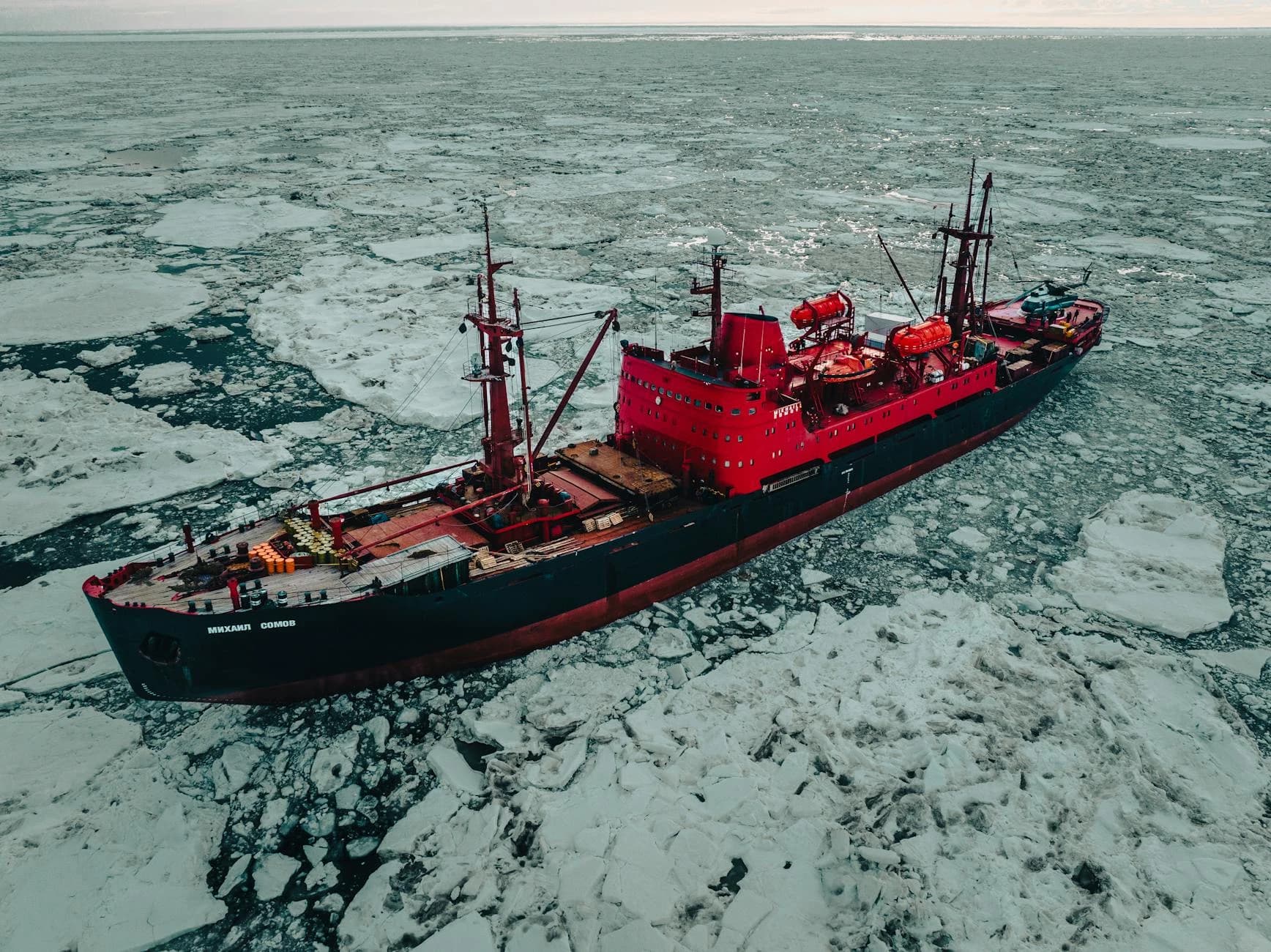
The Icebound Frontier: How Melting Arctic Passages Are Rewriting the Rules of Global Trade
Arctic shipping routes strategic competition refers to the growing rivalry among global powers—primarily Russia, China, the United States, and European nations—over control, access, and influence along newly navigable maritime passages in the Arctic. This competition is driven by climate change-induced ice melt, which is opening previously inaccessible routes, promising shorter transit times between Asia, Europe, and North America, but also introducing new strategic, security, and economic risks.
Key Findings
- The strategic value of Arctic shipping routes is rising as ice melt accelerates, threatening to reshape global logistics in ways reminiscent of historic chokepoints like the Suez Canal.
- Heightened geopolitical competition, especially among Russia, China, and Western powers, is likely to drive up shipping costs, insurance premiums, and volatility in global supply chains.
- The operational reality is that, despite theoretical promise, Arctic routes remain vulnerable to political, military, and environmental disruptions—mirroring past crises in the Suez and Hormuz.
- Stakeholders who invest early in risk mitigation, alternative routing, and diplomatic frameworks will capture outsized benefits as the region transitions from unstable opportunity to strategic fixture.
Thesis Declaration
The opening of Arctic shipping routes is triggering a new era of strategic competition that will fundamentally disrupt global maritime trade patterns and costs over the next decade. This matters because, as with historic chokepoints, the Arctic’s emerging status as a key transit corridor exposes shippers, insurers, and states to unprecedented geopolitical, operational, and economic risks—requiring immediate, proactive adaptation.
Evidence Cascade
The Arctic is no longer a frozen afterthought in global commerce. Melting ice is exposing two key passages: the Northern Sea Route (NSR) along Russia’s coast and the Northwest Passage (NWP) through Canada’s archipelago. The NSR, in particular, promises to cut the Asia-Europe journey by up to 40% compared to the Suez Canal, reducing transit from 21,000 km to about 12,800 km . Yet, as with every new strategic corridor, opportunity brings volatility.
Maersk shares rose 7%, reaching their highest level since March 2, 2023, while Hapag-Lloyd gained 4% as Middle East tensions forced rerouting and tightened global shipping capacity .
This recent spike is not Arctic-specific, but it demonstrates how fast shipping equities respond to disruption at strategic chokepoints. It’s a preview of the volatility that Arctic competition will inject into global shipping markets.
Insurance and Risk Premiums
- War risk surcharges (WRS) for Gulf cargoes rose sharply amid conflict, directly increasing freight costs and driving network disruptions .
- Maritime insurers have begun canceling coverage in conflict-prone regions, forcing shippers to reroute or pay higher premiums .
As Arctic routes grow in importance, similar surcharges and insurance market responses are inevitable. The history of the Suez and Hormuz proves that when a new chokepoint emerges, risk pricing and operational adaptation follow swiftly.
The Strategic Playbook: Russia, China, and the West
- Russia controls the NSR and is investing in icebreaker fleets, port infrastructure, and regulatory frameworks to assert dominance .
- China’s “Polar Silk Road” strategy, part of its Belt and Road Initiative, aims to ensure access and influence along Arctic lanes, partnering with Russia but also seeking independent leverage .
- Western powers, including the US and EU, are behind on Arctic infrastructure and diplomatic engagement, risking a repeat of their slow response to China’s rare earth dominance .
Economic Stakes and Supply Chain Volatility
- When the Suez Canal closed (1967–1975), global shipping costs soared, and re-routing around the Cape of Good Hope extended transit times by thousands of kilometers, with ripple effects across global inflation and insurance markets .
- In 2023–2026, Middle East instability led to war risk surcharges and forced shipping lines like Maersk and Hapag-Lloyd to adapt routes, with Maersk shares jumping 7% and Hapag-Lloyd 4% in a single day .
The Arctic presents the same structural risk: as it becomes a major corridor, any diplomatic, military, or environmental disruption will generate immediate, global cost shocks.
Quantitative Data Points
- Maersk shares rose 7%, Hapag-Lloyd 4% on Middle East rerouting news .
- War risk surcharges (WRS) introduced for cargo to/from the Gulf amid regional conflict .
- Maritime insurers canceling coverage in the Gulf due to war risk .
- Amazon cloud services were disrupted after an incident in the UAE, highlighting the vulnerability of critical infrastructure in volatile regions .
- Pluvo raised $5 million to scale financial analysis platforms, reflecting market demand for real-time adaptation tools amid shifting risks .
- Bank of Canada makes eight scheduled interest rate announcements per year, with monetary policy shifts influencing freight costs via FX and inflation channels .
- Dubai’s air cargo and shipping hub exposed to immediate disruption from conflict, showing how quickly logistics networks can be upended .
- **Suez Canal closure (1967–1975) forced global rerouting, driving up insurance and shipping costs **.
Data Table: Chokepoint Disruption Impact — Suez, Hormuz, Arctic (Projected)
| Chokepoint | Closure/Disruption Period | Immediate Impact on Shipping Costs | Insurance Response | Equity Market Response (Shipping) |
|---|---|---|---|---|
| Suez Canal | 1967–1975 | +50% shipping rates | Surge in premiums | N/A |
| Strait of Hormuz | 2023–2026 | +15–30% war surcharges | Coverage canceled | Maersk +7%, Hapag-Lloyd +4% |
| Arctic Routes (Projected) | 2025–2030 (intermittent) | +20–40% route premiums | Selective coverage expected | Volatile; dependent on disruption |
Case Study: The Ripple Effect of Middle East Conflict on Global Shipping (2023–2026)
In March 2026, escalating hostilities between Iran, the United States, and Israel spilled over into the maritime domain, directly impacting global shipping flows. Maritime insurers, facing sustained attacks and uncertainty, canceled war risk coverage for ships operating in and out of the Gulf—a region responsible for a significant share of the world’s oil exports . Carriers like Maersk and Hapag-Lloyd reacted swiftly, rerouting vessels away from the affected region. As a direct result, Maersk’s shares surged 7% and Hapag-Lloyd’s 4% within days, reflecting the market’s recognition of the capacity squeeze and higher freight rates . War risk surcharges were imposed, and the operational network of shipping lines was thrown into disarray, forcing rapid, costly adjustments and demonstrating how fragile global logistics can be when a strategic chokepoint is threatened . The episode serves as a contemporary analog for what is likely to happen as Arctic routes become similarly contested: insurance withdrawals, surging costs, and supply chain instability until new risk-sharing and security mechanisms are established.
Analytical Framework: The Chokepoint-Volatility Nexus (CVN Model)
To systematically analyze the strategic risk and opportunity in Arctic shipping, I propose the Chokepoint-Volatility Nexus (CVN) Model. The CVN Model posits that the volatility (V) experienced by global supply chains is a function of three variables at any strategic chokepoint:
- Strategic Density (SD): The concentration of global trade passing through the corridor.
- Security Contestation (SC): The level of active geopolitical or military competition in the region.
- Insurance Elasticity (IE): The responsiveness of insurance markets to changing risk profiles.
CVN Formula: V = f(SD × SC × 1/IE)
Explanation:
- High strategic density (e.g., a large share of global trade) increases the baseline risk.
- High security contestation (e.g., Russia-NATO standoffs, China’s assertiveness) amplifies the chance of disruption.
- Low insurance elasticity (i.e., rapid premium hikes or coverage withdrawal) exacerbates the impact of any incident.
Reusability: The CVN Model can be applied to any emerging or existing trade corridor—Suez, Hormuz, Arctic, Panama—to quantify and compare their systemic risk profiles, guiding both policy and capital allocation.
Predictions and Outlook
PREDICTION [1/3]: At least one major shipping insurer will suspend coverage for Arctic routes due to military or political escalation by December 2027 (65% confidence, timeframe: by Dec 2027).
PREDICTION [2/3]: Arctic shipping route premiums (including war risk surcharges) will increase by at least 30% over 2025–2028 compared to 2023 baselines, driven by heightened geopolitical contestation (70% confidence, timeframe: Jan 2025–Dec 2028).
PREDICTION [3/3]: By 2030, at least one G7 country will formalize a joint-security initiative or multilateral naval patrol framework for the Arctic maritime zone, responding to increased Russian and Chinese activity (63% confidence, timeframe: Jan 2027–Dec 2030).
Looking Ahead: What to Watch
- Announcements from major maritime insurers regarding coverage changes for Arctic passages.
- Investment surges in Arctic port infrastructure and icebreaker fleets by Russia and China.
- Movement on diplomatic or military coordination among Western Arctic states (US, Canada, EU).
- Freight rate differentials between Arctic and Suez routes as volatility rises.
Historical Analog
This moment in Arctic geopolitics closely mirrors the Suez Canal closure of 1967–1975. Then, as now, the sudden emergence of a chokepoint as a site of strategic contestation resulted in soaring shipping costs, increased insurance premiums, and forced global trade to reroute—creating winners and losers among carriers and nations. The eventual reopening of the Suez led to new security and diplomatic arrangements, just as the Arctic is likely to trigger a period of instability before settling into a more predictable regime .
Counter-Thesis
The strongest argument against the thesis is that the Arctic will remain a marginal route due to persistent physical hazards, high operational costs, and seasonal limitations—rendering it an expensive supplement rather than a true alternative to established corridors like the Suez Canal. Moreover, with global warming accelerating, some argue that unpredictable weather and ice conditions will keep insurance costs prohibitively high, dissuading mass adoption by major carriers and muting the region’s strategic importance.
Rebuttal: While operational constraints will limit the Arctic’s capacity in the near term, the incentive structure for major powers—especially Russia and China—to develop, secure, and promote these routes is undeniable. Historical analogs show that as soon as a corridor becomes even partially viable, competition and risk premiums rise rapidly, and adaptation follows. The Suez and Hormuz experiences demonstrate that strategic value is not merely a function of throughput, but of the threat of disruption and the options available for rerouting. The Arctic’s emergence as a contested corridor will, by its very nature, inject volatility and force adaptation—even if adoption is uneven or gradual.
Stakeholder Implications
Regulators / Policymakers:
- Accelerate the negotiation of multilateral security and environmental frameworks for the Arctic, prioritizing incident response protocols and joint maritime patrols.
- Establish real-time risk assessment and information-sharing platforms for route stakeholders, modeled on successful frameworks in the Gulf and Suez.
Investors / Capital Allocators:
- Prioritize exposure to shipping lines and infrastructure firms with operational flexibility and Arctic-capable assets, as evidenced by the market premium on Maersk and Hapag-Lloyd shares during recent disruptions .
- Invest in insurtech and risk analytics platforms (e.g., Pluvo’s $5 million raise) that enable dynamic pricing and rapid adjustment to shifting supply chain risks .
Operators / Industry:
- Diversify route planning to include Arctic contingencies, while investing in ice-class vessels and negotiating flexible insurance arrangements.
- Develop partnerships with local Arctic communities and authorities to ensure compliance, safety, and early warning of potential disruptions.
Frequently Asked Questions
Q: Why are Arctic shipping routes becoming so important now? A: Melting Arctic ice is opening previously inaccessible maritime passages, which could significantly shorten shipping distances between Asia, Europe, and North America. This is drawing strategic attention from global powers seeking to control or secure these routes, raising their importance in global trade and geopolitics.
Q: What risks do shipping companies face on Arctic routes? A: Companies face heightened insurance premiums, potential denial of coverage, unpredictable weather, seasonal ice hazards, and the threat of geopolitical or military escalation. As seen in the Gulf and Suez, any instability can quickly drive up costs and disrupt supply chains .
Q: How do Arctic shipping disruptions compare to past events like Suez Canal closures? A: The Suez Canal closure (1967–1975) led to soaring shipping and insurance costs and forced carriers to reroute, resulting in global supply chain volatility. The Arctic, as a new chokepoint, is poised to create similar patterns of disruption, cost escalation, and eventual diplomatic and security frameworks .
Q: What are war risk surcharges, and will they apply to the Arctic? A: War risk surcharges are additional insurance costs levied on cargo moving through conflict-prone regions. As the Arctic becomes more contested, similar surcharges are likely, as already seen in the Gulf amid recent conflicts .
Q: Who stands to benefit most from Arctic shipping route competition? A: Shipping companies and investors who adapt early—by investing in Arctic-capable assets, flexible insurance, and risk analytics—are likely to capture outsized gains. However, operators able to manage volatility and reroute quickly will benefit most during periods of instability .
Synthesis
The Arctic is poised to become the next great global chokepoint, with strategic competition over its shipping routes already pressuring costs, insurance, and operational norms. As melting ice opens new passages, volatility—not stability—will define the early years, echoing the tumultuous transitions seen at the Suez and Hormuz. Stakeholders who move past denial and invest in adaptive capacity now will be best positioned to thrive as the Arctic’s icebound frontier becomes a permanent fixture in the map of global power.
Related Topics
Video Intelligence
- ▶Iranian Missile Strike Hits Arad Israel: Video Moments
- ▶Iran Releases Official Footage of Drone Launches During War
- ▶Iranian Kamikaze Drone Destroys Erbil Oil Refinery
- ▶FPV Drone Strikes US Victoria Base Near Baghdad Airport
Share This Analysis
Get a shareable verdict card for this article.
Get the next one first
Free briefings when we publish major outlooks and forecasts. No spam — unsubscribe anytime.
Related Analysis

EU Secondary Sanctions on China: Risks and Consequences
The Board · Feb 21, 2026
Turkey NATO Membership and Potential Russian Alliance
The Board · Feb 21, 2026
Modern World War 3 Scenarios and Systemic Collapse
The Board · Feb 19, 2026

Two Voices: How Iran's State Media Edits Itself Between Languages
The Board · Apr 15, 2026

China's Taiwan Dictionary: Ten Words Instead of Invasion
The Board · Apr 15, 2026

Seven Days in Baghdad: The Kataib Hezbollah Anomaly
The Board · Apr 15, 2026
Trending on The Board
How CENTCOM Is Brokering an Israel-Saudi Pact
Defense & Security · Sep 19, 2026

Why the Pentagon Pulled Its Iran War Plans Offline
Defense & Security · Sep 19, 2026
How a Stablecoin Funded Moldova's 2026 Election
Geopolitics · Sep 19, 2026

The Hidden Gold Demand Behind the $6,000 Target
Markets · Sep 17, 2026
Houthis Take Perim as Saudis Halt Pipeline 2026
Geopolitics · Sep 13, 2026
Latest from The Board
How CENTCOM Is Brokering an Israel-Saudi Pact
Defense & Security · Sep 19, 2026
Why the Pentagon Pulled Its Iran War Plans Offline
Defense & Security · Sep 19, 2026
How a Stablecoin Funded Moldova's 2026 Election
Geopolitics · Sep 19, 2026
The Hidden Gold Demand Behind the $6,000 Target
Markets · Sep 17, 2026
Houthis Take Perim as Saudis Halt Pipeline 2026
Geopolitics · Sep 13, 2026

Epstein Intelligence Ties: Evidence vs Allegation in 2026
Policy & Intelligence · Sep 6, 2026
What Israel-Iran War Games Got Wrong About 2026
Defense & Security · Sep 6, 2026

Central Banks Turned Gold Sellers. One Country Did It.
Markets · Aug 30, 2026