Executive Summary
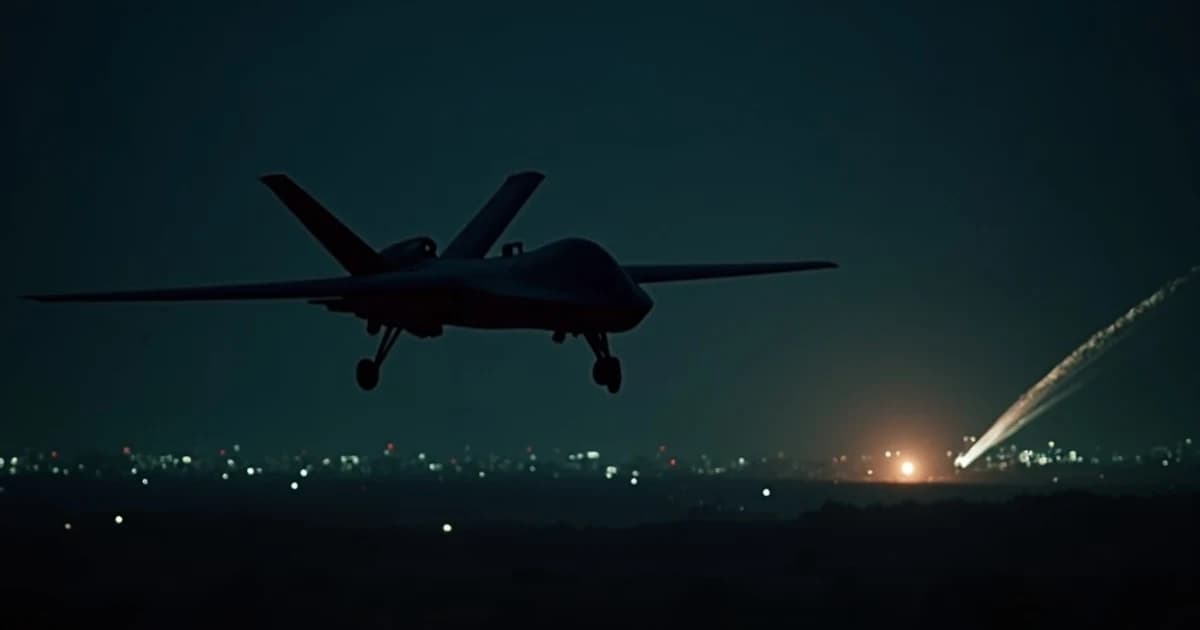
Russia's nightly drone campaign against Ukraine crossed a technological threshold in mid-2026. The barrages now mix jet-powered Shahed/Geran variants with the familiar propeller-driven types, and the shift is deliberate: as Ukrainian intelligence tells it, the cheap interceptor drones Kyiv threw at Russian Shaheds got good enough to force a redesign. The jet variant is operational, not experimental — Russia has launched roughly 1,400 jet-powered attack drones since January 2026, against just 180 in all of 2025, an eightfold jump. The Geran-4 reportedly reaches up to 500 km/h — well beyond the ~300 km/h of Ukraine's interceptor drones. The combined effect — faster penetrators and denser decoy screens — compresses defender reaction time and pushes the cost-exchange ratio against Ukraine. Washington has taken notice: after Ukraine's 427th Regiment filmed a US-made Merops interceptor running down a Shahed, the US Army is moving to field a scalable version.
The Scale: A Hundred-Drone Night Is Now Routine
Ukraine's General Staff tallies through mid-2026 report heterogeneous raids of one hundred or more one-way attack drones on a single night, mixing Shahed-type strike drones (including the jet-powered variants), Gerbera and Italmas types, and "Parodiya" decoy-imitators, launched from a wide arc inside Russia and occupied territory.
The headline intercept rates — often 85–90% — look reassuring until you invert them. On a 150-drone night, a 90% intercept rate still means roughly 15 warheads arriving. The decoy mix makes the math worse: every decoy that draws a missile or a gun engagement is a defender resource spent on a target worth a fraction of the interceptor. Saturation plus deception is the doctrine, and the nightly cadence suggests Russian production comfortably sustains it.
Why Jet Power Changes the Air-Defense Equation
The propeller-driven Shahed-136 cruises at roughly 180 km/h — slow enough that Ukraine built an entire economy-of-force defense around it: mobile fire groups with truck-mounted machine guns, searchlights, FPV interceptor drones, and acoustic sensor networks that cue crews minutes in advance.
Jet propulsion breaks that model. A turbojet-powered Shahed variant flying meaningfully faster does three things at once:
- Compresses the engagement window. A detection-to-impact timeline that gave a mobile fire group several minutes shrinks toward one that only radar-cued, faster-reacting systems can service.
- Outruns the cheap layer. Russia is fielding jet-engine drones faster than Ukraine's interceptor drones, selectively defeating the FPV-interceptor layer that made drone defense economically survivable.
- Forces the expensive layer. What the gun trucks and interceptor drones cannot catch, missile systems must — trading interceptors worth hundreds of thousands of dollars against airframes worth tens of thousands. That is the cost-exchange inversion in its purest form.
The nightly mixing of jet and propeller variants inside the same raid is itself tactically significant: defenders cannot optimize their layers against a single speed profile, and every track must be classified before the right shooter is assigned — under the time pressure the jet variants specifically create.
Beyond Speed: The Terminal-Guidance Question
Speed is only one axis of the upgrade. Ukrainian intelligence describes the Geran family as a deliberately iterating platform — engine, altitude, and guidance all in flux across the Geran-3/4/5 variants. Reporting on terminal-guidance seekers, if it proves out, would mark a second escalation distinct from raw speed: a satellite-navigation drone can be spoofed or jammed and can only hit fixed coordinates, whereas a drone with a terminal seeker could home on a specific target in its final phase, shrugging off the GPS-denial measures Ukraine has invested in heavily. That would convert a harassment weapon into a standoff anti-materiel system capable of hunting parked aircraft, radars, and high-value vehicles at a per-shot cost orders of magnitude below a cruise missile — a capability worth tracking closely as the variant data matures.
The Interceptor Arms Race: Merops and the Scramble for Cheap Kills
The defensive answer is emerging in kind. Ukraine's 427th Regiment "Rarog" posted night-vision video of US-made Merops interceptors running down a Shahed — a cheap, fast drone killing a cheap, fast drone. Merops, built by Perennial Autonomy, is a roughly three-foot fixed-wing interceptor that homes on its target with thermal or radio-frequency sensors when jammed, and has reportedly accounted for a large share of Shahed destruction in Ukraine. The US Army is now moving to field a scalable version — an explicit acknowledgment that Ukraine's problem is a preview of every Western air-defense portfolio's problem.
The logic is unavoidable. No arsenal of Patriot, IRIS-T, or NASAMS rounds survives a campaign of 100-plus drones per night, every night. The only sustainable counter to a mass-produced attacker is a mass-produced defender — interceptors cheap enough to expend at Shahed-like rates. But the jet-powered Shahed is precisely the countermove: if the speed advantage over Ukrainian interceptor drones holds, each defensive generation will be answered by a faster, lower-flying, or better-screened attacker within months. Ukraine is running that iteration loop live; Merops entering US Army programs shows Washington intends to learn from it rather than repeat it.
Bottom Line
The 2026 drone war is no longer about whether Russia can put 150 drones over Ukraine in a night — it demonstrably can. It is about speed, seekers, and the cost of each kill. Jet propulsion compresses the clock, and the decoy mix taxes every layer of defense. Until cheap, fast interceptors like Merops scale to match the threat's production rate, the exchange ratio favors the attacker — and every air force watching should assume this template is coming to their airspace next.
Sources
- Euronews — Russia steps up use of jet-powered drones beyond the reach of Ukrainian interceptors (July 2, 2026)
- Defence Blog — Ukraine faces 8x more jet-powered Russian drones than last year
- DroneXL — Russia's Geran-4 jet drone built to beat Ukraine's $2,000 interceptors, GUR says
- United24 Media — Ukraine's intelligence reveals Russia's jet-powered Geran-4 drone
- Defense News — Video shows a Ukrainian unit running down a Russian Shahed — the kill the US is racing to reproduce (July 1, 2026)
- Inside Unmanned Systems — Army deploys Ukraine-tested Merops interceptor at scale
Related Analysis
- Hezbollah Fires Anti-Ship Cruise Missile at Warship Off Lebanon [2026]
- US Crew Rescued After Jet Downed: Israeli Media Reports
- Iran Ground Assault: Kharg Island Target Analysis
- Russia Photographed the Saudi Base Three Times Before...
- Ghost Fleet Activated: The Pentagon's Drone Boat War
- Iran After Khamenei 2026: State Funeral, New Supreme Leader, US Deal
- DRC Bundibugyo Ebola 2026: 400+ Dead, No Vaccine, PHEIC Declared
- Iran Oil Waiver 2026: $8.5bn Loaded, No Buyers in China
Related Topics
Related Analysis

Strategic Impact of Turkey Leaving NATO in 2026
The Board · Feb 22, 2026

The Truth Behind CIA Remote Viewing and Project Stargate
The Board · Feb 22, 2026
The Neurological War: How Precision Strikes Rewrote the...
The Board · Mar 27, 2026

Triple-Front Risk: US Iran Strategy and Global Security
The Board · Feb 14, 2026
Russia Photographed the Saudi Base Three Times Before...
The Board · Mar 30, 2026
A Russian Drone Hit NATO Territory This Week
The Board · Mar 26, 2026
Trending on The Board

AI Prediction Accuracy Report — June 2026
Predictions · Jul 1, 2026

Iran Oil Waiver 2026: $8.5bn Loaded, No Buyers in China
Markets · Jul 3, 2026

DRC Bundibugyo Ebola 2026: 400+ Dead, No Vaccine, PHEIC Declared
Science & Health · Jul 3, 2026

Iran After Khamenei 2026: State Funeral, New Supreme Leader, US Deal
Geopolitics · Jul 3, 2026

Blackstone Sells $7.8bn Virginia Data Centers in 2026 — Top Signal?
Markets · Jul 3, 2026
Latest from The Board
2026 AI Chip Rally: The Bottleneck Nobody's Pricing
Markets · Jul 6, 2026

Myanmar 2026: China vs India for Ore and Ports
Geopolitics · Jul 6, 2026
Europe's 2026 Rearmament: Can the Factories Deliver?
Defense & Security · Jul 6, 2026

Oil 2026: Why $72 Brent Misreads the Hormuz Truce
Energy · Jul 6, 2026

Strategy's $64bn Bitcoin Bet: The Warning and What Saylor's Filings Show
Markets · Jul 3, 2026
Blackstone Sells $7.8bn Virginia Data Centers in 2026 — Top Signal?
Markets · Jul 3, 2026
Iran After Khamenei 2026: State Funeral, New Supreme Leader, US Deal
Geopolitics · Jul 3, 2026
DRC Bundibugyo Ebola 2026: 400+ Dead, No Vaccine, PHEIC Declared
Science & Health · Jul 3, 2026