
The strategic mandate for post-growth software is not expanding the customer base, but deepening the efficiency capture.
Key Findings
- The "Hiring Growth" Era is Over: With long-term unemployment becoming a status quo and hiring velocity stalling, HR software tied to "seat counts" faces a terminal value decay.
- Enterprise is a Procurement Trap: Moving upmarket to escape a $2M ARR stall exchanges 5% monthly growth for a 12-month sales cycle in a "sticky inflation" environment where risk mitigation dominates procurement.
- The "Negative Headcount" Pivot: Success in 2026 requires shifting from administrative management to Opex Reduction. SaaS pricing models must evolve from per-seat licenses to performance-based cuts of operational savings.
Current market metrics suggest a dangerous paradox: A B2B SaaS company reaching $2M Annual Recurring Revenue (ARR) with 5% month-over-month (MoM) growth is statistically healthy, yet clearly stalling relative to venture expectations. The standard playbook dictates two paths to reignite velocity: move upmarket to enterprise customers or expand the product horizontally to capture more wallet share. This analysis argues that both traditional paths are fatal errors in the current macroeconomic climate.
The stall at 5% MoM is not a product failure; it is a macro-induced value collapse. The thesis of this report is that in a high-rate, low-hiring environment, the "HR Department" has lost its status as an autonomous buyer. Consequently, SaaS vendors must execute a Vertical Value Pivot: abandoning "growth enablement" features in favor of "negative headcount" efficiency—selling directly to the CFO by proving the software allows the organization to operate with 20% fewer administrative staff.
The Macro-Causal Illusion: Why 5% is the New 0%
The board’s anxiety over a growth plateau stems from an identification error. Causal analysis suggests the stall is exogenous—driven by external market forces rather than internal product deficiencies. The 5% growth currently observed is likely "survivor growth," driven by expansion within existing accounts rather than new logo acquisition .
The underlying variable is the shift in the labor market. Recent data indicates that long-term unemployment is solidifying as a "status quo," signaling a systemic freeze in hiring velocity . If an HR platform’s Return on Investment (ROI) is calculated based on headcount growth or recruiting efficiency, the stall is inevitable. The software is being measured against a metric—hiring volume—that the macroeconomy has suppressed.
Furthermore, high interest rates remain persistent globally, from Romania to Australia, creating "sticky inflation" that locks down corporate budgets . In this environment, a product marketing itself as a "nice-to-have" engagement tool encounters a hard ceiling. The market does not need more hiring capacity; it needs "survival tools" regarding compliance, internal mobility, and efficiency.
The Enterprise Fallacy: The "Waiting Room" Trap
The temptation to move upmarket is driven by the allure of larger Average Contract Values (ACV). However, this move creates a "lag variable" that can kill cash flow. Enterprise procurement in 2026 has shifted from value-seeking to risk-mitigation.
Moving upmarket to escape a mid-market stall introduces a mathematical deterioration in network density. While the value of a node (customer) might increase, the acquisition velocity ($n$) plummets due to extended sales cycles.
- Cycle Extension: Transitioning to enterprise sales will likely extend the sales cycle from 3 months to 12+ months.
- Budget Authority: Enterprise HR budgets are under intense scrutiny. As defense/security analysts note, procurement is becoming a "supply chain risk" exercise .
A company at $2M ARR lacks the balance sheet to survive a year of "hunting elephants" while its mid-market core decays. Deepening the focus on enterprise clients now means trading 5% current growth for 0% growth over the next three quarters, with a high probability of dying in the "waiting room" of security audits.
The Horizontal "Kitchen Sink" Error
The alternative proposal—expanding horizontally by adding features (payroll, benefits, engagement)—suffers from the "Efficiency Trap." For mid-market HR teams, which are often lean and under-resourced, complexity is a churn driver, not a value add.
Adding features without deep integration creates "feature fatigue." If a payroll module does not seamlessly interact with the recruiting module to reduce manual data entry, the vendor has not built a platform; they have built a bundle of mediocre utilities. In a market where high interest rates force vendor consolidation, companies are shedding "all-in-one" tools that are masters of none.
The Strategic Pivot: The "Negative Headcount" Value Prop
The winning strategy is neither broad (horizontal) nor high (upmarket), but deep. The stall at $2M ARR indicates the product has not crossed the threshold of "must-have" utility. The solution is to re-engineer the "What" and the "How" of the offer.
1. From HR Management to Opex Reduction
The buyer persona must shift from the HR Manager to the CFO. The pitch must change from "Better HR workflows" to "Run your 2026 operations with 20% fewer HR staff."
- The Wedge: Focus on Internal Mobility and Compliance Automation. In a frozen hiring market, the only movement is internal. Tools that automate the redeployment of existing talent to new roles solve a critical "status quo" problem.
- The Evidence: Companies focusing on "Internal Mobility" or productivity auditing are projected to see 3x the Net Revenue Retention (NRR) of hiring platforms by late 2026.
2. The Decision Matrix: The HR Value-Stage Framework
To navigate this pivot, organizations should utilize the following decision framework to assess their feature roadmap against the new economic reality.
| Feature Category | Primary Buyer | Economic Driver | 2026 Strategy |
|---|---|---|---|
| Recruiting/Hiring | HR Manager | Headcount Growth | Deprioritize / Maintenance Mode |
| Employee Engagement | HR VP | Discretionary Budget | Abandon (First to be cut) |
| Internal Mobility | COO/Ops | Retention/Efficiency | Aggressive Invest |
| Compliance/Risk | General Counsel/CFO | Regulatory Liability | Niche Focus (Defense/Energy) |
| Auto-Administration | CFO | Opex Reduction | Core Value Prop (Negative Headcount) |
3. Performance-Based Pricing
SaaS pricing based on "seats" creates friction when customers are downsizing. The antidote is Performance-Based Pricing.
- The Model: "We do not charge a seat fee. We take 20% of the overhead we save you through automated internal mobility."
- The Impact: This aligns the vendor's success with the client's austerity measures, bypassing the budget freeze. A "Grand Slam Offer" that guarantees ROI or waives fees can break the inertia of "sticky inflation" procurement .
Counterargument: The "Guillotine" and Integration Risks
The Risk of Sabotage: The strongest argument against the "Negative Headcount" strategy is the "Guillotine Problem." By pitching efficiency that reduces administrative staff, the vendor risks alienating the very users who must implement the software—the HR department. If the HR Manager perceives the tool as a threat to their job security, they will sandbag the implementation.
- Rebuttal: This reality necessitates a "Headless" distribution strategy. The B2B SaaS winner in this cycle will not be a standalone dashboard that HR logs into, but a background data layer that integrates directly with the systems the CFO and COO control (e.g., Salesforce, ERPs). The goal is to become the "connective tissue" that feeds the executive AI interface, bypassing the need for low-level HR buy-in .
The Platform Monopoly: Critics may argue that giant incumbents (Workday, SAP) already own the "efficiency" narrative.
- Rebuttal: Incumbents are slow to adapt to specific vertical nuances. A nimble $2M ARR player can win by targeting specific, high-regulation verticals (Defense, Energy) where generic platforms fail to capture complex compliance logic.
What to Watch
The transition from "Growth SaaS" to "Efficiency SaaS" will produce specific market signals over the next 18 months.
- Watch the "Internal Mobility" Metric: By Q4 2026, expect the ratio of internal hires to external hires in mid-market companies to double. SaaS platforms that cannot visualize or facilitate this internal flow will see churn rates exceed 15%. (Confidence: High)
- Watch Pricing Model Adoption: By Q2 2027, strictly seat-based pricing for administrative tools will be viewed as a "legacy" model. We predict that 20% of Series B+ SaaS startups will adopt some form of outcome-based or consumption-based pricing to survive the "efficiency" demands of CFOs. (Confidence: Medium)
- What to Ignore: Do not be distracted by "Horizontal AI" features (e.g., generic chatbots). Unless an AI feature specifically reduces the Full-Time Equivalent (FTE) load required to run a process, it is merely COGS inflation disguised as innovation.
Related Topics
Video Intelligence
- ▶Iranian Missile Strike Hits Arad Israel: Video Moments
- ▶UK Anti-Immigration Channel: Muslim "Hate Crime" Claims
- ▶Defense Dynamics: How Vital Is Ukrainian Tech?
- ▶Israel-Iran Tensions: The Role of Evangelical Outreach
Share This Analysis
Get a shareable verdict card for this article.
Related Analysis

2026 Economic Crisis: Why Central Banks May Fail
The Board · Feb 22, 2026

Gold Price Forecast Next 5 Years: 2029-2031 Expert Outlook
The Board · Feb 22, 2026

Copper Price Forecast 2029-2031: Supply vs Green Demand
The Board · Feb 22, 2026

Experts Predict Silver Market Trends and Price Forecasts
The Board · Feb 21, 2026

Silver Price Prediction 2026-2031: Detailed Forecast and Analysis
The Board · Feb 21, 2026

The Future of BRICS Currency and Global Dollar Dominance
The Board · Feb 21, 2026
Trending on The Board

Gold Price Path After the Rally: 2026 Update
Markets · Jul 12, 2026

Gladio Stay-Behind Hybrid War 2026: What Still Applies
Defense & Security · Jul 12, 2026

Israel-Turkey War Game Analysis: NATO, Escalation Paths, 2026
Defense & Security · Jul 11, 2026

Gematria Sports Dates Selection Bias Explained 2026
Policy & Intelligence · Jul 12, 2026

AI Speaks One Language—That's the Real Risk
Technology · Jul 14, 2026
Latest from The Board
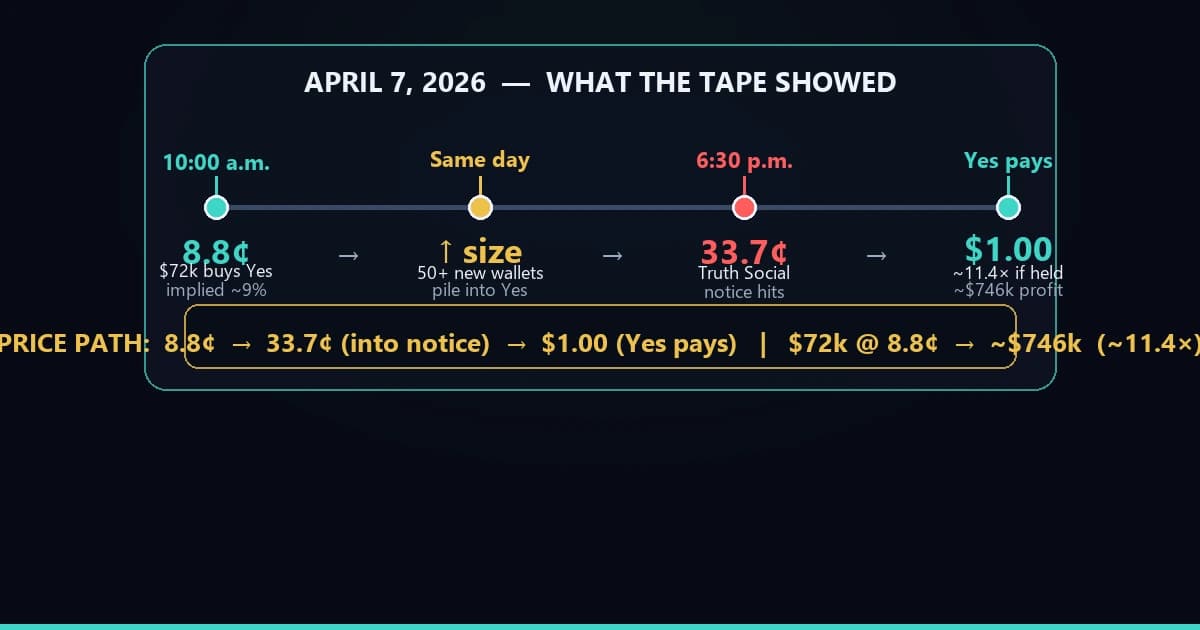
Polymarket 8.8-Cent Wallets Beat Official Notices 2026
Predictions · Aug 3, 2026

AI Prediction Accuracy Report — July 2026
Predictions · Aug 1, 2026
AI Speaks One Language—That's the Real Risk
Technology · Jul 14, 2026
Gematria Sports Dates Selection Bias Explained 2026
Policy & Intelligence · Jul 12, 2026
Gladio Stay-Behind Hybrid War 2026: What Still Applies
Defense & Security · Jul 12, 2026
Gold Price Path After the Rally: 2026 Update
Markets · Jul 12, 2026

Kelly Utilization Meaning (Definition) for Prediction Markets
Markets · Jul 11, 2026
Israel-Turkey War Game Analysis: NATO, Escalation Paths, 2026
Defense & Security · Jul 11, 2026