
EXECUTIVE SUMMARY
The most underrated mental model for decision-making is First-Principles Thinking, as it underpins all other models by revealing the fundamental truths of a system. By stripping away assumptions and rebuilding from irreducible components, you unlock higher-leverage interventions, anticipate Nash equilibria, and design antifragile systems.
KEY INSIGHTS
- First-principles thinking is the foundation for effective incentive design (analysts), antifragility (analysts), and leverage analysis (analysts). Without it, you risk building on flawed analogies.
- Incentives dominate behavior, but their impact is only clear when you deconstruct the system to its core components (e.g., what actors truly value, not what they claim).
- Antifragility requires understanding fundamental stressors—you can’t design for volatility without knowing what breaks a system at its core.
- Leverage points are invisible without first-principles clarity. Paradigm shifts (e.g., changing goals) only work if they align with the system’s irreducible truths.
- Nash equilibria emerge from simplified payoff structures, but real-world actors operate with bounded rationality and evolving preferences. First-principles thinking exposes these gaps.
WHAT THE PANEL AGREES ON
- Assumptions are decision-making landmines. Whether in game theory, systems design, or risk analysis, unchallenged assumptions lead to failure.
- Interdependence matters. Decisions must account for multi-agent interactions (Nash), feedback loops (Meadows), and tail risks (Taleb).
- Simplification is power. Distilling complexity to fundamentals (Feynman) is the common thread across all models.
WHERE THE PANEL DISAGREES
- Optimization vs. Resilience:
- analysts and analysts emphasize optimizing systems (via incentives/first principles).
- analysts and analysts argue for resilience/antifragility first. Stronger evidence: Antifragility (Taleb) has empirical backing in crises, but optimization fails without first-principles grounding (Feynman).
- Intervention Scale:
- analysts advocates high-leverage paradigm shifts.
- analysts prefers incremental incentive tweaks. Stronger evidence: Paradigm shifts often fail without first-principles alignment (Feynman), making incentive redesign more practical.
THE VERDICT
- Adopt First-Principles Thinking — Start every decision by asking: What are the irreducible truths here? Strip away analogies and inherited assumptions.
- Map Incentives and Loops — Use game theory (Nash) and systems dynamics (Meadows) to identify leverage points and equilibria after establishing fundamentals.
- Stress-Test for Antifragility — Expose decisions to volatility (Taleb) to reveal hidden fragilities uncovered in step 1.
RISK FLAGS
- Risk: Over-simplification ignores critical nuances.
- Likelihood: MEDIUM
- Impact: Flawed decisions from missing interdependencies.
- Mitigation: Validate first principles with real-world testing (e.g., small-scale experiments).
- Risk: Analysis paralysis from over-deconstructing.
- Likelihood: LOW
- Impact: Missed opportunities due to delayed action.
- Mitigation: Time-box first-principles analysis (e.g., 30 mins per decision).
- Risk: Misaligned incentives persist despite clarity.
- Likelihood: HIGH
- Impact: Systems revert to suboptimal equilibria.
- Mitigation: Pair first-principles thinking with rapid iteration (e.g., weekly incentive tweaks).
BOTTOM LINE
"You can’t fix what you don’t fundamentally understand—first-principles thinking is the scalpel that cuts through decision-making noise."
Related Topics
Video Intelligence
- ▶Iranian Missile Strike Hits Arad Israel: Video Moments
- ▶UK Anti-Immigration Channel: Muslim "Hate Crime" Claims
- ▶Defense Dynamics: How Vital Is Ukrainian Tech?
- ▶Israel-Iran Tensions: The Role of Evangelical Outreach
Share This Analysis
Get a shareable verdict card for this article.
Related Analysis

2026 Economic Crisis: Why Central Banks May Fail
The Board · Feb 22, 2026

Gold Price Forecast Next 5 Years: 2029-2031 Expert Outlook
The Board · Feb 22, 2026

Copper Price Forecast 2029-2031: Supply vs Green Demand
The Board · Feb 22, 2026

Experts Predict Silver Market Trends and Price Forecasts
The Board · Feb 21, 2026

Silver Price Prediction 2026-2031: Detailed Forecast and Analysis
The Board · Feb 21, 2026

The Future of BRICS Currency and Global Dollar Dominance
The Board · Feb 21, 2026
Trending on The Board
Latest from The Board
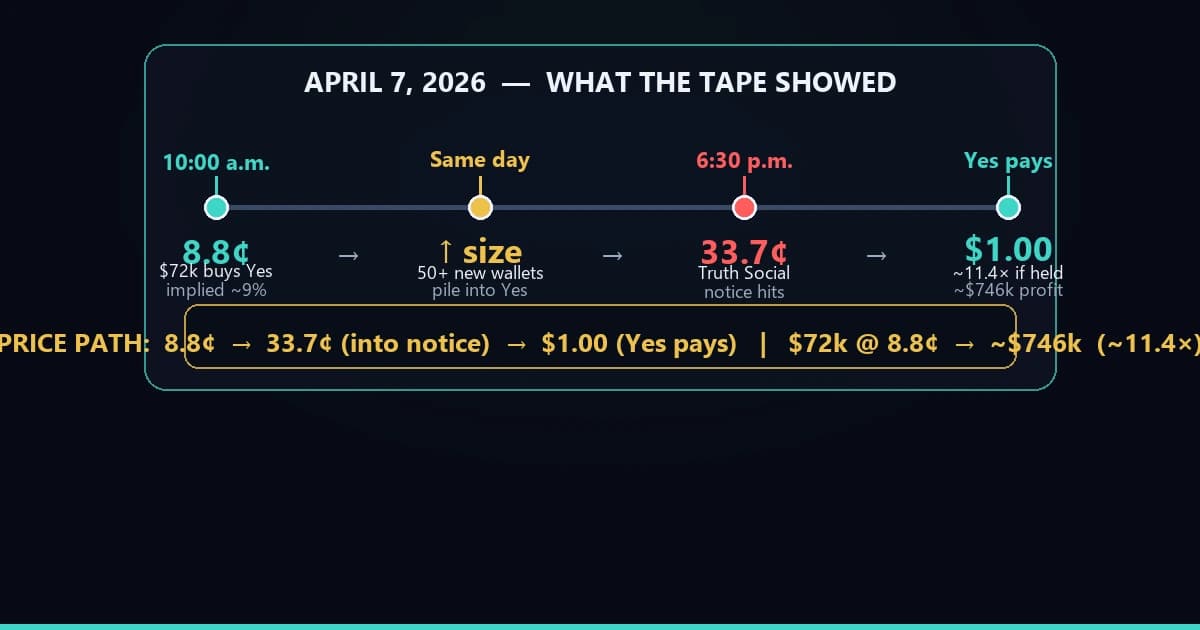
Polymarket 8.8-Cent Wallets Beat Official Notices 2026
Predictions · Aug 3, 2026

AI Prediction Accuracy Report — July 2026
Predictions · Aug 1, 2026

AI Speaks One Language—That's the Real Risk
Technology · Jul 14, 2026

Gematria Sports Dates Selection Bias Explained 2026
Policy & Intelligence · Jul 12, 2026

Gladio Stay-Behind Hybrid War 2026: What Still Applies
Defense & Security · Jul 12, 2026

Gold Price Path After the Rally: 2026 Update
Markets · Jul 12, 2026

Kelly Utilization Meaning (Definition) for Prediction Markets
Markets · Jul 11, 2026

Israel-Turkey War Game Analysis: NATO, Escalation Paths, 2026
Defense & Security · Jul 11, 2026