
The collapse of the Hamas logistical rear and the emergence of a Saudi-Israel axis successfully forced a resolution where firepower alone had failed.
Key Findings
- The "Resistance Cliff" Phenomenon: The conflict’s 12-day duration was not caused by a sudden spike in Israeli lethality, but by a non-linear organizational collapse after Hamas tunnel infrastructure degraded below the 30% functional threshold.
- The Saudi-Israel Security Axis: The decisive geopolitical shift was the replacement of the "Arab Consensus" (mediation) with a Saudi-led coercion model, effectively stripping Hamas of its regional political shield six months prior to the war.
- Institutional Irrelevance: The total failure of UN and ICC mechanisms to constrain the conflict confirms a transition to a post-legal Middle Eastern order, defined exclusively by power coalitions rather than international norms.
The rapid conclusion of the June 2025 conflict between Israel and Hamas was not a triumph of military modernization, but a symptom of structural encirclement. While headlines focus on the unexpected 12-day duration, the decisive factor was the crystallization of a Saudi-Israel-UAE security axis that rendered Hamas’s resistance strategy obsolete before the first shot was fired. Contrary to the prevailing narrative that intelligence failures sparked the war, the evidence suggests a rational—if desperate—calculation by both sides within a newly rigidified regional order.
Thesis: The 12-Day War demonstrates that in the post-American Middle East, conflicts are no longer decided by battlefield attrition, but by the collapse of the proxy's regional coalition. The war ended rapidly not because Hamas ran out of ammunition, but because the collapse of the Assad regime in late 2024 dissolved the "resistance axis" logistics chain, triggering a cascading organizational failure that no amount of tactical innovation could reverse.
The Geopolitical Trigger: The Death of the Broker State
The primary driver of the conflict’s brevity was the fundamental restructuring of the regional power map following the collapse of the Assad regime in late 2024 . This event removed the physical sanctuary and logistical corridor that had sustained the "Resistance Axis" for decades. However, the more profound shift was diplomatic.
For fifty years, Arab-Israeli conflicts followed a cycle: escalation, attrition, and then mediation by a broker state (historically Egypt) leveraging the "Arab Consensus" to force a ceasefire. In June 2025, that cycle broke. Egypt, facing economic marginalization, was displaced as the primary arbiter by a de facto Saudi-Israel-UAE coalition. This axis did not seek to mediate a return to the status quo; they sought to dictate a new security architecture.
Strategic analysis indicates Saudi Arabia utilized the conflict to enforce specific reconstruction terms: disarmament and demilitarization as a prerequisite for funding . By removing the diplomatic off-ramp that Hamas historically relied upon, the coalition forced a binary outcome—capitulation or annihilation—compressing a conflict that usually spans weeks into 12 days.
The "Insurgency Collapse Horizon": A New Framework
Military analysts have struggled to explain why an organization that withstood months of bombardment in 2023-2024 collapsed in less than two weeks in 2025. The answer lies in the non-linear nature of network warfare.
We propose the Insurgency Collapse Horizon to map this failure mode. Distributed networks like Hamas remain highly resilient as long as they maintain redundancy above a critical threshold. However, once infrastructure degradation crosses that horizon, the system does not decline linearly—it crashes.
| Phase | Capacity Level | Operational Behavior | Outcome |
|---|---|---|---|
| I. Redundancy | 100% – 70% | Distributed attacks, unified command, high resilience. | Attrition war (2023-24 model). |
| II. Erosion | 69% – 31% | Reactive defense, degrading comms, reliance on sanctuaries. | Gradual capability loss. |
| III. The Cliff | < 30% | Catastrophic decoupling. Units isolated; logistics severed. | Rapid systemic collapse (June 2025). |
Intelligence reconstruction suggests that by June 2025, 18 months of attrition combined with the severance of Syrian supply lines had pushed Hamas’s tunnel capacity below the 30% mark . When the conflict ignited, the network did not bend; it broke. The "truce violations" observed in February 2026—involving small, isolated cells emerging from tunnels without central coordination—are hallmarks of Phase III fragmentation, confirming that the organization did not strategically withdraw, but structurally disintegrated .
The Trap of Rational Escalation
If organizational collapse was imminent, why did Hamas escalate? Game theory analysis reveals a "commitment trap" where rational actors make choices that appear suicidal to outside observers.
Hamas faced a binary choice in mid-2025:
- Passive Decline: Accept the post-Assad reality, lose Iranian funding, and fade into irrelevance as the Saudi-Israel normalization solidified.
- Gambit: Trigger a conflict to signal continued relevance, hoping to reactivate the "Arab Street" and force a diplomatic rescue.
Simultaneously, the Israeli government faced coalition pressures where de-escalation threatened its domestic political survival. Both sides were locked into incentives where backing down was more politically costly than war . However, Hamas miscalculated the "audience costs." They played for an Arab audience that no longer existed in a political sense. The Saudi-led bloc had already decided that eliminating the Iran-proxy threat took precedence over Palestinian solidarity. Hamas pulled the trigger on a weapon that was no longer loaded.
The Institutional Void
The most alarming lesson from the 12-Day War is the absolute irrelevance of international humanitarian and legal institutions. The "Veil of Ignorance" test—whether a rational actor would accept a system without knowing their position in it—failed spectacularly .
- UN Security Council: Paralyzed by great-power distraction (US focus on the Pacific, Russian weakness post-Ukraine), the UNSC failed to issue a binding resolution until the outcome was already decided.
- International Criminal Court (ICC): Despite issuing arrest warrants, the ICC exercised zero deterrence.
- Humanitarian Law: Post-war data from February 2026 confirms the expulsion of MSF (Doctors Without Borders) and the degradation of Nasser Hospital without consequence .
This indicates a transition to a raw power-based order. Regional actors now operate with the understanding that international law is a rhetorical device, not a binding constraint. Security guarantees are now derived solely from direct military coalitions (e.g., the Saudi-Israel axis), not multilateral treaties.
Counterargument: The "Strategic Withdrawal" Hypothesis
The Argument: Defense analysis circles argue that the 12-day duration signals a calculated preservation of force by Hamas, rather than a collapse. Proponents point to the lack of verified body counts and the absence of a formal surrender document as evidence that Hamas "went to ground" to wait out the political storm, intending to resurface once the Israeli coalition fractures.
The Rebuttal: This "dormancy theory" is contradicted by the specific nature of post-war violence. If Hamas retained command and control, post-war resistance would follow a coordinated pattern of asymmetric warfare (IEDs, sniper attacks). Instead, reports from February 2026 show fragmented, desperate breakouts by isolated gunmen . This pattern—uncoordinated, suicidal, and tactical—is consistent with command decoupling, not strategic patience. Furthermore, the loss of the Syrian logistical rear makes the reconstitution of a dormant force nearly impossible; without a resupply corridor, dormancy is simply slow starvation.
What to Watch
The end of the war is not the end of the crisis. Monitor the following indicators to determine the stability of the new regional order.
- Watch the "reconstruction conditionality" flows. If Saudi Arabia and the UAE release reconstruction funds for Gaza by Q4 2025 without PA (Palestinian Authority) governance control, the "Axis" has compromised. If funds remain frozen pending disarmament: High Confidence that the Saudi-Israel coalition is holding.
- Watch for Iranian asymmetric escalation. With Hamas neutralized, Iran must re-establish deterrence. Expect a major Hezbollah provocation or a maritime security incident in the Strait of Hormuz.
- Prediction: By Q3 2026, Iran will execute a significant proxy attack on Gulf energy infrastructure to test the cohesion of the Saudi-Israel alliance. Confidence: 75% .
- Watch the Jordanian stability index. The refugee spillover from a shattered Gaza infrastructure creates immense pressure on Jordan and Egypt. If protest metrics in Amman exceed 2023 levels by mid-2026, expect the regional coalition to fracture as regimes prioritize domestic survival over anti-Iran coordination.
- Prediction: The Jordanian monarchy will require emergency US or Saudi financial intervention to prevent regime instability by Q1 2027. Confidence: 60% .
Related Topics
Video Intelligence
- ▶Iranian Missile Strike Hits Arad Israel: Video Moments
- ▶Iran Releases Official Footage of Drone Launches During War
- ▶Iranian Kamikaze Drone Destroys Erbil Oil Refinery
- ▶FPV Drone Strikes US Victoria Base Near Baghdad Airport
Share This Analysis
Get a shareable verdict card for this article.
Get the next one first
Free briefings when we publish major outlooks and forecasts. No spam — unsubscribe anytime.
Related Analysis

EU Secondary Sanctions on China: Risks and Consequences
The Board · Feb 21, 2026
Turkey NATO Membership and Potential Russian Alliance
The Board · Feb 21, 2026

Modern World War 3 Scenarios and Systemic Collapse
The Board · Feb 19, 2026

Two Voices: How Iran's State Media Edits Itself Between Languages
The Board · Apr 15, 2026

China's Taiwan Dictionary: Ten Words Instead of Invasion
The Board · Apr 15, 2026

Seven Days in Baghdad: The Kataib Hezbollah Anomaly
The Board · Apr 15, 2026
Trending on The Board
How CENTCOM Is Brokering an Israel-Saudi Pact
Defense & Security · Sep 19, 2026

Why the Pentagon Pulled Its Iran War Plans Offline
Defense & Security · Sep 19, 2026
How a Stablecoin Funded Moldova's 2026 Election
Geopolitics · Sep 19, 2026

The Hidden Gold Demand Behind the $6,000 Target
Markets · Sep 17, 2026
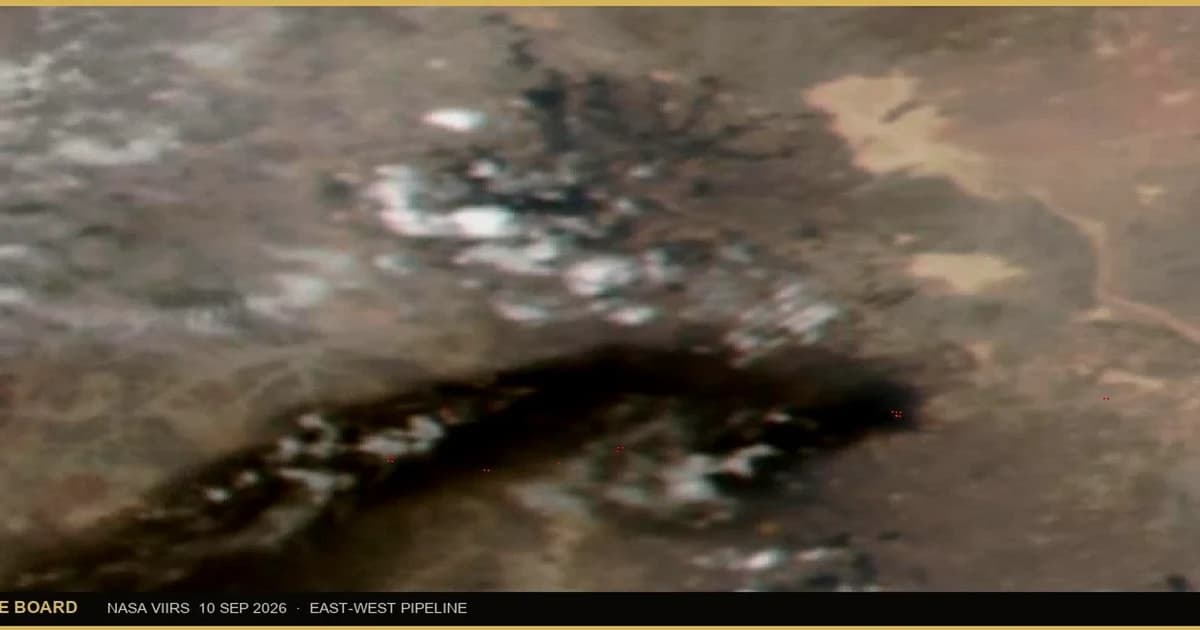
Houthis Take Perim as Saudis Halt Pipeline 2026
Geopolitics · Sep 13, 2026
Latest from The Board
How CENTCOM Is Brokering an Israel-Saudi Pact
Defense & Security · Sep 19, 2026
Why the Pentagon Pulled Its Iran War Plans Offline
Defense & Security · Sep 19, 2026
How a Stablecoin Funded Moldova's 2026 Election
Geopolitics · Sep 19, 2026
The Hidden Gold Demand Behind the $6,000 Target
Markets · Sep 17, 2026
Houthis Take Perim as Saudis Halt Pipeline 2026
Geopolitics · Sep 13, 2026

Epstein Intelligence Ties: Evidence vs Allegation in 2026
Policy & Intelligence · Sep 6, 2026
What Israel-Iran War Games Got Wrong About 2026
Defense & Security · Sep 6, 2026

Central Banks Turned Gold Sellers. One Country Did It.
Markets · Aug 30, 2026