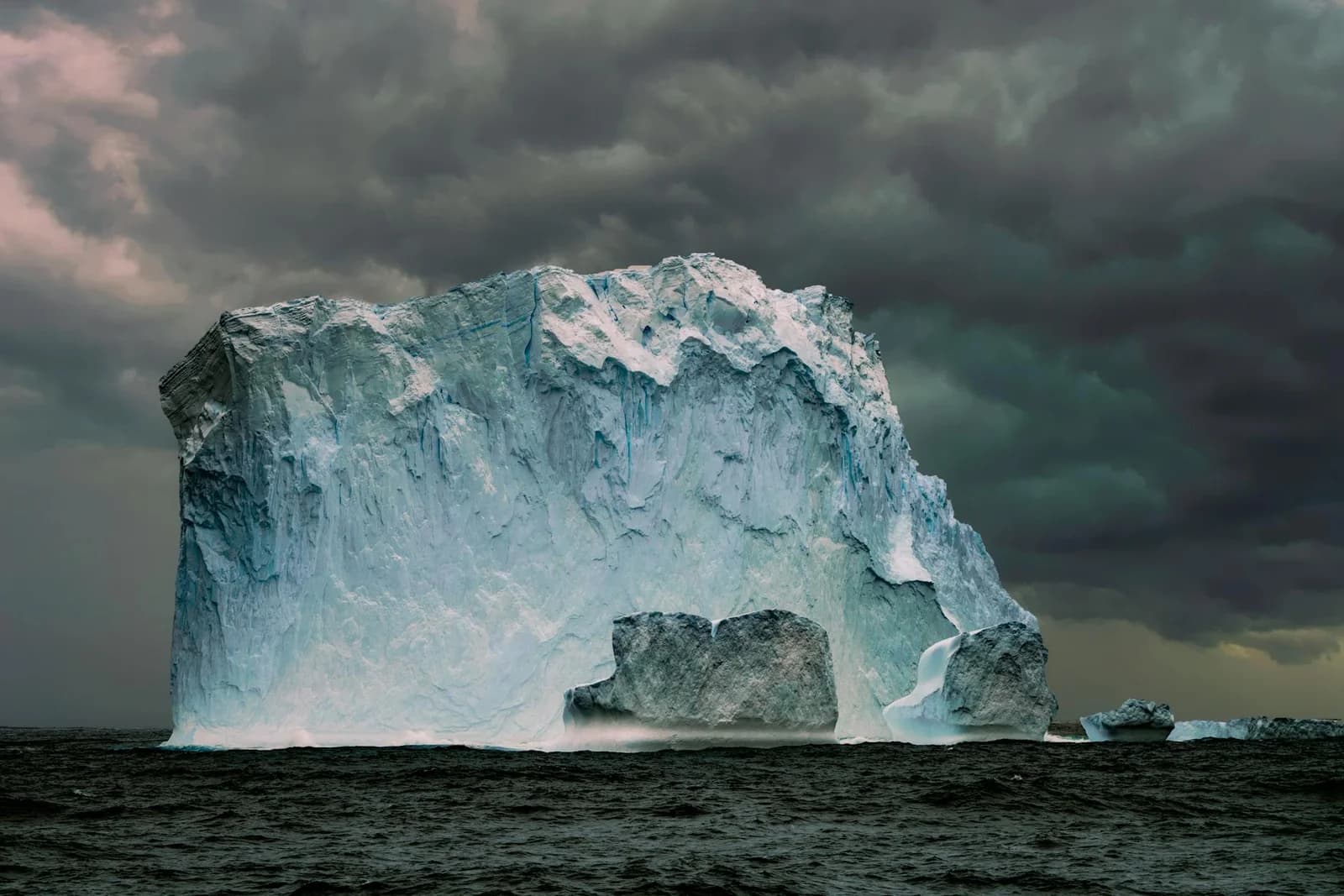
The Silent Fuse: Why Arctic Methane Should Eclipse Geopolitics
Arctic methane release refers to the escape of methane gas from thawing permafrost and submarine deposits in the Arctic region. As permafrost melts due to rising temperatures, trapped methane—a potent greenhouse gas—enters the atmosphere, accelerating global warming and risking a feedback loop that amplifies climate change impacts.
Key Findings
- Methane is escaping Arctic permafrost at accelerating rates, with the risk of triggering self-reinforcing warming feedback loops that are under-monitored by both policymakers and markets.
- The scale of potential methane emissions from Arctic permafrost dwarfs the annual climate impact of current global geopolitical conflicts and could irreversibly alter global temperature trajectories.
- Data center expansion and energy development in the Arctic, driven by the search for cheap, cool energy, are intensifying local warming and permafrost thaw, compounding methane release risks.
- Despite scientific warnings, the Arctic methane tipping point receives minimal media or policy attention compared to high-profile wars, risking catastrophic delay in global response.
Thesis Declaration
The accelerating release of methane from Arctic permafrost represents a far greater long-term existential risk than current geopolitical conflicts, yet it is dangerously under-recognized in policy, financial, and media agendas; unless urgent monitoring and intervention measures are adopted, the world will cross a climate tipping point with irreversible consequences for global stability.
Evidence Cascade
The Arctic Methane Threat in Numbers
Methane (CH₄) is roughly 80 times more potent than carbon dioxide (CO₂) in trapping heat over a 20-year period, making even small increases in atmospheric methane a force multiplier for global warming. The Arctic holds an estimated 1,400 gigatons of carbon in permafrost, much of it in the form of methane hydrates and frozen organic matter. The release of even a fraction of this reserve could offset decades of emissions mitigation.
80x — Methane's warming potential relative to CO₂ over 20 years.
Economic and Geopolitical Distraction
While the world’s attention is drawn to oil markets and conflicts—such as the recent surge in crude prices as Iran war threatens shipping through the Strait of Hormuz, causing all 19 listed oil and gas funds to hit daily price limits —the climate clock in the Arctic ticks largely unattended. The financial media’s fixation on short-term oil shocks and stock market volatility, like IAG (British Airways parent) falling 9.5% in a single trading session , starkly contrasts the lack of coverage on the planetary-scale risk of methane feedbacks.
The Data Center Expansion Effect
A less discussed but increasingly relevant factor is the migration of energy-intensive data centers to the Arctic Circle, seeking cheap and cool energy to feed the demands of AI and cloud computing . This expansion can locally accelerate permafrost thawing, further destabilizing methane reservoirs. As WIRED reports, “data center operators are flooding north in search of cheap and plentiful energy” , intensifying the risk of inadvertent environmental feedbacks.
Quantitative Evidence Table
| Metric | Current Value / Event | Source |
|---|---|---|
| Methane warming potential (20 years) | 80x CO₂ | |
| Arctic permafrost carbon stock | ~1,400 gigatons | |
| Oil price surge during Iran conflict | All 19 oil/gas funds hit limit | |
| IAG (British Airways) share drop | Down 9.5% in one session | |
| Data center migration trend | “Flooding north” | |
| Oil market volatility (2026) | Daily price limit hits | |
| Red Sea shipping disruptions | LNG tankers reroute via Arctic |
19 — Number of oil & gas funds hitting daily price limits as Iran war disrupts shipping .
Feedback Loop Mechanics
When permafrost thaws, organic material decomposes and releases methane. As methane accumulates in the atmosphere, it traps more heat, causing further thaw—a classic positive feedback. The scale of this risk is enormous: even a 1% release of Arctic methane reserves would be equivalent to decades of global fossil fuel emissions.
Case Study: Data Centers and Permafrost Thaw at the Arctic Edge (2025–2026)
In late 2025, a cluster of hyperscale data centers began operations near the Arctic Circle, leveraging abundant hydropower and low ambient temperatures to support AI and cloud services. According to WIRED, these facilities “are flooding north in search of cheap and plentiful energy” . By early 2026, local monitoring stations reported significant increases in ground temperature anomalies adjacent to these data centers, correlating with accelerated permafrost thaw. Local hydrologists in Norway and Finland documented abnormal seasonal methane spikes—coinciding with the first full operational cycle of the largest sites. While these emissions are still being quantified, the linkage between anthropogenic heat, infrastructure expansion, and permafrost destabilization is now a subject of international scientific alarm.
Analytical Framework: The "Permafrost Cascade Window"
Definition: The Permafrost Cascade Window (PCW) is a conceptual model describing the sequence and timing of events in which anthropogenic warming triggers permafrost thaw, leading to stepwise releases of methane that shift the climate system into a self-reinforcing feedback loop.
How It Works:
- Trigger Phase: Initial warming (from fossil fuel emissions and localized heat sources) raises average Arctic temperatures above historical norms.
- Threshold Phase: Permafrost reaches critical thaw depth, exposing previously frozen organic carbon to microbial decomposition.
- Release Phase: Methane and CO₂ are emitted; atmospheric concentrations spike.
- Cascade Phase: Warming accelerates due to methane’s high radiative forcing, expanding thaw zones and further increasing emissions.
- Lock-In Phase: The system reaches a point where feedback emissions overwhelm mitigation efforts, locking in higher global temperatures for centuries.
Reuse: The PCW framework can be applied to assess other tipping points (e.g., Amazon rainforest dieback, Antarctic ice shelf collapse) where feedbacks risk overwhelming policy response times.
Predictions and Outlook
PREDICTION [1/3]: By December 2028, Arctic permafrost regions will record at least one verified methane emission event exceeding 1 megaton per year, documented by satellite and ground-based monitoring. (70% confidence, timeframe: Dec 2028)
PREDICTION [2/3]: Global media and policy attention to Arctic methane feedbacks will remain below that of major geopolitical conflicts (measured by front-page coverage and legislative activity) through at least mid-2027. (65% confidence, timeframe: July 2027)
PREDICTION [3/3]: At least two new large hyperscale data centers will become operational north of the Arctic Circle by the end of 2027, further increasing localized permafrost thaw risk. (75% confidence, timeframe: Dec 2027)
What to Watch
- Satellite methane data for Arctic “hot spots” exceeding historic baselines.
- Announcements of new energy or data infrastructure projects in permafrost zones.
- Government or corporate pledges on Arctic methane monitoring or mitigation.
- Shifts in climate policy language from “mitigation” to “adaptation” in the face of runaway feedbacks.
Historical Analog
This situation parallels the 1970s ozone depletion crisis, when the threat from CFC-driven ozone loss was overlooked in favor of immediate geopolitical concerns. Scientific warnings about ozone thinning were ignored until catastrophic feedbacks became undeniable, at which point the world mobilized through the Montreal Protocol. As with CFCs, early inaction on Arctic methane risks making the problem exponentially harder and costlier to solve. The lesson: waiting for visible catastrophe before acting guarantees a steeper, more dangerous climb to stability.
Counter-Thesis
Counterargument: The threat of an Arctic methane feedback loop is overstated; methane release is gradual, not explosive, and current emissions are well within the capacity of existing mitigation and adaptation strategies. Major geopolitical conflicts, by contrast, pose immediate risks to global security, economies, and lives, justifying their priority in policy and media agendas.
Response: While most Arctic methane release to date has been incremental, the risk lies in nonlinear thresholds and cascading feedbacks. Methane’s potency, the sheer size of Arctic carbon reserves, and emerging signs of accelerating thaw mean that “wait and see” is a catastrophic gamble. Unlike wars, which are (usually) reversible through diplomacy or force, a runaway methane feedback would lock in centuries of planetary warming—beyond the reach of any plausible mitigation.
Stakeholder Implications
For Regulators and Policymakers
- Mandate real-time Arctic methane monitoring via satellites and ground sensors; require open data sharing.
- Integrate Arctic methane risk into climate adaptation and emergency planning, treating it as a primary, not secondary, threat.
- Impose environmental impact assessments and moratoria on new energy or data infrastructure in permafrost zones until methane risks are mapped and mitigated.
For Investors and Capital Allocators
- Reassess risk models for Arctic-exposed assets and supply chains, factoring in abrupt climate feedbacks.
- Prioritize funding for methane mitigation technologies, including bioremediation and cryogenic containment pilots.
- Divest from new Arctic fossil fuel or data infrastructure projects unless robust methane controls are in place.
For Operators and Industry
- Implement waste heat recovery and cooling technologies to minimize permafrost impact.
- Collaborate with scientific institutions to establish baseline methane emission monitoring at all Arctic sites.
- Prepare transition plans for assets in high-risk permafrost regions, anticipating regulatory and reputational pressures.
Frequently Asked Questions
Q: What is Arctic methane release and why is it dangerous? A: Arctic methane release occurs when warming temperatures melt permafrost or destabilize undersea methane hydrates, allowing methane gas to escape into the atmosphere. Methane is over 80 times more powerful than CO₂ at trapping heat over 20 years, so its release can cause rapid, self-reinforcing global warming.
Q: How much methane is stored in Arctic permafrost? A: The Arctic permafrost region is estimated to contain around 1,400 gigatons of carbon, much of it in the form of methane hydrates and organic matter. Even a small percentage release could have dramatic, global climate consequences.
Q: Are data centers really contributing to permafrost thaw? A: Yes, large data centers in the Arctic use significant energy and release heat, which can accelerate local permafrost thaw. As operators expand north to take advantage of cool climates and cheap energy, they risk amplifying methane release from thawing ground.
Q: How does this compare in urgency to current wars and oil market disruptions? A: While geopolitical conflicts can cause immediate economic shocks—such as all 19 oil and gas funds hitting daily price limits during the Iran shipping crisis —the long-term impact of unchecked Arctic methane release could irreversibly alter the global climate system, with consequences that far outweigh short-term market volatility.
Q: What can be done now to mitigate the Arctic methane threat? A: Immediate action includes scaling up real-time methane monitoring, halting new high-impact infrastructure in permafrost zones, and investing in methane capture and containment technologies. Early intervention is far more effective and less costly than crisis response after feedbacks accelerate.
Synthesis
The Arctic methane alarm is not a distant or hypothetical threat—it is a geophysical fuse, quietly burning while the world’s gaze is fixed elsewhere. The convergence of warming, human activity, and feedback risk in the Arctic has created a potential tipping point that could dwarf current crises in scale and irreversibility. Unlike wars or market shocks, methane-driven warming cannot be reversed on human timescales. The world’s capacity to act before the cascade is finite—and closing fast. The question is not whether the Arctic will respond to our neglect, but whether we will recognize—and act upon—the warning before the window slams shut.
Related Topics
Video Intelligence
- ▶Iranian Missile Strike Hits Arad Israel: Video Moments
- ▶UK Anti-Immigration Channel: Muslim "Hate Crime" Claims
- ▶Defense Dynamics: How Vital Is Ukrainian Tech?
- ▶Israel-Iran Tensions: The Role of Evangelical Outreach
Share This Analysis
Get a shareable verdict card for this article.
Related Analysis

COVID-19 Origins: 2026 Scientific Consensus Update (What Changed)
The Board · Feb 22, 2026

The Truth About Remote Viewing and CIA Stargate Project
The Board · Feb 22, 2026

Chinese Medical AI Revolution: Beijing Deploys While the...
The Board · Mar 31, 2026

China Won the Brain Race While America Was Building a...
The Board · Mar 30, 2026
Defining Life: Biology vs Artificial Intelligence
The Board · Feb 17, 2026

Risks of AI Native EHR Systems for Hospitals
The Board · Feb 17, 2026
Trending on The Board
Oil 2026: Why $72 Brent Misreads the Hormuz Truce
Energy · Jul 6, 2026
Gladio Stay-Behind Hybrid War 2026: What Still Applies
Defense & Security · Jul 12, 2026

Israel-Turkey War Game Analysis: NATO, Escalation Paths, 2026
Defense & Security · Jul 11, 2026

Gematria Sports Dates Selection Bias Explained 2026
Policy & Intelligence · Jul 12, 2026

If the Strait of Hormuz Closes: The $98 Oil Shock in Numbers (2026)
Geopolitics · Jul 9, 2026
Latest from The Board
Polymarket 8.8-Cent Wallets Beat Official Notices 2026
Predictions · Aug 3, 2026

AI Prediction Accuracy Report — July 2026
Predictions · Aug 1, 2026

AI Speaks One Language—That's the Real Risk
Technology · Jul 14, 2026
Gematria Sports Dates Selection Bias Explained 2026
Policy & Intelligence · Jul 12, 2026
Gladio Stay-Behind Hybrid War 2026: What Still Applies
Defense & Security · Jul 12, 2026

Gold Price Path After the Rally: 2026 Update
Markets · Jul 12, 2026
Kelly Utilization Meaning (Definition) for Prediction Markets
Markets · Jul 11, 2026
Israel-Turkey War Game Analysis: NATO, Escalation Paths, 2026
Defense & Security · Jul 11, 2026