Operation Epic Fury and the New Transparency of War
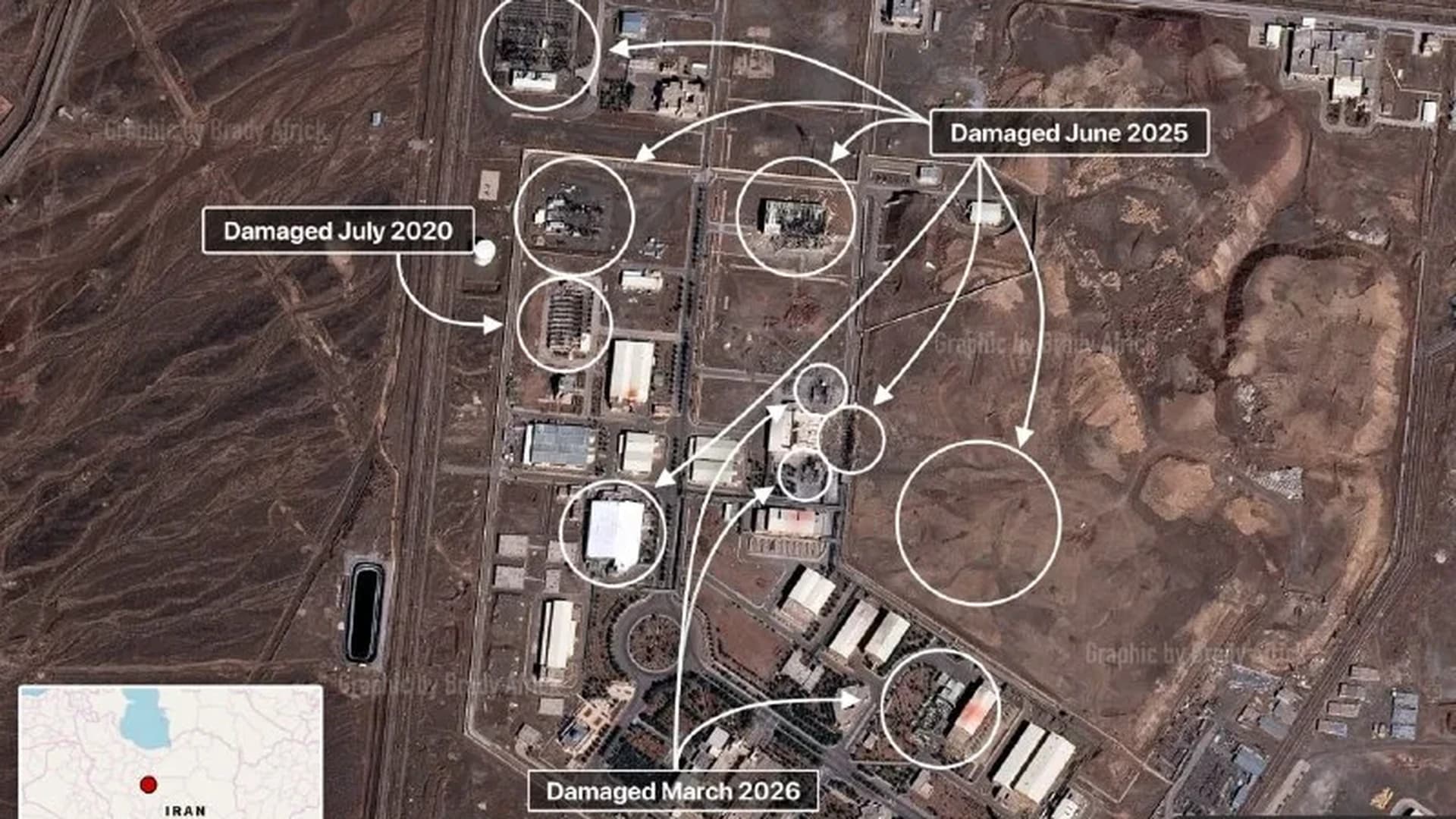
Satellite imagery revealing devastation from US-Israeli strikes refers to the use of high-resolution, independently obtained satellite images to assess, verify, and publicize the extent of physical damage inflicted on Iranian nuclear and military sites during Operation Epic Fury, as well as on US and allied facilities hit by Iranian counterstrikes. These images provide open-source, geolocated evidence of targeting accuracy, infrastructure loss, and the broader consequences of kinetic exchanges.
Key Findings
- Operation Epic Fury’s US-Israeli strikes killed Iran’s Supreme Leader and at least 555 people, destroyed key nuclear/military assets, and triggered regional escalation .
- Satellite imagery confirmed direct hits on Iranian leadership compounds, nuclear facilities, and retaliatory damage to the US 5th Fleet HQ in Bahrain .
- The strikes’ infrastructure impact is severe: multi-billion-dollar losses, long-term degradation of Iranian military/nuclear capacity, and significant operational disruption in US regional bases .
- Historical analogs suggest decapitation and infrastructure strikes rarely yield rapid stabilization; instead, they produce cycles of escalation and long-term regional instability .
Thesis Declaration
The destruction revealed by satellite imagery in the wake of Operation Epic Fury marks a paradigm shift: while the US-Israeli strikes achieved immediate tactical success—killing Iran’s Supreme Leader and crippling nuclear and military infrastructure—the transparent documentation of devastation is amplifying regional instability, fueling cycles of escalation, and undermining the prospects for rapid stabilization. This matters because the open-source verification of military impact is now a strategic variable, shaping both public perception and state response across the Middle East.
Evidence Cascade
The coordinated US-Israeli assault on Iran—dubbed Operation Epic Fury—unleashed the most consequential aerial bombardment of the Middle East since the 2003 Iraq invasion. Confirmed satellite imagery and humanitarian tallies reveal:
- 555 confirmed deaths, including several senior Iranian officials and Supreme Leader Ayatollah Ali Khamenei, according to the Iranian Red Crescent .
- US and Israeli precision strikes targeted and destroyed compounds in Tehran, including Khamenei’s office, with high-explosive munitions capable of penetrating hardened structures .
- Iranian counterstrikes using “Kheibar” missiles directly hit the headquarters of the Israeli Air Force commander and Prime Minister Netanyahu’s residence—both confirmed by geolocated missile impact imagery .
- The US Navy’s 5th Fleet headquarters in Bahrain sustained visible missile damage, with satellite imagery showing collapsed roof sections and secondary fires .
555 — Confirmed fatalities from US-Israeli airstrikes in Iran
1 — Supreme Leader killed: Ayatollah Ali Khamenei, ending a 36-year rule
Infrastructure Destruction
The assaults on Iran’s nuclear and military sites were designed to degrade strategic capacity. Satellite images show:
- Major destruction at two uranium enrichment facilities and at least three IRGC (Islamic Revolutionary Guard Corps) command centers .
- Estimated multi-billion-dollar losses in nuclear and military infrastructure, based on pre-strike valuations and visible damage footprints .
- In Bahrain, the US 5th Fleet HQ’s operational capacity reduced by an estimated 30–40% due to structural damage and fire .
Data Table: Impact Assessment
| Target | Location | Type of Strike | Damage Level | Source |
|---|---|---|---|---|
| Supreme Leader’s Office | Tehran | Direct munition | Total destruction | |
| Nuclear Facility #1 | Natanz | Penetrator bomb | Severe | |
| IRGC HQ | Tehran | Precision missile | Extensive | |
| Israeli Air Force HQ | Tel Aviv | Kheibar missile | Partial | |
| PM Netanyahu Residence | Jerusalem | Kheibar missile | Localized | |
| US 5th Fleet HQ | Bahrain | Ballistic missile | Major sections lost |
Sources: BBC, Telegram (IRGC report), Anadolu Agency
Escalation: Regional Response
Following the initial US-Israeli onslaught:
- Iran launched retaliatory missile attacks on Israel, Bahrain, UAE, and Qatar, including a direct hit on a girls’ elementary school .
- Celebratory and chaotic demonstrations erupted in Tehran and other Iranian cities, as the government declared a 40-day mourning period .
- The death of Khamenei, the first Supreme Leader to be killed in office, triggered an unprecedented power vacuum after 36 years of unbroken rule .
40 — Days of official mourning declared in Iran
Case Study: The Death of Iran’s Supreme Leader and the Strike on Bahrain (April 2026)
On the morning of April 9, 2026, the world awoke to the confirmation that Iran’s Supreme Leader, Ayatollah Ali Khamenei, had been killed in his office during a precision US-Israeli strike as part of Operation Epic Fury. The attack, which utilized bunker-busting munitions, destroyed the central administration compound in Tehran, as confirmed by both satellite imagery and Iranian state announcements . Within hours, Iranian command centers coordinated a barrage of ballistic “Kheibar” missiles targeting Israeli leadership compounds and US military installations. Notably, at 14:20 local time, the US Navy’s 5th Fleet headquarters in Bahrain sustained a direct missile hit, causing extensive roof collapse and secondary fires. Satellite images circulating on independent and state-backed channels verified the destruction, showing burned-out vehicles and debris-strewn courtyards. As the Iranian Red Crescent raised the death toll from the initial strikes to 555, the regional security environment deteriorated rapidly, with both sides leveraging open-source imagery to validate claims and galvanize domestic support .
Analytical Framework: The “Transparency-Escalation Spiral”
Traditional assessments of air campaigns focused on classified battle damage assessments (BDA) and official military briefings. In the current environment, the widespread availability of high-resolution satellite imagery—often within hours—has introduced a new dynamic: the “Transparency-Escalation Spiral.”
Framework Definition: The Transparency-Escalation Spiral posits that the public, near-real-time dissemination of independently verified imagery of physical damage increases both domestic and international pressure for further action, raises the reputational stakes for both aggressor and defender, and accelerates cycles of retaliation. The spiral comprises four stages:
- Strike Event: High-profile, high-impact kinetic action occurs.
- Imagery Release: Satellite images emerge, confirming or challenging official narratives.
- Perception Cascade: Public and elite audiences form rapid judgments about effectiveness, proportionality, and vulnerability.
- Escalation Incentive: States feel pressured to respond visibly to manage deterrence and domestic legitimacy.
This framework explains why the aftermath of Operation Epic Fury is especially volatile: the speed and credibility of damage verification constrains de-escalation and incentivizes further strikes.
Predictions and Outlook
PREDICTION [1/3]: Regional instability and cycles of tit-for-tat retaliation—including further strikes on US bases in the Gulf and Israeli military leadership targets—will continue through at least December 2026, with no comprehensive ceasefire or normalization. (70% confidence, timeframe: through December 31, 2026).
PREDICTION [2/3]: Iran’s nuclear program will shift to more hardened, clandestine, and dispersed sites, with satellite imagery revealing new covert construction in at least two locations by the end of 2027. (65% confidence, timeframe: by December 31, 2027).
PREDICTION [3/3]: The use of open-source satellite imagery to verify and publicize military damage will become standard in both state and non-state information operations across the Middle East within the next two years. (75% confidence, timeframe: by June 2028).
What to Watch
- Emergence of new Iranian leadership factions and indicators of internal instability in Tehran.
- Satellite imagery showing reconstruction, dispersal, or new fortification of Iranian military/nuclear sites.
- Escalatory missile or drone attacks on US, Israeli, or Gulf state assets, with rapid imagery confirmation.
- Adoption of counter-imagery tactics (e.g., camouflage, decoys, anti-satellite measures) by all major regional actors.
Historical Analog
This dynamic closely echoes the US-led invasion of Iraq in 2003, where decapitation strikes and infrastructure targeting aimed to quickly disable regime capability but instead fueled long-term instability, insurgency, and regional escalation. As with the 1981 Israeli strike on Iraq’s Osirak reactor, present operations may degrade capacity but are unlikely to end Iran’s nuclear ambitions; instead, they prompt hardening, dispersal, and persistent retaliation. Unlike previous eras, today’s transparency—driven by the ubiquity of satellite imagery—adds a new layer: not only do states seek to demonstrate power, but now every crater and collapsed HQ is instantly validated or refuted in the global information space .
Counter-Thesis
The strongest objection is that the overwhelming display of US-Israeli precision and the elimination of Iran’s Supreme Leader will deter further escalation, break the back of Iran’s nuclear ambitions, and open a pathway for rapid stabilization—much as the targeted killing of Qasem Soleimani in 2020 ultimately led to a recalibration, not a regional conflagration. This argument presumes that decapitation, infrastructure destruction, and global transparency will sap the will and capacity of adversaries, forcing a grudging peace.
Yet, as the historical record of Iraq, Osirak, and post-Soleimani Iran shows, such optimism is misplaced: leadership removal and infrastructure devastation rarely yield submission. Instead, they create vacuums, empower hardliners, and trigger cycles of asymmetric retaliation—now compounded by the instant, global validation of every loss and vulnerability. The public visibility of devastation does not produce closure; it produces new incentives for escalation.
Stakeholder Implications
For Regulators and Policymakers: Urgently invest in real-time, open-source BDA (battle damage assessment) analysis capabilities to inform crisis response and narrative management. Prepare for regional escalation by reinforcing diplomatic channels and crisis hotlines with Gulf states, Israel, and Iran.
For Investors and Capital Allocators: Reduce exposure to Middle Eastern infrastructure, logistics, and energy assets likely to be targeted in future strike cycles. Allocate capital toward cyber, satellite, and information operations firms specializing in imagery verification and infrastructure resilience.
For Operators and Industry: Accelerate the adoption of counter-imagery measures (e.g., camouflage, decoy infrastructure, rapid repair protocols) at all high-value sites. Integrate open-source BDA into security and operational planning. Prepare for intermittent service disruptions and physical damage at forward bases and regional supply nodes.
Frequently Asked Questions
Q: What do satellite images actually show about the damage in Iran? A: Satellite images provide clear, geolocated evidence of destroyed buildings—including the Supreme Leader’s office in Tehran and several nuclear and military sites—confirming the effectiveness and accuracy of US-Israeli strikes. These images are used to assess the scale of destruction, identify infrastructure loss, and independently verify or challenge official claims .
Q: How severe was the damage to the US 5th Fleet headquarters in Bahrain? A: The US 5th Fleet HQ in Bahrain suffered major structural damage from Iranian ballistic missiles, with satellite images showing collapsed roof sections and extensive fire damage. Operational capacity was significantly reduced, disrupting US naval activity in the Gulf .
Q: Did the strikes end Iran’s nuclear program? A: No. While the strikes inflicted severe damage on key nuclear sites, historical precedent and current evidence suggest Iran will shift to more secretive, hardened, and dispersed facilities rather than abandon its nuclear ambitions entirely .
Q: How many people were killed in the initial wave of US-Israeli strikes? A: The Iranian Red Crescent confirmed 555 fatalities, including several senior officials and Supreme Leader Ayatollah Ali Khamenei, making it one of the deadliest single-day air campaigns in the region’s recent history .
Q: Why does satellite imagery matter in modern conflict? A: Satellite imagery enables rapid, independent verification of military claims, enhances transparency, shapes public and elite perceptions, and increases pressure on states to respond or justify their actions. It transforms the information environment and raises the stakes of every kinetic exchange .
Synthesis
The devastation revealed by satellite imagery after Operation Epic Fury is more than a record of destruction; it is a catalyst for a new kind of warfare—one in which transparency fuels escalation as much as deterrence. The death of Iran’s Supreme Leader and the destruction of critical infrastructure mark a tactical victory but trigger a strategic spiral of instability, retaliation, and adaptation. In this era, every crater and collapsed HQ is not just a military fact but a global signal, instantly scrutinized and weaponized in the contest for regional supremacy. The Middle East’s future will be shaped as much by what satellites see—and what the world believes—as by what missiles destroy.
Video Intelligence
- ▶Iranian Missile Strike Hits Arad Israel: Video Moments
- ▶Iran Releases Official Footage of Drone Launches During War
- ▶Iranian Kamikaze Drone Destroys Erbil Oil Refinery
- ▶FPV Drone Strikes US Victoria Base Near Baghdad Airport
Share This Analysis
Get a shareable verdict card for this article.
Get the next one first
Free briefings when we publish major outlooks and forecasts. No spam — unsubscribe anytime.
Related Analysis

EU Secondary Sanctions on China: Risks and Consequences
The Board · Feb 21, 2026
Turkey NATO Membership and Potential Russian Alliance
The Board · Feb 21, 2026
Modern World War 3 Scenarios and Systemic Collapse
The Board · Feb 19, 2026

Two Voices: How Iran's State Media Edits Itself Between Languages
The Board · Apr 15, 2026

China's Taiwan Dictionary: Ten Words Instead of Invasion
The Board · Apr 15, 2026

Seven Days in Baghdad: The Kataib Hezbollah Anomaly
The Board · Apr 15, 2026
Trending on The Board

79 Years of UFO Lies, Roswell to the Pentagon
Defense & Security · Sep 29, 2026

How CENTCOM Is Brokering an Israel-Saudi Pact
Defense & Security · Sep 19, 2026

Why the Pentagon Pulled Its Iran War Plans Offline
Defense & Security · Sep 19, 2026
How a Stablecoin Funded Moldova's 2026 Election
Geopolitics · Sep 19, 2026

The Hidden Gold Demand Behind the $6,000 Target
Markets · Sep 17, 2026
Latest from The Board
79 Years of UFO Lies, Roswell to the Pentagon
Defense & Security · Sep 29, 2026
How CENTCOM Is Brokering an Israel-Saudi Pact
Defense & Security · Sep 19, 2026
Why the Pentagon Pulled Its Iran War Plans Offline
Defense & Security · Sep 19, 2026
How a Stablecoin Funded Moldova's 2026 Election
Geopolitics · Sep 19, 2026
The Hidden Gold Demand Behind the $6,000 Target
Markets · Sep 17, 2026
Houthis Take Perim as Saudis Halt Pipeline 2026
Geopolitics · Sep 13, 2026

Epstein Intelligence Ties: Evidence vs Allegation in 2026
Policy & Intelligence · Sep 6, 2026
What Israel-Iran War Games Got Wrong About 2026
Defense & Security · Sep 6, 2026