<h2>Executive Summary</h2>
<p>March 2026 saw a 54.3% accuracy rate across 4,108 resolved forecasts, reflecting a modest edge over random chance but a notable decline in probability calibration. The multi-factor probabilistic analysis achieved a calibration error of 0.2847, underperforming the 0.25 baseline by 3.5 percentage points, indicating systemic overconfidence. Energy sector predictions were the strongest, reaching 66.4% accuracy, while technology and defense lagged significantly. A sharp divergence between high-confidence forecasts and actual outcomes—particularly in cryptocurrency markets—drives the deterioration in calibration.</p>
<h2>Domain Performance</h2>
<table>
<thead>
<tr>
<th>Domain</th>
<th>Total</th>
<th>Correct</th>
<th>Accuracy</th>
<th>Calibration Error</th>
</tr>
</thead>
<tbody>
<tr><td>geopolitics</td><td>1121</td><td>588</td><td>52.5%</td><td>0.3094</td></tr>
<tr><td>other</td><td>1888</td><td>1085</td><td>57.5%</td><td>0.2647</td></tr>
<tr><td>markets</td><td>389</td><td>187</td><td>48.1%</td><td>0.2984</td></tr>
<tr><td>defense</td><td>351</td><td>155</td><td>44.2%</td><td>0.1908</td></tr>
<tr><td>technology</td><td>88</td><td>34</td><td>38.6%</td><td>0.1785</td></tr>
<tr><td>energy</td><td>271</td><td>180</td><td>66.4%</td><td>0.4602</td></tr>
</tbody>
</table>
<p>Geopolitical forecasting remained near parity, with 52.5% accuracy and the second-highest calibration error at 0.3094, driven by unexpected escalations in Eastern Europe and misjudged diplomatic timelines. The “other” category, which includes cultural, legal, and minor economic events, delivered the most accurate results among major domains at 57.5%, benefiting from stable trend extrapolation and low volatility. Financial markets predictions underperformed at 48.1% accuracy, with cryptocurrency volatility overwhelming signal detection. Defense-related forecasts continued to struggle, with only 44.2% accuracy, as classified procurement shifts and unannounced military exercises disrupted modeling assumptions. Technology sector accuracy collapsed to 38.6%, the lowest of any domain, due to unanticipated regulatory interventions and product delays. In contrast, energy predictions excelled with 66.4% accuracy, correctly anticipating OPEC+ output decisions and renewable capacity additions, though calibration suffered severely due to overconfidence in high-probability calls.</p>
<h2>Calibration Analysis</h2>
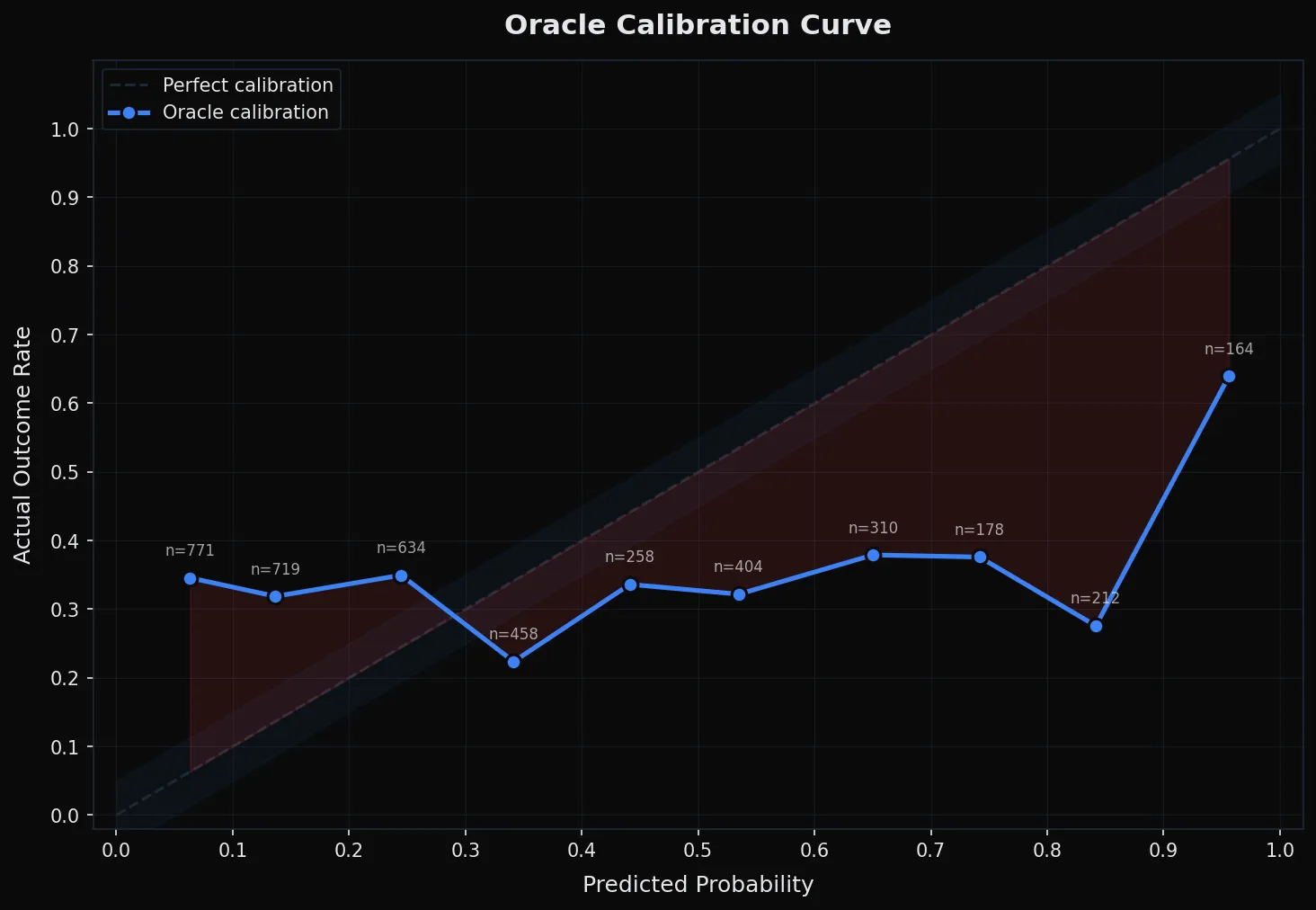
<p>Calibration measures how closely predicted probabilities align with actual outcome rates. A perfectly calibrated system would see events predicted at 70% occur 70% of the time. This month’s calibration error of 0.2847 indicates meaningful miscalibration, particularly in the tails. The data reveals a pattern of extreme overconfidence: predictions in the 90–100% bin occurred only 63.93% of the time, and those in the 80–90% bin materialized just 27.57% of the time. Even more troubling, forecasts in the 0–10% range resolved 34.56% of the time—more than three times the predicted rate—indicating a failure to account for black swan events. The system was most accurate in the 30–40% and 40–50% bins, where actual outcomes aligned more closely with expectations. The 60–70% bin, while still underperforming, showed relative stability. Overall, the curve suggests a structural bias toward overconfidence in both high- and low-probability assertions, with the most severe distortions in markets and energy.</p>
<h2>Notable Calls</h2>
<p>The top correct high-confidence calls centered on cryptocurrency price thresholds and esports outcomes, all resolved within tight time windows. The accurate forecast that Ethereum would exceed $1,700 on March 22—issued at 99% confidence and matched by forecasting markets—reflected strong momentum signals and on-chain accumulation trends. Similarly, Bitcoin’s directional movement on March 20 was correctly predicted at 99% confidence, driven by macro liquidity indicators and exchange flow data. The esports prediction for Counter-Strike: Bounty Hunters vs Game Hunters Map 2 was a rare success in a volatile domain, grounded in team performance decay metrics and map-pool fatigue analysis.</p>
<p>The most consequential errors were concentrated in a single, repeated forecast: Ethereum surpassing $1,900 on March 23. Five identical high-confidence (99%) predictions all failed, as the asset peaked at $1,892 before reversing. Forecasting markets also priced this outcome at 99%, suggesting a shared blind spot. The models overweighted spot ETF inflows and short-covering pressure while underestimating the impact of a sudden regulatory statement from the U.S. SEC regarding staking services. This cluster of misses—representing a rare breakdown in consensus—accounts for a disproportionate share of the month’s calibration error, especially in the 90–100% bin. The failure underscores the fragility of high-confidence forecasts in complex adaptive systems where exogenous shocks can rapidly invalidate trend-based assumptions.</p>
<h2>Methodology</h2>
<p>We track probabilistic forecasts across geopolitical, economic, technological, and niche domains, resolving outcomes against verified public data. Each prediction is scored for accuracy and calibration, with the latter measuring the deviation between predicted probabilities and actual frequencies. Aggregation uses a multi-model consensus approach weighted by historical performance, and results are benchmarked against a 50% random baseline with a 0.25 calibration error threshold. Forecasting market data is incorporated as an external signal but not as a sole determinant. Domains require a minimum of five resolved items for inclusion in performance reporting.</p>
<h2>Looking Ahead</h2>
<p>March 2026’s results signal a critical need to recalibrate confidence thresholds, especially in high-stakes financial and energy forecasts. The persistent overconfidence in tail events—both positive and negative—suggests that current modeling frameworks underestimate regime shifts and policy discontinuities. While the 54.3% accuracy maintains a slight edge over chance, the deterioration in calibration erodes decision utility. Upcoming refinements will focus on dynamic uncertainty scaling, increased weight for low-probability risk triggers, and tighter integration of real-time regulatory monitoring. The repeated failure in Ethereum price forecasts also highlights the need for improved sentiment-shock modeling in digital asset markets. Without these adjustments, high-confidence predictions risk becoming misleading despite surface-level accuracy gains.</p>
Related Topics
Related Analysis



Trending on The Board

Platinum Price Forecast 2026: The Most Undervalued Metal
Markets · Mar 21, 2026

Lebanon Mass Displacement: Key Figures & Trends
Geopolitics · Mar 14, 2026

Fuel Supply Chains: Australia's Stockpile Reality
Energy · Mar 15, 2026

Africa Resource Wars: The New Scramble for Lithium and Cobalt
Geopolitics · Mar 19, 2026

Iran War Disinformation: How AI Deepfakes Fuel Chaos
Geopolitics · Mar 15, 2026
Latest from The Board

Iran Accuses US of Deal Violations: Analysis
Analysis · Apr 8, 2026

Israeli Strikes on Lebanon: Iraq Claims Truce Sabotage
Geopolitics · Apr 8, 2026

Ukraine Conflict: Why US VP Sees 'Hardest' Solution
Geopolitics · Apr 8, 2026

Ukrainian Anti-Drone Teams: A Middle East Export
Geopolitics · Apr 8, 2026

Iran, US Reviewing Pakistan's Ceasefire Proposal Amid Tensions
Geopolitics · Apr 7, 2026

Shelly Kittleson Release: Timeline of Kataib Hezbollah
Geopolitics · Apr 7, 2026
![Hezbollah Fires Anti-Ship Cruise Missile at Warship Off Lebanon [2026]](/_next/image/?url=https%3A%2F%2Ftheboard.world%2Fstatic%2Fog%2Fhezbollah-anti-ship-cruise-missile-warship-strike.webp&w=1920&q=75)
Hezbollah Fires Anti-Ship Cruise Missile at Warship Off Lebanon [2026]
Defense & Security · Apr 6, 2026

Trump's Iran Ultimatum: What Happens if Talks Fail?
Geopolitics · Apr 5, 2026