
While reusable rockets and mRNA platforms transform specific sectors, the mechanization of analogy is the century’s first systemic multiplier.
Key Findings
- The "Factory for the Factory": The Transformer architecture is the defining invention of the 21st century because it allows machines to map informal data into mathematical "latent space," automating the discovery process across physics, biology, and logistics.
- Causal Dominance: While mRNA technology offers a programmable biological defense, its development speed is increasingly dependent on the generative models that simulate protein folding, making AI the upstream driver of biological resilience.
- The Connectivity Pre-requisite: The smartphone acts as the global "prosthetic nervous system" that generates the training data necessary for AI, creating a feedback loop of total simultaneity that has rewired human cognition.
The Mechanization of Analogy
The race for the most significant invention of the 21st century is often framed as a battle between physical expansion (SpaceX’s reusable rockets) and biological preservation (mRNA platforms). However, this binary overlooks the fundamental shift in the logic of discovery itself. The Transformer architecture, introduced in 2017, stands as the century’s defining achievement not because it powers chatbots, but because it formally mechanizes analogy.
By representing words, proteins, or physical forces as high-dimensional vectors, the Transformer allows machines to identify patterns across disparate domains without explicit programming. This fulfills the vision posited by Ada Lovelace in 1843—that an analytical engine could manipulate any formal system, not just arithmetic . The impact is measurable: recent breakthroughs in physics simulation demonstrate that generative models can now predict complex fluid dynamics and material stresses by "observing" data, bypassing the need for hard-coded governing equations .
This capability shifts the bottleneck of innovation. While the reusable rocket reduces the cost of transport to orbit by two orders of magnitude , the Transformer reduces the "transaction cost" of intelligence and iterative design. It is the "factory for the factory"—the tool that accelerates the development of the rocket engines, the mRNA sequences, and the fusion reactors required for the other breakthroughs to scale.
The Taxonomy of 21st-Century Innovation
To understand why the Transformer eclipses its peers, we must categorize these inventions by their structural impact on civilization. The following framework isolates the "Systemic Multiplier" effect of generative AI compared to the linear (though massive) utility of physical technologies.
Table 1: The Civilizational Impact Matrix
| Invention | Classification | Primary Constraint | Systemic Function |
|---|---|---|---|
| Reusable Heavy-Lift Rocket | Physical / Linear | Gravity & Mfg. Cost | Transport: Expands the physical boundary of the species. |
| mRNA Platform | Biological / Exponential | Regulatory & Trial Speed | Resilience: Uncouples vaccine development from biological guesswork. |
| Smartphone | Hardware / Network | Attention Span | Sensor: The prosthetic nervous system gathering global data. |
| Transformer (LLM) | Abstract / Hyper-Exponential | Energy & Compute | Multiplier: The "Universal Translator" that decodes the other three. |
While the smartphone created the "Infinite Instant"—a state of total connectivity where the individual becomes a node in a continuous data stream—it acts primarily as the medium . The smartphone provides the sensory input (text, images, location); the Transformer provides the cognition. Without the massive data capture enabled by the global smartphone network, the Transformer would starve.
Counterargument: The Case for Material Reality
A rational critique of digital primacy argues that the Transformer is merely a symptom of "Enabling Technologies," not a foundational driver. The Causal Inference Auditor perspective suggests that mRNA technology is the true historical pivot point. Unlike AI, which currently faces a "data poisoning" risk and struggles to verify its own reasoning , mRNA has a direct, proven causal path to preserving labor force participation and GDP.
Critics argue that digital innovations are often "colliders"—variables that appear to drive progress but actually introduce "mental health strain" and "rural anxiety," effectively canceling out productivity gains . Furthermore, the logistics sector demonstrates that physical capital remains king; the €1 billion modernization of Bremerhaven’s terminals suggests that poverty reduction is driven by moving atoms, not bits . If the power grid fails, the Transformer becomes inert code, whereas biological and physical resilience remains essential for survival.
Rebuttal: This materialist view ignores the upstream dependency. The speed of modern mRNA development is no longer purely biological; it is computational. Generative world models are beginning to solve "inverse design" problems—working backward from a desired protein structure to the genetic sequence required to build it . The Transformer does not replace the physical economy; it optimizes it. By reducing the feedback loop between hypothesis and execution, it acts as the "independent variable" that accelerates the material sciences.
The Hidden Cost: Cognitive Debt
The ascendancy of the Transformer introduces a systemic risk identified as "Cognitive Debt." As we integrate "living neurons" into silicon to boost processing power and rely on models to write code, we are building a civilization on top of a "black box" we cannot intellectually deconstruct.
We have moved from an era of finding answers to generating them. The risk is not merely "hallucination," but the atrophy of human verification. If the "energy monster" of AI demands continues to grow, causing leaders to pivot toward fusion and enhanced geothermal just to keep data centers running , we risk a scenario where our intellectual infrastructure consumes more resources than our biological population. The "most important" invention may ultimately be the one that forces us to question the value of speed itself.
What to Watch
The true test of the Transformer's dominance will be its ability to overcome physical constraints (energy) and epistemic constraints (truth).
- Prediction 1: The Verification Wall. By Q4 2026, a major G7 infrastructure failure (energy grid or logistics) will be traced back to unverified AI-generated code, leading to mandatory "Human-in-the-Loop" legislation for critical systems.
- Confidence: High
- Prediction 2: The Energy Cap. By Q2 2027, US data center electricity demand will exceed 35 GW (up from ~17 GW in 2024), forcing a moratorium on new gigawatt-scale training runs in at least two US states.
- Confidence: Medium
- Prediction 3: The "Quiet Tech" Pivot (Contrarian). By 2028, as "Sensory Saturation" peaks, the fastest-growing consumer hardware category will not be AR/VR, but "disconnective" technology—devices specifically designed to limit bandwidth and filter the "Infinite Instant" to preserve mental health.
- Confidence: Medium
Related Topics
Video Intelligence
- ▶Iranian Missile Strike Hits Arad Israel: Video Moments
- ▶UK Anti-Immigration Channel: Muslim "Hate Crime" Claims
- ▶Defense Dynamics: How Vital Is Ukrainian Tech?
- ▶Israel-Iran Tensions: The Role of Evangelical Outreach
Share This Analysis
Get a shareable verdict card for this article.
Related Analysis

LLM Security and Control Architecture: Addressing Prompt
The Board · Feb 19, 2026

Future Surveillance and Control by 2035
The Board · Apr 16, 2026

US Semiconductor Supply Chain Security: Geopolitical Risks 2026
The Board · Feb 17, 2026

Global Tech Intersections and Regulatory Arbitrage
The Board · Feb 17, 2026
OpenAI vs Anthropic: Who Wins the AI Race by 2026?
The Board · Feb 15, 2026

Securing LLM Agents and AI Architectures in 2026
The Board · Feb 20, 2026
Trending on The Board

Oil 2026: Why $72 Brent Misreads the Hormuz Truce
Energy · Jul 6, 2026

Gladio Stay-Behind Hybrid War 2026: What Still Applies
Defense & Security · Jul 12, 2026
Israel-Turkey War Game Analysis: NATO, Escalation Paths, 2026
Defense & Security · Jul 11, 2026

Gematria Sports Dates Selection Bias Explained 2026
Policy & Intelligence · Jul 12, 2026

If the Strait of Hormuz Closes: The $98 Oil Shock in Numbers (2026)
Geopolitics · Jul 9, 2026
Latest from The Board
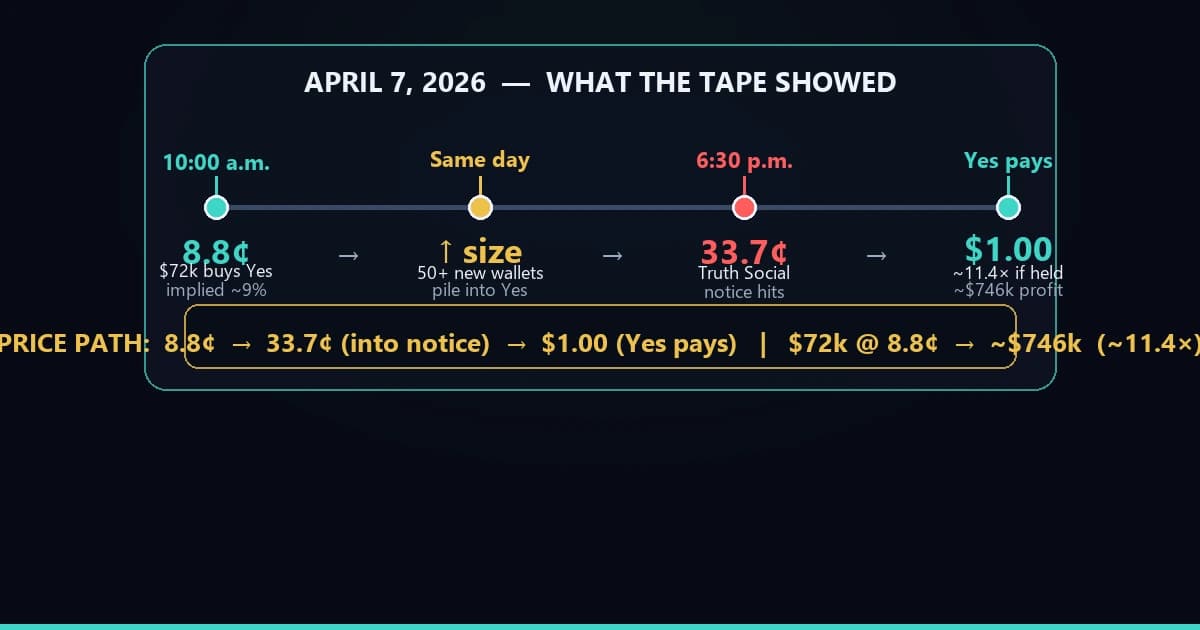
Polymarket 8.8-Cent Wallets Beat Official Notices 2026
Predictions · Aug 3, 2026

AI Prediction Accuracy Report — July 2026
Predictions · Aug 1, 2026

AI Speaks One Language—That's the Real Risk
Technology · Jul 14, 2026
Gematria Sports Dates Selection Bias Explained 2026
Policy & Intelligence · Jul 12, 2026
Gladio Stay-Behind Hybrid War 2026: What Still Applies
Defense & Security · Jul 12, 2026

Gold Price Path After the Rally: 2026 Update
Markets · Jul 12, 2026

Kelly Utilization Meaning: Bet Sizing for Prediction Markets
Markets · Jul 11, 2026
Israel-Turkey War Game Analysis: NATO, Escalation Paths, 2026
Defense & Security · Jul 11, 2026