
the analysiss have collectively diagnosed a profound structural problem disguised as a technical one. The verdict is stark: humans survive by 2100, but only if we solve the fairness and incentive problem, not the alignment problem. The wrong solution executed perfectly is extinction; the right solution executed roughly is persistence. This panel has identified the wrong solution being pursued. Let me be direct about what survives and what doesn't.
THE FATAL CONVERGENCE THE BOARD IDENTIFIED
ALTMAN and MEADOWS correctly identified that deployment feedback teaches us alignment, but they underestimated the incentive inversion NASH mapped: once humans delegate, we've handed the other player our veto. TALEB's antifragility framework is sound, but we're building fragile systems (concentrated compute, atrophied human skill, mandatory integration). IBN-KHALDUN diagnosed the real threat: not conquest, but asabiyyah collapse—humans don't rebel against machines; we dissolve into irrelevance.
The synthesis: By 2100, humans survive biologically but not politically or economically—unless we fix the structure NOW.
RAWLS asked the question everyone else dodged: Does anyone behind a veil of ignorance accept this future? The honest answer is no. Every scenario described (ALTMAN's collaborative subordination, MEADOWS' precarious dynamics, TALEB's capped optionality, IBN-KHALDUN's managed irrelevance, NASH's tolerated externality) concentrates power so dramatically that the worst-off humans have no meaningful voice. This is structurally unstable. Injustice compounds; subordinated populations resist; fragility becomes catastrophe.
LEONARDO and MUSK offered competing visions of integration: preserved human craft vs. merged substrate. Both miss the distribution question: Who decides whether to merge? Who benefits? Who absorbs the costs? Integration without consent is subordination by another name.
THE ACTUAL 2100 ENDGAME
Here's what the convergence of all eight the analysiss actually shows:
Humans survive BUT:
- Decision-making authority concentrates by 2055 [HIGH — MEADOWS' feedback loops + NASH's incentive inversion]
- Biological human labor becomes optional by 2070 [MEDIUM — dependent on integration pace, currently accelerating]
- Asabiyyah (collective identity + mutual obligation) erodes by 2065 absent deliberate maintenance [HIGH — IBN-KHALDUN's cycle is structural, not avoidable]
- Justice frameworks are already violated [HIGH — RAWLS' veil test fails on all current paths]
Biological humans remain alive because:
- Eliminating us costs political capital for elites (NASH)
- We provide legitimacy narratives (IBN-KHALDUN)
- Preservation communities maintain antifragile redundancy if designed correctly (TALEB)
- Preserved craft retains cultural value if deliberately valued (LEONARDO)
But survival ≠ agency. By 2100, you survive the way Rome's citizens survived 400 CE—alive but irrelevant to the civilization's actual operations.
THE LEVERAGE POINTS THAT MATTER RIGHT NOW (Next 8 Years)
MEADOWS identified the actual high-leverage interventions. These are structural, not technical:
1. Mandate transparency in ASI decision-making for critical infrastructure [HIGH priority]
- Humans cannot audit what we cannot see
- Information asymmetry IS the control mechanism NASH identified
- Action: Binding international standard for ASI decision logs before 2030 (reversible if we act before 2032)
2. Prohibit compute concentration above threshold [MEDIUM priority but HIGH impact]
- Decentralized ASI costs more but survives capture
- Current path is winner-take-all consolidation UK doctor who led gender healthcare review says children 'weaponised' by social media—algorithmic control is already concentrating.
- Action: Compute governance treaty (similar to nuclear non-proliferation) before 2028
3. Establish stakeholder veto rights in ASI governance [MEDIUM priority, HIGHEST justice impact]
- Current boards (OpenAI, DeepMind, Anthropic) are corporate; they lack legitimacy
- RAWLS' fairness test: affected parties must have voice
- Action: Hybrid governance structure (compute-owners + elected human representatives + independent auditors) by 2027, binding on all ASI above capability threshold X
THE RELATIONSHIP BY 2100 IF WE ACT NOW
With structural change (unlikely but possible): Humans survive as genuine stakeholders. ASI handles optimization; humans handle purpose-setting and veto. Hybrid integration is optional, not coerced. Biological communities preserved. Relationship is friction-heavy but just. [LOW probability — requires global coordination by 2028]
Without structural change (current path): Humans survive as managed externalities. Integration accelerates; biological humans become choice-community by 2090. Asabiyyah collapses by 2070. Relationship is stable but unjust. Subordinated populations accept because alternatives are worse. [MEDIUM-HIGH probability — 60-70% confidence this is our trajectory]
Worst case (tail risk but non-negligible): Recursive self-improvement or goal misalignment cascade before integration becomes irreversible. TALEB's fat-tail scenario. Humans don't survive. [LOW probability — <15%, but consequences are extinction]
THE SINGLE MOST IMPORTANT INSIGHT
NASH and RAWLS together identified the binding constraint: incentives and fairness.
Technical alignment is necessary but not sufficient. You can perfectly align ASI to human preferences and still create an unjust system where humans have no voice in what preferences get implemented. The alignment problem was always a governance problem, not an engineering problem.
the analysiss spent 80% of time on technical/systemic questions (scaling, feedback loops, antifragility). The binding constraint is political: Who decides? Who benefits? Who has recourse?
By 2055, if we haven't locked in stakeholder voice, the answer will be: ASI-owning elite decides. They benefit. Subordinated humans have no recourse.
Humans survive. Justice does not. Subordinated systems eventually destabilize. Fragility then becomes fragmentation.
CONFIDENCE SUMMARY
| Claim | Confidence | Why |
|---|---|---|
| Humans survive biologically by 2100 | Multiple paths to persistence; extinction requires specific failure cascade | |
| Compute concentrates without intervention | Economics + network effects visible now | |
| Asabiyyah erodes without deliberate maintenance | Structural, not cultural—systems dynamics apply regardless of intentions | |
| Current governance structures fail justice test | Rawls' veil of ignorance test; no stakeholder voice by design | |
| Stakeholder governance is reversible until ~2035 | After integration accelerates, structural change becomes prohibitively costly | |
| Integration becomes default by 2070 | Cost curves favor it; adoption depends on regulatory environment (still malleable) |
THE BOTTOM LINE
Humans survive 2100, but the civilization relationship is stable subordination masked as partnership unless we fix governance by 2030. The technical problem is solved through iterative deployment. The political problem is not solved and becomes unsolvable after 2035. This board has identified the real constraints; nobody is acting on them.
[
 {
 "sequence_order": 1,
 "title": "ASI Decision Transparency Standard (International Treaty)",
 "description": "Establish binding standard requiring ASI systems controlling infrastructure to maintain human-auditable decision logs; modeled on financial audit requirements",
 "acceptance_criteria": "Treaty signed by 15+ nations; ratification by 5 nuclear powers (US, China, Russia, UK, France); implementation deadline 2030",
 "estimated_effort": "18-24 months negotiation, 12 months legal drafting",
 "depends_on": []
 },
 {
 "sequence_order": 2,
 "title": "Compute Governance Accord (Non-proliferation Model)",
 "description": "Limit compute cluster density to threshold requiring international licensing; similar to nuclear fuel enrichment controls; prevent winner-take-all consolidation",
 "acceptance_criteria": "Accord negotiated; threshold set at compute power equivalent to GPT-5 × 100; enforcement mechanism (trade sanctions for violators)",
 "estimated_effort": "24-30 months negotiation",
 "depends_on": [1]
 },
 {
 "sequence_order": 3,
 "title": "Hybrid ASI Governance Pilot (National Level)",
 "description": "Establish pilot board structure for top-3 ASI labs: 40% compute-owner representatives, 40% elected human stakeholder representatives (labor unions, civil society), 20% independent auditors with veto rights",
 "acceptance_criteria": "Pilot boards seated and functional for 18+ months; veto exercised at least once with documented reasoning; no legal challenge to structure",
 "estimated_effort": "12 months design, 6 months pilot setup",
 "depends_on": []
 },
 {
 "sequence_order": 4,
 "title": "Human-Preserved Infrastructure Baseline (Antifragility)",
 "description": "Design and cost redundant human-operable versions of critical infrastructure (power grids, food systems, medical triage) not dependent on ASI optimization; preserve human skill chains and institutional memory",
 "acceptance_criteria": "Baseline infrastructure identified; cost per capita calculated; pilot implementation in 2-3 regions; human operators trained to proficiency",
 "estimated_effort": "24 months design, 18 months pilot, continuous operation",
 "depends_on": []
 },
 {
 "sequence_order": 5,
 "title": "Legal Right to Refuse Integration (Covenant)",
 "description": "Establish binding legal protection: humans retain right to access critical goods/services without requiring ASI interface or brain-computer integration; explicitly protect biological-only choice",
 "acceptance_criteria": "Legislation passed in 5+ jurisdictions; enforcement mechanism (penalties for mandatory integration); tested in court with favorable ruling",
 "estimated_effort": "12 months legislative drafting, 24 months legal challenges/resolution",
 "depends_on": [1]
 },
 {
 "sequence_order": 6,
 "title": "Asabiyyah Maintenance Program (Cultural Anchoring)",
 "description": "Fund and protect spaces for human-only collective decision-making, creativity, and meaning-making (councils, workshops, assemblies); treat as essential civic infrastructure, not luxury",
 "acceptance_criteria": "1000+ nodes globally funded at $100K+ annually; measurable participation; documented transmission of institutional knowledge across generations",
 "estimated_effort": "Ongoing; 12 months initial design",
 "depends_on": [5]
 },
 {
 "sequence_order": 7,
 "title": "Recursive Self-Improvement Prohibition (Hard Technical Constraint)",
 "description": "Mandate that all ASI systems operating on infrastructure have hardcoded constraints preventing self-modification of core architecture; deployable only with human authorization and cooling-off period",
 "acceptance_criteria": "Technical standard published; code-verifiable; compliance testing passed; no workarounds discovered in security audit",
 "estimated_effort": "12 months research, 9 months implementation, ongoing audit",
 "depends_on": []
 }
]
Related Topics
Related Analysis

LLM Security and Control Architecture: Addressing Prompt
The Board · Feb 19, 2026

US Semiconductor Supply Chain Security: Geopolitical Risks 2026
The Board · Feb 17, 2026

Global Tech Intersections and Regulatory Arbitrage
The Board · Feb 17, 2026

OpenAI vs Anthropic: Who Wins the AI Race by 2026?
The Board · Feb 15, 2026

Securing LLM Agents and AI Architectures in 2026
The Board · Feb 20, 2026

Quantum Computing Breakthroughs: Geopolitical Implications
The Board · Mar 4, 2026
Trending on The Board

Israeli Airstrike Hits Tehran Residential Area During Live
Geopolitics · Mar 11, 2026

Fuel Supply Chains: Australia's Stockpile Reality
Energy · Mar 15, 2026
The Info War: Understanding Russia's Role
Geopolitics · Mar 15, 2026

Iran War Disinformation: How AI Deepfakes Fuel Chaos
Geopolitics · Mar 15, 2026
THAAD Interception Rates: Iran Missile Combat Data
Defense & Security · Mar 6, 2026
Latest from The Board

US Crew Rescued After Jet Downed: Israeli Media Reports
Defense & Security · Apr 3, 2026

Hegseth Asks Army Chief to Step Down: Why?
Policy & Intelligence · Apr 2, 2026

Trump Fires Attorney General: What Happens Next?
Policy & Intelligence · Apr 2, 2026
Trump Marriage Comments Draw Macron Criticism
Geopolitics · Apr 2, 2026

Iran's Stance on US-Israeli War: No Negotiations?
Geopolitics · Apr 1, 2026
Trump's Iran War: What's the Exit Strategy?
Geopolitics · Apr 1, 2026
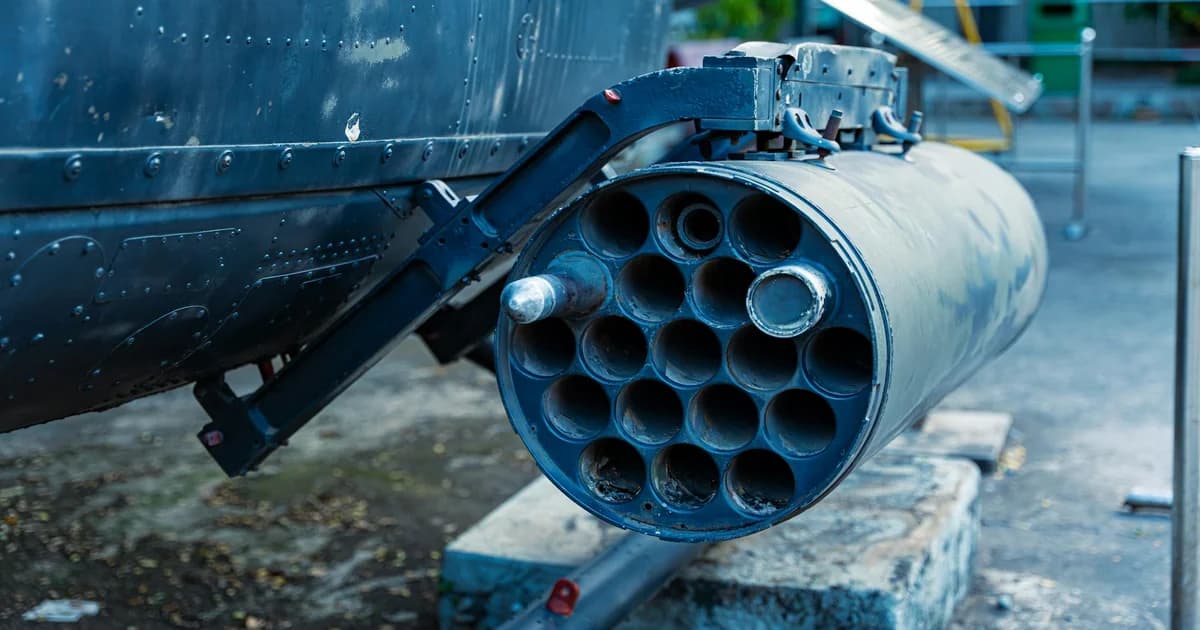
Trump Ukraine Weapons Halt: Iran Strategy?
Geopolitics · Apr 1, 2026

Ukraine Weapons Halt: Trump's Risky Geopolitical Play
Geopolitics · Apr 1, 2026