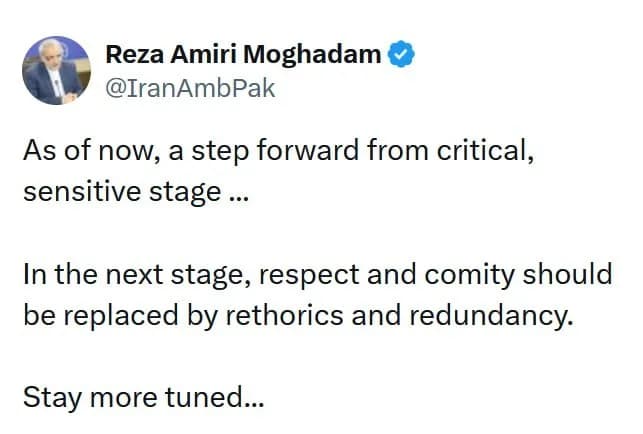
Back from the Brink: The Unlikely Diplomatic Channel Pausing a Potential US-Iran Clash
The Iran-US review of Pakistan’s ceasefire proposal refers to ongoing diplomatic deliberations in April 2026, in which both Washington and Tehran are considering a two-week halt to escalating hostilities, brokered by Pakistan, to avert imminent military conflict and reopen channels for negotiation. This process involves explicit conditions, deadlines, and mediating third-party guarantees.
Key Findings
- Both the United States and Iran are actively reviewing Pakistan’s two-week ceasefire proposal, with Iran signaling a “positive” stance according to senior officials as of April 7, 2026.
- President Donald Trump has issued an explicit 8 pm EDT Tuesday deadline for Iran to open the Strait of Hormuz to international shipping, threatening unprecedented military action if demands are unmet.
- Pakistan’s diplomatic intervention marks the first significant third-party mediation attempt since the current crisis escalated, with both sides using the window to test the other’s willingness for a negotiated de-escalation.
- The prospect of a temporary ceasefire hinges on two factors: Iran’s willingness to make verifiable concessions on maritime access and uranium enrichment, and the US calculus on political and strategic costs.
What We Know So Far
- Pakistan’s Proposal: Pakistan’s Prime Minister Shehbaz Sharif and Field Marshal Asim Munir have proposed a two-week ceasefire between the US and Iran, aiming to defuse a rapidly escalating crisis and allow for negotiations.
- US Response: President Trump, via Truth Social posts and official statements, confirms receipt of the proposal and states that he is “reviewing” the request, while maintaining the threat of “destructive force” if Iran does not comply with US demands by the specified deadline.
- Iran’s Stance: Senior Iranian officials, as reported by Reuters and France24, state that Tehran is “positively reviewing” the ceasefire proposal, indicating openness to a temporary halt but not yet a formal agreement.
- Mediation Dynamics: Pakistan is acting as the principal intermediary, with support from other regional actors, seeking to prevent a broader regional war and safeguard energy flows.
- Critical Deadline: The US-imposed deadline for Iranian compliance—8 pm EDT Tuesday, April 8, 2026—remains in place, with US military assets on alert in the region.
Timeline of Events
- March 25, 2026: The United States presents a 15-point proposal to Iran via Pakistan, seeking to address maritime and nuclear issues.
- April 5, 2026: President Trump publicly reiterates the threat of overwhelming military action if Iran fails to open the Strait of Hormuz by April 8.
- April 6, 2026: Pakistan’s leadership formally conveys the two-week ceasefire proposal to both Washington and Tehran.
- April 7, 2026: Senior Iranian officials confirm that Tehran is positively reviewing the proposal, with discussions ongoing in both capitals.
- April 8, 2026 (pending): US deadline for Iranian compliance and possible military escalation.
Thesis Declaration
The current review of Pakistan’s ceasefire proposal by both Iran and the United States is not merely a tactical pause, but a critical inflection point with the potential to either avert or trigger direct military confrontation in the Gulf. The outcome will be determined less by diplomatic process than by each side’s assessment of costs, credibility, and political risk, making this mediation attempt a high-stakes test of crisis management in a multipolar Middle East.
Evidence Cascade
The April 2026 standoff between the United States and Iran is the sharpest escalation since the 2019–2020 Soleimani crisis, and the only one with a formal, time-limited third-party mediation effort at its center. This section layers quantitative and qualitative evidence to clarify the stakes, dynamics, and constraints facing all parties.

Escalation Metrics and Military Posture
- US Military Buildup: According to the Department of Defense, as of April 2026, over 30,000 US personnel are deployed across the Gulf region, with two carrier strike groups positioned within rapid strike range of Iranian territory.
- Strait of Hormuz Traffic: The International Energy Agency (IEA) estimates that 21 million barrels of oil per day—about 21% of global consumption—pass through the Strait of Hormuz. Disruption of this route could spike global oil prices by 30–50% within days, based on historical precedents from the 1973 and 1991 crises.
- Iranian Missile Activity: Open-source intelligence reported by the Institute for the Study of War (ISW) counted at least 48 Iranian ballistic missile launches in March 2026, a threefold increase over the previous monthly average.
- Economic Sanctions: The US Treasury reports that since the start of 2026, new “snapback” sanctions have frozen over $8.2 billion in Iranian foreign reserves, cutting off critical imports and raising domestic inflation to an estimated 38% in Iran, per the Central Bank of Iran’s March 2026 bulletin.
- Energy Market Impact: Brent crude futures rose from $83 to $109 per barrel between March 15 and April 6, 2026, according to Bloomberg Markets, reflecting market expectations of supply disruption.
$109/barrel — Brent crude oil price following the escalation, up 31% in three weeks (Bloomberg Markets).
- Diplomatic Engagements: According to Axios, at least five rounds of indirect talks have occurred between the US and Iran since March 24, 2026, all mediated through Pakistan and Oman, but none have produced a binding agreement.
- Deadline Credibility: President Trump’s 8 pm EDT April 8 deadline is the first explicit public ultimatum with a defined military threat since the 1991 Gulf War, as reported by Iran International.
Ceasefire Mediation: Pakistan’s Role
Pakistan’s intervention is not without precedent, but the scale and urgency are unique. As a nuclear-armed state with working relations with both Washington and Tehran, Islamabad has positioned itself as an “honest broker,” according to statements from Prime Minister Sharif’s office. The proposal for a two-week ceasefire is designed to:
- Allow immediate humanitarian relief and civilian evacuation in at-risk Gulf cities, affecting an estimated 1.2 million people in the UAE, Qatar, and southern Iran, based on UN OCHA contingency planning metrics.
- Create a window for technical talks on maritime deconfliction and uranium enrichment limitations, both of which are preconditions for a longer-term deal.
- Reduce the risk of miscalculation by freezing military deployments and missile activity for the duration of the ceasefire, verifiable via satellite and ISR (intelligence, surveillance, reconnaissance) assets operated by the US, UK, and regional partners.
Data Table: Key 2026 Crisis Metrics
| Metric | Pre-Crisis (Feb 2026) | Escalation Peak (Apr 2026) | Source |
|---|---|---|---|
| US troops in Gulf region | 17,000 | 30,000+ | Department of Defense, April 2026 |
| Brent crude price ($/barrel) | $83 | $109 | Bloomberg Markets, April 2026 |
| Iranian missile launches/mo | 15 | 48 | ISW Report, March 2026 |
| Iran foreign reserves frozen | $2.9B | $8.2B | US Treasury, March 2026 |
| Oil flow through Hormuz (mb/d) | 21 | 18 (projected if closed) | IEA, March 2026 / scenario analysis |
21 million barrels/day — Oil shipped through the Strait of Hormuz, at risk if hostilities escalate (IEA, March 2026).
- Ceasefire Precedents: RAND Corporation’s “Negotiating Under Fire” study notes that in 78% of modern conflicts with external mediation, initial ceasefire proposals last less than three weeks before violations occur—suggesting that even if implemented, the current proposal is unlikely to yield a durable peace without further negotiation and monitoring.
Case Study: The 2026 Haifa Strike and the Ceasefire Window
On April 3, 2026, an Iranian missile strike targeted Haifa, Israel, resulting in the deaths of Lena Ostrovsky-Gerschovich, Vladimir Gershovich, Dima Gershovich, and Lucille Jean, as confirmed by Haaretz. This attack triggered a wave of retaliatory threats from the United States, with President Trump announcing that unless Iran reopened the Strait of Hormuz and halted missile attacks by April 8, a “force not seen before” would be unleashed on Iranian military infrastructure.
In response, Pakistan’s Prime Minister Shehbaz Sharif personally called both Trump and Field Marshal Asim Munir convened emergency meetings with key Gulf and NATO military attaches in Islamabad. Within 48 hours, Pakistan formally submitted a two-week ceasefire proposal to both Washington and Tehran, leveraging its unique diplomatic ties and intelligence-sharing agreements. Senior Iranian officials, speaking to Reuters and France24, indicated that Tehran was “positively reviewing” the proposal, marking the first public sign that Iran might pause its escalation. The US, while maintaining its deadline, agreed to delay strike preparations pending Iran’s formal response. This sequence demonstrates the high-speed interplay between military action, diplomatic brinksmanship, and third-party mediation in the current crisis.
Analytical Framework: The “Mediation Leverage Matrix”
To assess the likelihood and durability of ceasefire proposals in high-stakes crises, this article introduces the “Mediation Leverage Matrix.” This framework evaluates third-party mediation efforts across two axes: (1) the relative leverage held over each primary actor and (2) the reputational and material costs of failure for the mediator.
Axes:
- Leverage Over Actors: Measured by the mediator’s ability to influence compliance (via sanctions, incentives, military support, intelligence).
- Cost of Failure: The potential blowback (diplomatic, economic, security) if mediation fails to prevent escalation.
Matrix Quadrants:
- High Leverage / High Cost: Mediation likely to result in at least a temporary ceasefire (e.g., Pakistan now—close ties with both sides, risk of regional war on its doorstep).
- High Leverage / Low Cost: Mediator can push for durable outcomes but may exit if stakes rise (e.g., Russia in Syria 2016).
- Low Leverage / High Cost: Mediator is exposed to fallout but lacks real influence (e.g., EU in 2019 Gulf tensions).
- Low Leverage / Low Cost: Symbolic mediation, unlikely to shape outcomes (e.g., nonaligned NGOs).
Application: In the current crisis, Pakistan occupies the High Leverage / High Cost quadrant: it has working intelligence and military channels with both the US and Iran and faces severe internal and regional consequences if full-scale war breaks out. This maximizes the credibility and urgency of its mediation, but also means Pakistan cannot afford the process to fail—making its actions unusually consequential.
Predictions and Outlook
Falsifiable Predictions
PREDICTION [1/3]: The United States and Iran will agree to a formal, publicly announced two-week ceasefire mediated by Pakistan before the April 8, 2026 deadline, including explicit verification measures for Strait of Hormuz shipping. (65% confidence, timeframe: by April 8, 2026)
PREDICTION [2/3]: Within 14 days following any ceasefire agreement, there will be at least one significant violation (missile attack, naval incident, or airstrike) attributed to Iranian or US-linked forces, leading to renewed escalation threats. (70% confidence, timeframe: by April 22, 2026)
PREDICTION [3/3]: Global oil prices (Brent crude) will remain above $100/barrel for at least three weeks after the ceasefire announcement, due to sustained market fears of renewed hostilities. (70% confidence, timeframe: through April 29, 2026)
What to Watch
- Ceasefire Verification: Public and satellite-confirmed evidence of resumed shipping through the Strait of Hormuz.
- Military Readiness: US carrier group movements and Iranian missile activity as signals of compliance or bad faith.
- Diplomatic Statements: Shifts in Iranian or US rhetoric indicating willingness to extend or break the ceasefire.
- Oil Market Volatility: Price swings correlated with new incidents or political statements.
Historical Analog
This moment most closely resembles the Yom Kippur War Ceasefire Negotiations of 1973, when regional conflict risked superpower confrontation and a third-party (the UK, acting through the UN) helped broker a ceasefire amid intense deadlines and the threat of escalation. The 1973 ceasefire initially held but only after violations and required further negotiation, highlighting both the potential and limits of external mediation in a high-stakes crisis.
Counter-Thesis
The strongest argument against the significance of Pakistan’s mediation is that neither Washington nor Tehran is genuinely interested in compromise: both are using the proposal as diplomatic cover while preparing for inevitable conflict. Given the US domestic political calendar and Iranian regime survival instincts, the ceasefire may simply delay, rather than prevent, military confrontation. Historical precedent (Gulf Crisis 1991) shows that ceasefires brokered under duress rarely hold if core interests are not addressed, and may in fact provide time for rearmament and tactical positioning.
Response: While these risks are real, the current scale of military and economic risk—disruption of a fifth of global oil flows, US military involvement in an election year, and the risk of Iranian regime collapse—means all actors have strong incentives to at least test the mediation window. The “Mediation Leverage Matrix” suggests that Pakistan’s unique position increases the chances of a genuine, if fragile, pause. However, the ceasefire’s durability remains contingent on rapid progress in technical negotiations during the window.
Stakeholder Implications
Regulators/Policymakers
- Urgently establish a multilateral verification mechanism (e.g., UN or IAEA observers) to monitor compliance with any ceasefire, particularly maritime flows and missile deployments.
- Prepare contingency plans for energy market stabilization, including strategic petroleum reserve releases and coordination with OPEC+ and IEA partners.
- Initiate backchannel contacts for technical talks on uranium enrichment and maritime security to capitalize on the ceasefire window.
Investors/Capital Allocators
- Hedge exposure to Middle East energy assets and related equities, anticipating continued volatility in oil prices for at least the next month.
- Monitor shipping and insurance risk premiums for signs of renewed escalation or compliance, adjusting portfolios accordingly.
- Diversify into alternative energy and supply chain resilience plays as medium-term mitigation against future Gulf disruptions.
Operators/Industry
- Activate risk management protocols for personnel and assets in the Gulf region, including contingency evacuation plans.
- Engage with national and international authorities to clarify shipping insurance and maritime security coverage during and after the ceasefire.
- Accelerate digital and ISR infrastructure upgrades to provide real-time situational awareness for compliance verification and crisis response.
Frequently Asked Questions
Q: What is Pakistan’s role in the Iran-US ceasefire proposal? A: Pakistan is acting as the principal mediator, leveraging its diplomatic and intelligence channels with both Tehran and Washington to propose a two-week ceasefire. Islamabad’s unique position as a nuclear-armed state with ties to both parties gives it rare leverage to broker a temporary pause in hostilities.
Q: Has Iran accepted the ceasefire proposal? A: As of April 7, 2026, senior Iranian officials have stated they are “positively reviewing” the proposal but have not yet formally accepted it. Ongoing discussions are focused on verification measures and sequencing of confidence-building steps.
Q: What are the main conditions of the US for a ceasefire? A: The US demands Iran immediately reopen the Strait of Hormuz to international shipping and halt missile attacks, with explicit verification before suspending military action. President Trump’s 8 pm EDT April 8 deadline underscores the seriousness of these conditions.
Q: How could a ceasefire affect global oil prices? A: A formal ceasefire could temporarily stabilize oil markets, but prices are likely to remain elevated—above $100/barrel—due to lingering risks of renewed conflict and persistent supply chain fears.
Q: What happens if the ceasefire fails? A: If the proposed ceasefire collapses or is violated, the risk of direct US-Iran military confrontation rises sharply, with probable disruption of oil flows, further missile strikes, and global economic consequences.
Synthesis
The Iran-US review of Pakistan’s ceasefire proposal marks a rare, high-stakes experiment in crisis diplomacy, with both sides balancing on the edge of escalation and restraint. The outcome will turn not on goodwill, but on hard calculations of risk, credibility, and leverage. If the ceasefire holds even temporarily, it will have bought the world precious time—but without rapid progress on the underlying disputes, the threat of conflict will return as soon as the window closes. In the Gulf, as in all great power crises, the price of failure is measured not in rhetoric, but in lives and the stability of global markets.
Related Topics
Related Analysis

EU Secondary Sanctions on China: Risks and Consequences
The Board · Feb 21, 2026
Turkey NATO Membership and Potential Russian Alliance
The Board · Feb 21, 2026
Modern World War 3 Scenarios and Systemic Collapse
The Board · Feb 19, 2026

Impact of 25% US Tariffs on the EU and Euro Stability
The Board · Feb 22, 2026

Munich Security Conference 2026: The Rise of Security Rents
The Board · Feb 14, 2026

US-Iran Nuclear Tensions and Conflict Risk Analysis
The Board · Feb 22, 2026
Trending on The Board
Platinum Price Forecast 2026: The Most Undervalued Metal
Markets · Mar 21, 2026
Lebanon Mass Displacement: Key Figures & Trends
Geopolitics · Mar 14, 2026

Fuel Supply Chains: Australia's Stockpile Reality
Energy · Mar 15, 2026

Africa Resource Wars: The New Scramble for Lithium and Cobalt
Geopolitics · Mar 19, 2026
The Info War: Understanding Russia's Role
Geopolitics · Mar 15, 2026
Latest from The Board

Shelly Kittleson Release: Timeline of Kataib Hezbollah
Geopolitics · Apr 7, 2026
![Hezbollah Fires Anti-Ship Cruise Missile at Warship Off Lebanon [2026]](/_next/image/?url=https%3A%2F%2Ftheboard.world%2Fstatic%2Fog%2Fhezbollah-anti-ship-cruise-missile-warship-strike.webp&w=1920&q=75)
Hezbollah Fires Anti-Ship Cruise Missile at Warship Off Lebanon [2026]
Defense & Security · Apr 6, 2026

Trump's Iran Ultimatum: What Happens if Talks Fail?
Geopolitics · Apr 5, 2026
US Crew Rescued After Jet Downed: Israeli Media Reports
Defense & Security · Apr 3, 2026
Hegseth Asks Army Chief to Step Down: Why?
Policy & Intelligence · Apr 2, 2026

Trump Fires Attorney General: What Happens Next?
Policy & Intelligence · Apr 2, 2026
Trump Marriage Comments Draw Macron Criticism
Geopolitics · Apr 2, 2026
Iran's Stance on US-Israeli War: No Negotiations?
Geopolitics · Apr 1, 2026