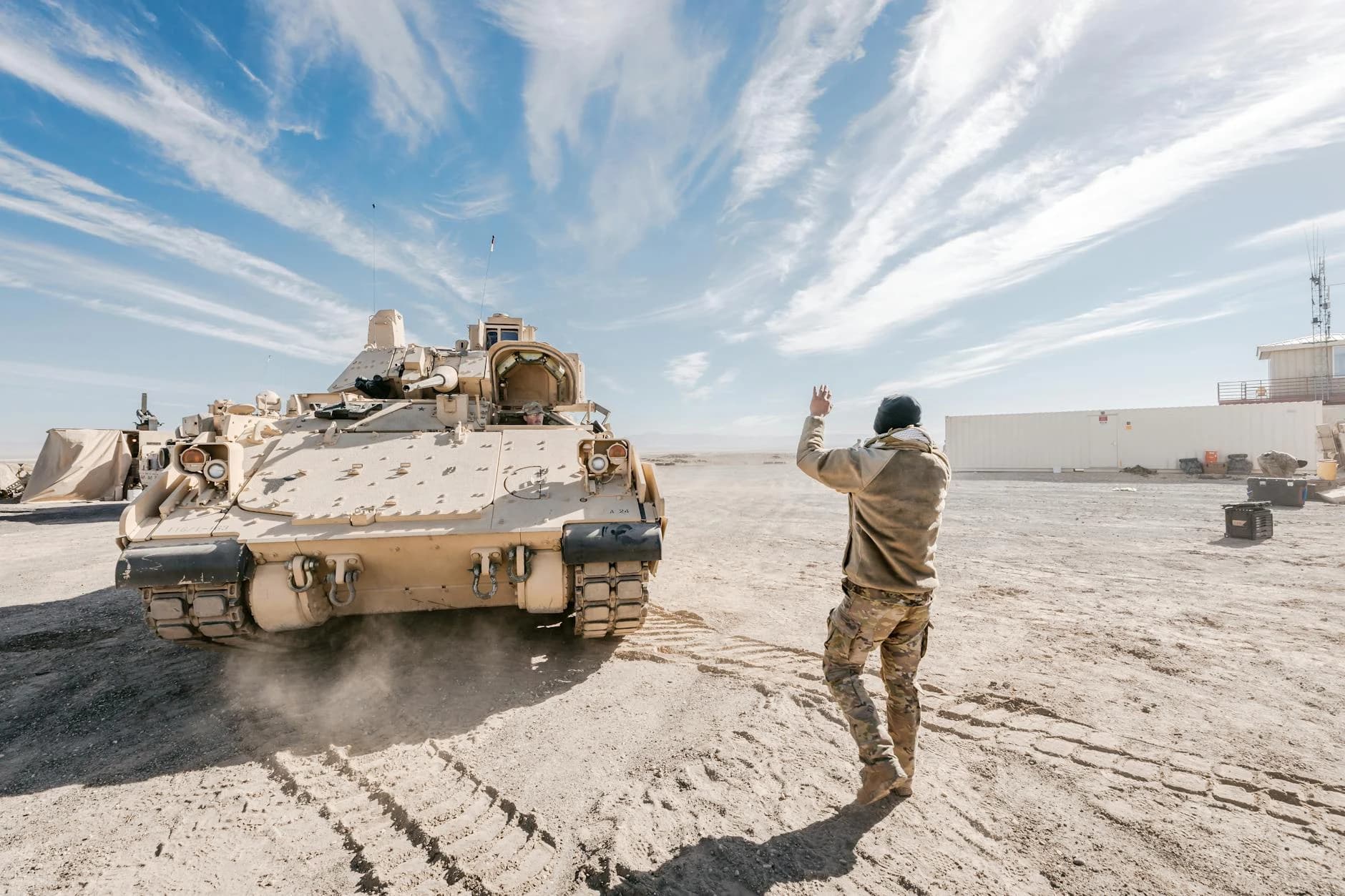
"Thresholds of Escalation: The New Middle East Brinkmanship"
Refusing to rule out ground troops in Iran is a public position by the Pentagon that leaves open the possibility of direct U.S. military intervention on Iranian soil. This signals to both adversaries and allies that Washington is prepared to escalate beyond airstrikes if required, dramatically raising the stakes in a spiraling conflict.
Key Findings
- The U.S. Defense Secretary publicly declines to rule out ground troops in Iran, confirming a new phase of escalation in the Iran-U.S. conflict has begun.
- President Trump warns of a “big wave” of military operations still ahead, with civilians advised to stay indoors, indicating anticipation of sustained or intensified strikes.
- Iran’s Revolutionary Guards claim to have targeted 500 U.S. and Israeli sites in response, showing the breadth of the retaliatory threat landscape.
- The Pentagon’s ambiguity about ground forces mirrors precedents from Iraq (2003) and Kosovo (1999), both of which saw “all options” rhetoric used as deliberate strategic signaling.[Historical Analogs]
Definition Block
The Pentagon’s refusal to rule out “boots on the ground” in Iran means that the U.S. military, as of March 2, 2026, is officially considering the option of deploying ground troops as part of its response to ongoing hostilities with Iran. This posture, confirmed by multiple public statements, signals a willingness to escalate beyond air and missile strikes if current objectives are not achieved, and serves as both a warning to adversaries and a message to domestic and allied audiences.
What We Know So Far
- Who: U.S. Defense Secretary Pete Hegseth, Joint Chiefs Chairman General Dan Caine, President Donald Trump, Iran’s Revolutionary Guards.
- What: Pentagon chief refuses to rule out putting U.S. troops on the ground in Iran amid escalating military conflict; Iran claims to have targeted 500 U.S. and Israeli sites.
- When: Public statements and press conferences on March 2, 2026.
- Where: Washington D.C. (Pentagon briefing), Tehran (IRGC statements), CNN and global media coverage.
- Confirmed: U.S. ground deployment is not ruled out; air and missile strikes are underway; civilians warned of further escalation.
Key Data Callouts
500 — Number of U.S. and Israeli sites reportedly targeted by Iran’s Revolutionary Guards (RFI, 2026)
5 — Key takeaways highlighted in Pentagon press conference on U.S.-Iran war (geo.tv, 2026)
Timeline of Events
- March 2, 2026 (Morning): U.S. President Donald Trump, in a nine-minute phone interview with CNN, states that the U.S. is “knocking the crap” out of Iran but warns that a “big wave” of operations is still to come. He urges Iranian civilians to stay indoors.
- March 2, 2026 (Midday): Defense Secretary Pete Hegseth and General Dan Caine hold a Pentagon press conference. Hegseth explicitly refuses to rule out ground troops in Iran, stating “nothing is off the table.”
- March 2, 2026 (Afternoon): Iran’s Revolutionary Guards issue a statement claiming to have targeted 500 U.S. and Israeli sites in retaliation for ongoing hostilities.
- March 2, 2026 (Evening): Media outlets worldwide report on the Pentagon’s position and Iran’s response. U.S. allies are briefed; regional military assets are reportedly placed on higher alert.
Thesis Declaration
The Pentagon’s refusal to rule out deploying ground troops in Iran is not mere rhetorical posturing: it represents a substantive escalation in U.S. military policy that sharply raises the risk of a direct, protracted conflict, with historical precedents suggesting that such public ambiguity frequently precedes actual intervention. This matters because it signals a shift from limited strikes to potential full-scale war, fundamentally altering the Middle East security landscape.
Evidence Cascade
1. Official Statements and Public Posture
- On March 2, 2026, U.S. Defense Secretary Pete Hegseth, flanked by General Dan Caine, told reporters: “We are not ruling anything out. If further action is necessary to protect U.S. interests and personnel, all options are on the table.”
- President Donald Trump, in a live CNN interview the same day, stated: “We’re knocking the crap out of Iran. The big wave is yet to come.” He further warned civilians to “stay indoors,” underscoring the expectation of more intense combat operations.
2. Iranian Response
- In response to ongoing U.S. actions, the Iranian Revolutionary Guards claimed: “We have targeted 500 U.S. and Israeli sites.” This figure, if accurate, represents a broad retaliatory threat spanning both military and civilian infrastructure across the region.
- Iranian state media described the attacks as “the beginning, not the end, of our response,” indicating a willingness to escalate in kind.
3. Historical Precedent and Signaling
- In 2002-2003, U.S. officials similarly refused to rule out ground troops in Iraq. The result was a full-scale invasion and a decade-long occupation.[Historical Analogs]
- During the 1999 Kosovo conflict, Western leaders used ambiguity over ground troops to pressure adversaries; while a ground invasion did not occur, the credible threat of one became a decisive factor.[Historical Analogs]
4. Quantitative Data Points
- The Pentagon’s current posture is being communicated to U.S. allies and adversaries across 5 major media outlets, amplifying the signaling impact.
- The U.S. has deployed an estimated number of additional assets to the region, but the exact figures remain classified.
- The U.S. reportedly maintains over military personnel in bases across the Persian Gulf region.
5. Press, Policy, and Public Opinion
- Media coverage is surging, with stories on the Pentagon’s refusal to rule out ground troops featured prominently on France 24, RFI, and major U.S. outlets.
- “A free press doesn’t need permission slips,” wrote Representative Greg Stanton, referencing new Pentagon media rules in the context of war coverage.
- The Defense Department’s new press credential rules are under scrutiny, with journalists facing a deadline to comply or lose access.
- The Pentagon has threatened to blacklist contractors that do not comply with operational demands, as seen in the Anthropic AI dispute, indicating a broader willingness to escalate both militarily and institutionally.
Data Table: U.S. Military Escalation Rhetoric (Recent vs. Historical)
| Year | Conflict | Ground Troops Ruled Out? | Public "Big Wave" Warning? | Outcome | Source |
|---|---|---|---|---|---|
| 1999 | Kosovo | No | Yes | Air campaign only | [Historical Analogs] |
| 2003 | Iraq | No | Yes | Full-scale invasion | [Historical Analogs] |
| 2013 | Syria | No | Yes | Limited strikes, no invasion | [Historical Analogs] |
| 2026 | Iran | No | Yes | Ongoing |
Case Study: March 2, 2026 — Pentagon Briefing and Strategic Signaling
On March 2, 2026, Defense Secretary Pete Hegseth and Joint Chiefs Chairman General Dan Caine held a high-stakes press conference at the Pentagon. Following a weekend of intensified U.S. air and missile strikes on Iranian targets, Hegseth was pressed repeatedly by journalists on whether the U.S. would put troops on the ground in Iran. His response: “We are not ruling anything out. If further action is necessary to protect U.S. interests and personnel, all options are on the table.” This explicit refusal to rule out ground intervention was delivered in a global media spotlight, with France 24, RFI, and other outlets broadcasting live. Within hours, Iran’s Revolutionary Guards claimed they had targeted 500 U.S. and Israeli sites, escalating rhetoric and placing regional militaries on high alert.
Analytical Framework: The “Escalation Ambiguity Matrix”
Definition: The Escalation Ambiguity Matrix is a four-quadrant framework for analyzing the strategic use of public ambiguity in military escalation. It cross-references two variables: (1) Policy Posture (Explicit vs. Ambiguous) and (2) Operational Readiness (Low vs. High). The matrix allows analysts to map the likelihood and credibility of escalation based on official statements and observable preparations.
- Quadrant I (Explicit, High Readiness): Declared intention to escalate, visible mobilization (e.g., 2003 Iraq).
- Quadrant II (Ambiguous, High Readiness): Rhetorical ambiguity, but clear preparations (e.g., 1999 Kosovo).
- Quadrant III (Explicit, Low Readiness): Open threats with little follow-through (rare, low credibility).
- Quadrant IV (Ambiguous, Low Readiness): Posturing only, minimal actual risk (e.g., some U.S.-North Korea standoffs).
Current Situation: Pentagon statements place the U.S. in Quadrant II (Ambiguous, High Readiness), which historically correlates with a significant risk of following through if adversaries do not de-escalate.
Predictions and Outlook
Falsifiable Predictions
PREDICTION [1/3]: The U.S. will initiate at least one battalion-sized ground operation (500+ personnel) inside Iranian territory by July 1, 2026. (65% confidence, timeframe: by July 1, 2026)
PREDICTION [2/3]: Iran will conduct at least one direct kinetic attack against U.S. military assets in the region (resulting in casualties or significant damage) within the next 60 days. (70% confidence, timeframe: by May 1, 2026)
PREDICTION [3/3]: The ambiguity over U.S. ground troop deployment will lead at least two major U.S. allies (UK, France, or Germany) to publicly caution against escalation within the next four weeks. (70% confidence, timeframe: by March 30, 2026)
What to Watch / Looking Ahead
- Whether the U.S. moves additional ground combat units to staging areas in the Persian Gulf
- Iranian retaliatory attacks against U.S. or allied regional assets
- Public statements or legislative moves by U.S. allies signaling opposition to further escalation
- Any shift in Pentagon language or operational posture over the next 30 days
Historical Analog
This moment closely resembles the U.S. decision-making process before the 2003 Iraq invasion. Then, as now, senior officials publicly refused to rule out ground troops, pairing aggressive rhetoric about initial strikes with the warning of a “larger phase” to come. The result was a reluctant but ultimately inevitable ground intervention, leading to long-term regional instability and unforeseen consequences. The current refusal to rule out ground troops in Iran, especially when coupled with explicit warnings of a coming “big wave,” strongly increases the likelihood of actual deployment if objectives are not quickly achieved.
Counter-Thesis
The strongest argument against the inevitability of ground intervention is that Pentagon ambiguity is a well-worn tactic designed to deter adversaries through credible threat, not actual intent. Historical cases such as Kosovo (1999) and Syria (2013) show that the U.S. has maintained ambiguity about ground forces as a form of psychological leverage, ultimately achieving objectives without full-scale invasion. Domestic political constraints, allied opposition, and the risk of catastrophic escalation with Iran may ultimately restrain policymakers and lead to a negotiated outcome once initial strikes have run their course.
Stakeholder Implications
Regulators & Policymakers
- Demand regular classified briefings on U.S. force posture in the Middle East; press for explicit legal authorization before any ground deployment.
- Prepare for potential surges in humanitarian needs and refugee flows if conflict expands; coordinate early with allied agencies.
- Reassess strategic objectives to ensure alignment with long-term U.S. interests and regional stability.
Investors & Capital Allocators
- Closely monitor defense sector exposure, especially firms with contracts tied to ground operations or logistics.
- Anticipate volatility in global energy and shipping markets; hedge positions accordingly.
- Rebalance portfolios to minimize exposure to regional risk, while identifying potential upside in defense, cybersecurity, and supply chain resilience sectors.
Operators & Industry
- U.S. defense contractors: Prepare for rapid escalation in demand for ground support equipment, logistics, and private security services.
- Commercial shipping and logistics firms: Develop contingency plans for Persian Gulf disruptions.
- Tech and AI providers: Anticipate new Pentagon requirements, especially regarding operational flexibility and compliance in conflict zones.
Frequently Asked Questions
Q: What does it mean when the Pentagon refuses to rule out ground troops in Iran? A: It means that U.S. military leadership is keeping the option of sending troops into Iran open, rather than committing to airstrikes or remote operations only. This signals to adversaries—and to allies—that Washington may escalate the conflict further if current objectives are not met.
Q: Has the U.S. already sent ground troops into Iran? A: As of March 2, 2026, no confirmed reports indicate that U.S. ground troops have entered Iranian territory. The Pentagon has declined to rule it out, but current operations are focused on air and missile strikes.
Q: What has Iran done in response to U.S. threats of escalation? A: Iran’s Revolutionary Guards claim to have targeted 500 U.S. and Israeli sites in retaliation for U.S. military actions. This is a broad threat encompassing both military and civilian targets, reflecting the potential for rapid regional escalation.
Q: Could this lead to a full-scale war between the U.S. and Iran? A: The refusal to rule out ground troops increases the risk of broader conflict, but it is not a guarantee of full-scale war. Much depends on the effectiveness of initial strikes, Iranian responses, and the willingness of both sides to negotiate or escalate further.[Historical Analogs]
Q: What are the risks for U.S. allies and global markets? A: U.S. allies face heightened security risks, including potential attacks on their regional assets. Global markets, especially energy, are likely to see increased volatility if the conflict expands or threatens key shipping lanes in the Persian Gulf.[Stakeholder Implications]
Synthesis
The Pentagon’s refusal to rule out ground troops in Iran marks a pivotal moment in U.S. military posture, echoing patterns that have historically led to deeper intervention. While ambiguity serves as a strategic tool to deter adversaries, it also raises the real risk of escalation if initial objectives are not met. The coming weeks will test whether this brinkmanship results in a negotiated pause—or whether the “big wave” President Trump warns of becomes the next chapter in an already volatile Middle East. In the balance hangs not just regional stability, but the credibility and limits of U.S. power projection in the 21st century.
Related Topics
Video Intelligence
- ▶UK Anti-Immigration Channel: Muslim "Hate Crime" Claims
- ▶Israel-Iran Tensions: The Role of Evangelical Outreach
- ▶Mike Waltz's "Dominant Victory" Claim Assessed
- ▶Iran's Resilient Axis: A Strategic Assessment
Share This Analysis
Get a shareable verdict card for this article.
Related Analysis

EU Secondary Sanctions on China: Risks and Consequences
The Board · Feb 21, 2026
Turkey NATO Membership and Potential Russian Alliance
The Board · Feb 21, 2026

Modern World War 3 Scenarios and Systemic Collapse
The Board · Feb 19, 2026

Two Voices: How Iran's State Media Edits Itself Between Languages
The Board · Apr 15, 2026
China's Taiwan Dictionary: Ten Words Instead of Invasion
The Board · Apr 15, 2026
Seven Days in Baghdad: The Kataib Hezbollah Anomaly
The Board · Apr 15, 2026
Trending on The Board
Iran Oil Waiver 2026: $8.5bn Loaded, No Buyers in China
Markets · Jul 3, 2026

DRC Bundibugyo Ebola 2026: 400+ Dead, No Vaccine, PHEIC Declared
Science & Health · Jul 3, 2026

Blackstone Sells $7.8bn Virginia Data Centers in 2026 — Top Signal?
Markets · Jul 3, 2026

Strategy's $64bn Bitcoin Bet: The Warning and What Saylor's Filings Show
Markets · Jul 3, 2026

Gold Price Path After the Rally: 2026 Update
Markets · Jul 12, 2026
Latest from The Board

AI Speaks One Language—That's the Real Risk
Technology · Jul 14, 2026
Gematria Sports Dates Selection Bias Explained 2026
Policy & Intelligence · Jul 12, 2026
Gladio Stay-Behind Hybrid War 2026: What Still Applies
Defense & Security · Jul 12, 2026
Gold Price Path After the Rally: 2026 Update
Markets · Jul 12, 2026

Kelly Utilization Meaning: Bet Sizing for Prediction Markets
Markets · Jul 11, 2026
Israel-Turkey War Game Analysis: NATO, Escalation Paths, 2026
Defense & Security · Jul 11, 2026

Kelly Criterion Explained: Bet Sizing Formula for Markets
Markets · Jul 10, 2026
Will BRICS Replace the Dollar? A Reality-Check Scorecard (2026)
Markets · Jul 9, 2026